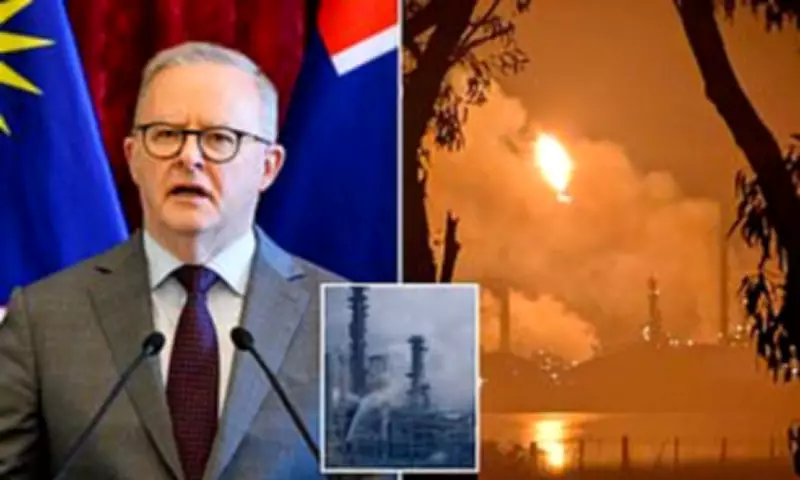
Prime Minister Anthony Albanese has made an abrupt and unexpected return to Australia, cutting short his diplomatic mission in Malaysia to address a developing national emergency. The sudden departure was triggered by a dramatic and devastating fire that erupted at the Viva Energy oil refinery in Geelong, Victoria, late on Wednesday night.
Emergency Recall to Assess Critical Damage
Mr Albanese's office confirmed around 7pm on Thursday that the Prime Minister had boarded a flight and would be travelling overnight directly to Geelong. Upon arrival, he is scheduled to visit the site of the Viva Energy refinery to receive a comprehensive firsthand update on the extensive damage caused by the inferno.
The Prime Minister will be accompanied on a detailed tour of the facility by senior officials from Viva Energy, alongside Defence Minister Richard Marles and Energy Minister Chris Bowen. This high-level delegation underscores the severity with which the government is treating the incident, given the refinery's crucial role in the national fuel supply chain.

Fuel Supply Consequences and Immediate Assessment
Speaking to reporters in Kuala Lumpur after a meeting with Malaysian Prime Minister Anwar Ibrahim, Mr Albanese acknowledged the serious implications of the fire. "Clearly, there will be consequences for it," he stated, adding that "a proper assessment [of the fire's impact on fuel supply] will be taking place over the coming short period."
The Viva Energy refinery is one of only two operational oil refineries left in Australia. It is responsible for supplying approximately 50 per cent of Victoria's total fuel requirements and a significant 10 per cent of the entire nation's fuel. The potential disruption to these supplies has immediately elevated the situation to a national priority.
Diplomatic Mission Yields Critical Fuel Deal
Mr Albanese's truncated visit to Malaysia was not without significant achievement. The diplomatic talks culminated in a vital new agreement where Australia will receive an additional 100 million litres of diesel. This emergency supply is intended to help mitigate the fallout from ongoing global energy market stresses, particularly those exacerbated by the conflict involving Iran.
The details of this bolstered supply arrangement were revealed by Mr Albanese following formal discussions with Prime Minister Anwar Ibrahim. The talks were centrally focused on ensuring the continuity of energy supplies between the two nations during the current global oil crunch.
Strengthening the "No Surprises" Energy Partnership
In a joint statement signed at the Malaysian government's Perdana Putra complex, the two leaders solidified a "no surprises" policy regarding the trade of critical oil and fuel supplies. This agreement is a direct response to the disruptions caused by international conflicts.
"The world looks very different to when you were here last year ... global energy markets are under serious stress," Mr Anwar remarked during a joint media conference, assuring his Australian counterpart that "Malaysia will always be a reliable partner to Australia."
The energy relationship is deeply reciprocal. Malaysia stands as Australia's third-largest fuel supplier, providing 14 per cent of its diesel, 10 per cent of its petrol, and 11 per cent of its jet fuel. In return, Australia supplies nearly all of Malaysia's imports of liquefied natural gas (LNG).
High-Level Talks to Secure Future Supplies
Prior to his emergency departure, Mr Albanese engaged in crucial high-level talks aimed at further securing Australia's fuel reserves. He met with executives from Petronas, one of Asia's largest oil companies, at the iconic Petronas Twin Towers in Kuala Lumpur.
"Friends need to work together, because we are living in very turbulent times," Mr Albanese said at the opening of the meeting, highlighting the strong existing trade ties, including Petronas's stake in Queensland's Gladstone LNG project.
The additional diesel secured from Malaysia will be sourced via shipments from Brunei—where Mr Albanese held energy-security talks prior to arriving in Malaysia—and from South Korea, facilitated under specific export finance regulations.

Navigating Complex Global Energy Politics
The diplomatic discussions also touched upon broader, more complex geopolitical issues. The Albanese government's potential consideration of new export taxes on resources in the upcoming May budget was a point of concern for Asian nations.
Furthermore, the energy trade landscape is complicated by Malaysia's own imports, which include hundreds of millions of dollars worth of Russian oil and fuel annually—some of which is subsequently sold on to Australia. This practice persists despite calls from Ukraine for a total global ban on the use of Russian oil.
In their joint statement, the leaders committed to "promote open and stable trade flows between our two countries, including for essential energy supplies," and pledged to "exchange views on energy trade-related matters on a 'no surprises' basis." The goal is to "deepen practical co-operation on energy security for both countries," recognising their mutually dependent roles as critical energy suppliers to one another.