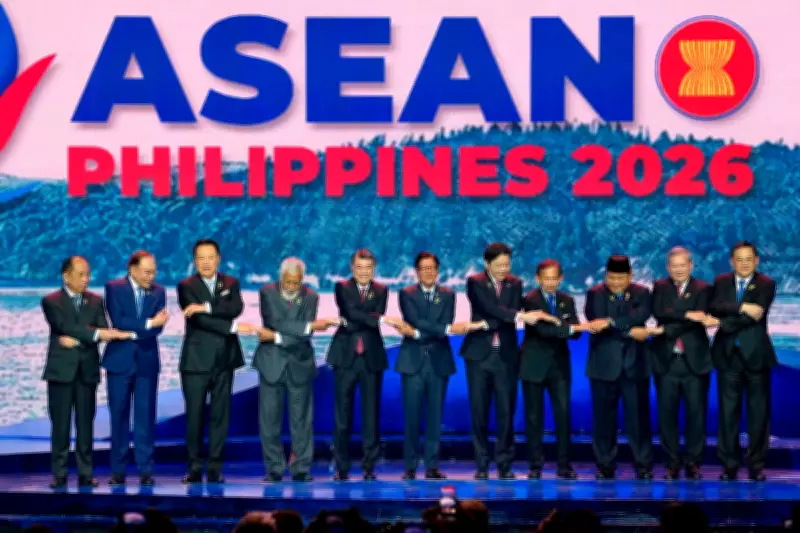
Alarmed by the ongoing Iran war, Southeast Asian leaders convened for an annual summit on Friday under intense pressure to mitigate the impact on their people and economies. One top minister stated the conflict “should not have occurred in the first place.”
Summit Focus on Contingency Planning
The Association of Southeast Asian Nations (ASEAN) heads of state decided to focus discussions on a contingency plan to ensure stable fuel and food supplies for their fast-growing region, which imports most of its oil and gas from the Middle East. The Philippines, hosting the summit on the central island province of Cebu, stripped the event of traditional pomp and pageantry due to global economic headwinds, as ordered by President Ferdinand Marcos Jr.
Evacuation Dilemma
A key challenge for ASEAN leaders is how to carry out large-scale evacuations from the Middle East, where over a million of their citizens live and work, if hostilities escalate again. Several Southeast Asian nationals have been killed since the United States and Israel launched military strikes on Iran on February 28. Despite a month-old ceasefire, sporadic hostilities continue, especially in the strategic Strait of Hormuz.

A draft joint declaration, seen by The Associated Press, calls on ASEAN’s 11 member states to share information and strengthen coordination with international organizations to ensure the safety of ASEAN nationals in affected areas.
Blunt Rhetoric from Thai Minister
While ASEAN delegates are known for conservative rhetoric, Thailand’s Foreign Minister Sihasak Phuangketkeow was more emphatic. He called for an indefinite extension of the U.S.-Iran ceasefire and assured safe passage through the Strait of Hormuz. “This war should not have occurred in the first place,” Sihasak told AP. “We don’t know what the objectives are right? The peace talks seem to be moving but we want the war to end.”
Contingency Plan Details
ASEAN’s plan includes ratifying an agreement for coordinated emergency fuel sharing, planning a regional power grid, diversifying crude oil sources, promoting electric vehicles, and studying new technologies like civilian nuclear energy.
Other Regional Flashpoints
Despite the focus on the Middle East, leaders will address major regional issues, including South China Sea territorial disputes involving China, Myanmar’s civil war, and a recent Thailand-Cambodia border conflict. A separate statement on maritime issues pledges to conclude negotiations for a Code of Conduct in the South China Sea. Talks on this non-aggression pact have dragged on for over a decade amid escalating confrontations, particularly between Chinese and Philippine forces.
This has fueled criticism of ASEAN as an ineffective “talk shop.” Members Brunei, Malaysia, Vietnam, and the Philippines are involved in the South China Sea standoffs, while other members include Cambodia, East Timor, Indonesia, Laos, Myanmar, Singapore, and Thailand.