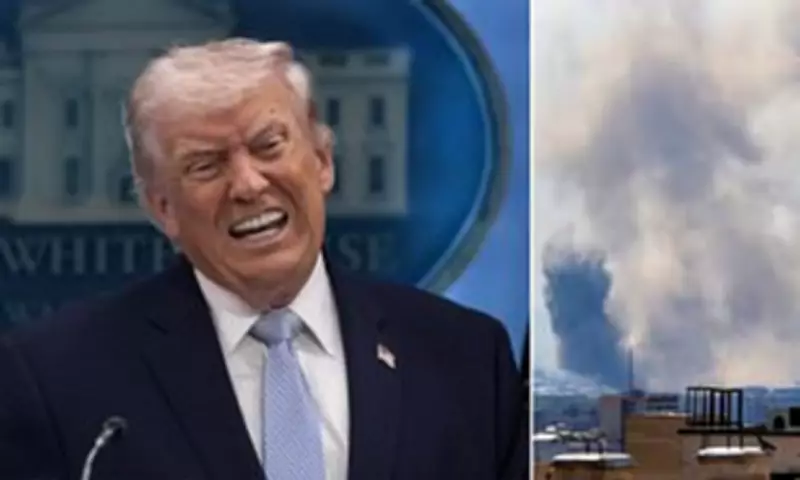
Ceasefire Announced in Middle East Conflict as Analysis Shows Iran's Strategic Victory
This morning, numerous critical questions remain unanswered following last night's announcement of a two-week ceasefire in the ongoing Middle East conflict. Yet if this pause genuinely signals the conclusion of the 2026 US-Iran war, one stark reality has become undeniably clear: Iran has emerged as the decisive victor.
Unclear Objectives and Shifting Goals
When the bombing campaign commenced, many observers struggled to decipher Donald Trump's precise war aims, given the seemingly incoherent nature of the President's stated objectives and their daily evolution. However, stripping away the bombastic and increasingly unhinged rhetoric reveals a sobering assessment: the administration has failed to secure virtually all its primary stated goals.
Failed Objectives: A Detailed Examination
Regime Change Remains Elusive

Foremost among the administration's ambitions was regime change in Iran, purportedly aided by the Iranian populace. Yet as of this morning, one of the world's most oppressive regimes remains firmly entrenched. The late 86-year-old Supreme Leader has simply been succeeded by his son, a transition occurring merely a couple of years ahead of schedule. While Iranian citizens did indeed take to the streets, they formed human shields around energy facilities and critical infrastructure threatened with destruction rather than rising against their government.
Military Obliteration Unachieved
A second key objective was the complete obliteration of Iran's military capabilities. However, in the hours immediately preceding and following the ceasefire announcement, Israel, the UAE, Saudi Arabia, Kuwait, Bahrain, and Qatar all reported repulsing ballistic missile and drone strikes originating from Iran. The Iranian army remains sufficiently potent that even Trump has conceded the risk of deploying US ground troops is prohibitively high. The Iranian navy, supposedly destroyed, continues escorting select vessels through the strategically vital Strait of Hormuz. Furthermore, Trump's claim that Iranian air defenses had been so heavily degraded that "there's nobody even shooting at us" was contradicted just 48 hours later when a US F-15 jet and an A-10 ground attack aircraft were shot down.
Nuclear Programme Uncertainty Persists
The status of Iran's nuclear programme remains shrouded in ambiguity. Trump previously asserted it was destroyed in June 2025, then shifted position as the war began, with aides claiming Iran was "probably a week away from having industrial-grade bomb making material." As hostilities progressed, administration statements alternated between insisting bombing had neutralized the threat and briefing that special forces plans were being prepared to seize remaining nuclear material. As the ceasefire took effect, Trump's only comment on the issue was the vague assurance that "it will be perfectly taken care of."
The Sole Achievement: A Costly Concession
The reopening of the Strait of Hormuz represents the administration's sole tangible achievement. However, this came at the significant concession of granting Iran the right to charge "tolls" on vessels passing through this critical maritime artery. Thus, after a month-long conflict that has cost the US 15 soldiers' lives, left 500 wounded, destroyed dozens of aircraft and radar sites, and incurred a conservative $800 million in damages (excluding operational costs), the question remains: what has Donald Trump actually accomplished? He has effectively transformed the world's most vital nautical passageway into a glorified toll road.
Broader Regional and Global Consequences
This assessment merely scratches the surface of the blood and treasure expended to satisfy Trump's egomania. The Iranian regime has not only survived but been emboldened. Across the Middle East, poets, bards, and street musicians are composing new verses commemorating Iran's heroic triumph against the "Great Satan," narratives that will likely energize a new generation of radicals and sympathizers.

In a region where many states previously viewed the US as their protector, former allies are now reckoning with the costs of an alliance that has resulted in approximately 30 additional deaths and hundreds of injuries. In Israel, which perceived this conflict as perhaps its final opportunity to eradicate its greatest existential threat, criticism is mounting rapidly. Opposition leader Yair Lapid declared: "There has never been such a diplomatic disaster in all our history."
Impact on Britain and NATO
Meanwhile, Britain is also counting the costs of a war Prime Minister Keir Starmer insisted the nation had no part in. NATO, the defensive alliance that has maintained security for 80 years, now lies in ruins with Trump actively advocating withdrawal. Even if this proves another empty threat, it seems inconceivable that Vladimir Putin will pass up the opportunity to stress-test the alliance during the remaining years of Trump's presidency.
For the first time in British history, the Armed Forces have been humiliated in a conflict they purportedly did not fight. The Royal Navy's inability to deploy a single reliable destroyer to defend British sovereign territory under attack revealed the bleak state of military readiness. Coupled with governmental and military planning failures, it took three weeks for HMS Dragon to arrive on station.
A further intelligence failure failed to predict Iran's ability to target the UK territory of Diego Garcia, with ministers subsequently attempting to conceal this attack from Parliament and the public. The chronic state of British air defenses was compounded by moral bankruptcy, as Starmer simultaneously pledged non-involvement while allowing US bombers to strike Iran from bases in southern England, claiming these attacks were vital for national defense.
Political Repercussions and Historical Judgment
Starmer is not the only British politician emerging with a sullied reputation. Kemi Badenoch displayed terrible judgment by initially endorsing US attacks, then flip-flopping as public opinion turned decisively against them. However, her stance pales against the sycophancy and politically myopic utterances of Nigel Farage and Reform leadership, who maintained support even after Trump's threat to wipe out a "whole civilization."
Today, no one can be entirely certain what the end game in Iran actually entails. But we do know this: Trump has somehow engineered a situation where he confronted one of history's most despotic theocracies and has been strategically, politically, and morally vanquished.
In coming hours and days, Trump's cheerleaders will attempt to spin defeat into victory across mainstream and social media. Yet there is nowhere left to hide. A years-long debate about where the 47th President would sit in historical annals has now concluded. When he tweeted in fury: "Open the F****in' Straits, you crazy b*****ds, or you'll be living in Hell," the outcome was sealed. Trump had been beaten, and everyone from Tehran to Tennessee recognized it.
During the Vietnam War, Lyndon B. Johnson famously declared: "I'm not going down in history as the first American President to lose a war." He did. Yesterday, Donald Trump became the second.