

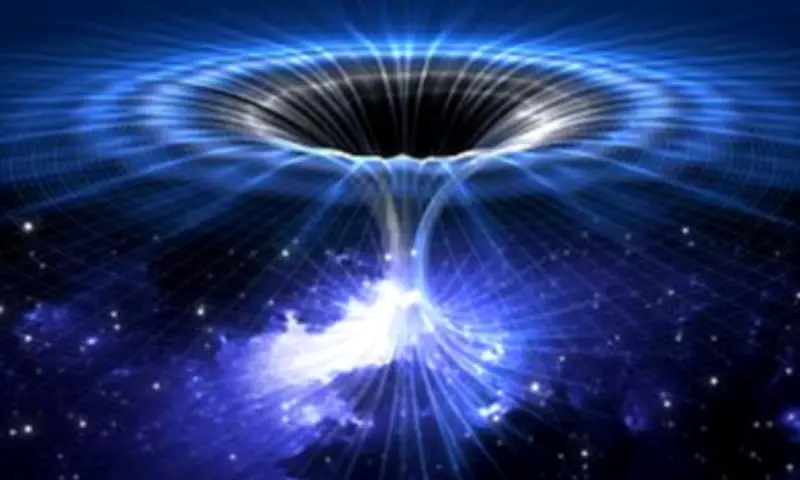
Wormholes are among the most peculiar and mind-bending structures in the universe. Now, scientists suggest that one of these cosmic tunnels through space and time could be concealed within our own galaxy.
What is a Wormhole?
Similar to a black hole, a wormhole is a region where gravity is so intense that it warps the fabric of spacetime itself. However, unlike a black hole, a wormhole bends spacetime to link two separate points, effectively punching a hole through the universe's surface. These points could be light-years apart or even separated by time, but traversing the wormhole would allow travel between them in mere seconds, reminiscent of the science fiction film Interstellar.
Although theoretically possible, scientists believe that any real wormhole would collapse almost instantly. Yet, a group of physicists now claims that the mysterious substance known as dark matter could create wormholes and even keep them open long enough for passage.

Dark Matter and Wormhole Stability
Dark matter is a hypothetical substance that constitutes roughly 27% of the universe. It is invisible and has never been directly observed, but its gravitational effects on visible matter are well-documented. The European Space Agency notes that we know dark matter exists, much like we know a room exists even in darkness.
Dr. Saibal Ray, an astrophysicist at GLA University in India and co-author of the study, explains that a wormhole functions as a passage from one point to another, akin to a tunnel between two manhole covers—one entry and one exit. Wormholes have two mouths connected by a throat, which could theoretically span the entire universe. One mouth would be a black hole pulling in matter, while the other would be a 'white hole' expelling everything.
A wormhole is considered 'traversable' if its throat is wide and stable enough for an object to pass through. In theory, anything entering one side would emerge almost instantaneously on the other.
Could There Be a Wormhole in the Milky Way?
While wormholes sound bizarre, they are mathematically possible under Einstein's theory of general relativity, which describes spacetime as a bumpy, uneven surface twisted by massive objects. The primary obstacle is stability: most physicists think wormholes would collapse in an instant.
Professor Dejan Stojkovic, a cosmologist at the University at Buffalo not involved in the study, told the Daily Mail: 'Wormholes are generally unstable. To provide stability, one must counter gravity's attractive force and prevent collapse. This requires large amounts of negative energy or an equivalent repulsive force.'
Dark matter may provide that repulsive force. According to Dr. Ray and his colleagues, the unique properties of dark matter could create a stable, traversable wormhole. While standard dark matter is attractive, certain 'exotic' models suggest it could have 'condensate properties' that force the wormhole's throat open during gravitational collapse.
Implications for Travel
If true, a wormhole could be lurking at the center of the Milky Way, hidden in plain sight. Dr. Ray states: 'We have theoretically shown that in the case of the Milky Way galaxy, in the central part as well as at the edge, a wormhole does exist.' The researchers calculate that this wormhole would be 32,600 light-years across—vast enough for a human or spaceship to traverse, offering a shortcut across the universe.
Skepticism and Challenges
Not all scientists are convinced. Dr. Andreea Font, an astrophysicist at Liverpool John Moores University, argues there is no evidence that dark matter can act as exotic matter. She describes theories suggesting dark matter does anything beyond gravitational attraction as 'well outside established physics.' Moreover, a wormhole of that size would require an enormous amount of negative energy—100,000 times the mass-energy of the entire galaxy, according to her calculations.
Professor Stojkovic, however, finds the general argument convincing, noting that the Hernquist dark matter profile used by the authors can violate the Null Energy Condition, which is necessary for a traversable wormhole. He suggests that nature may have already built such structures, and humans might someday take advantage of them.

Conclusion
While the existence of a wormhole in the Milky Way remains speculative, the research opens intriguing possibilities. Whether dark matter can indeed stabilize a wormhole is a question that awaits further theoretical and observational evidence.





