

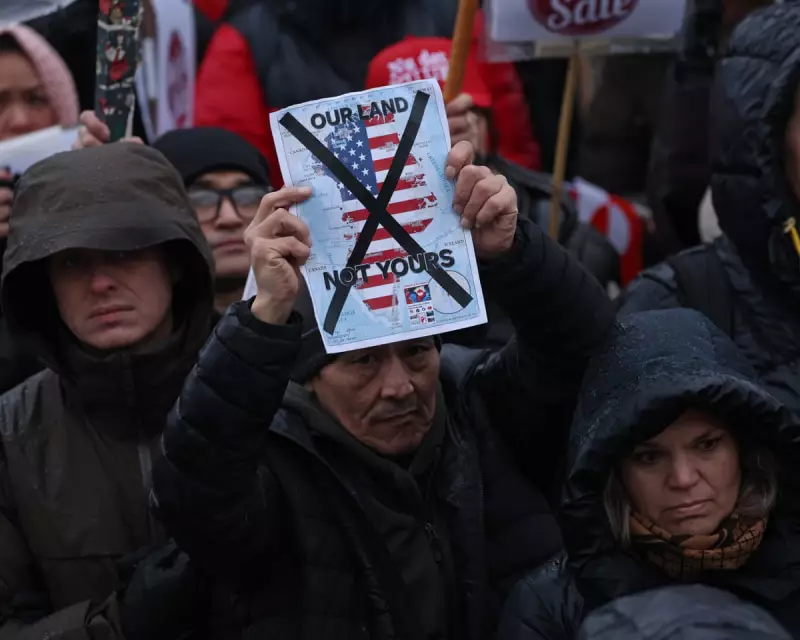
Greenlanders Rally Against Trump's Territorial Designs Amid Global Policy Turmoil
Citizens of Nuuk, the capital of Greenland, have taken to the streets in vocal protest against former US President Donald Trump's declared intentions to assume control of their autonomous Danish territory. This demonstration highlights growing international alarm as Trump's second administration continues to pursue a foreign policy agenda characterised by unpredictability and a stark departure from established diplomatic norms.
A Foreign Policy Held Hostage to Whims
One year into this unprecedented second term, a coherent United States foreign policy remains elusive. Instead, the global community is grappling with a world shaped by Trump's erratic decision-making, his acute sensitivity to perceived slights, and an apparent obsession with securing a legacy reminiscent of imperial leaders from centuries past. The atmosphere has been described by observers as resembling a "mad king's court," where daily international relations unfold like a chaotic carnival.
Recent Diplomatic Incidents Illustrate the Chaos
The past week alone provides a stark illustration of this new reality. Trump reportedly sent a text message to Norwegian Prime Minister Jonas Gahr Støre, stating that having been overlooked for the Nobel Peace Prize, he no longer felt obligated to prioritise peace alone. In the same communication, he asserted that global security was unattainable without "Complete and Total Control of Greenland." This declaration has drawn a sharp rebuke from Danish Prime Minister Mette Frederiksen, who warned that such a US takeover could signal the end of the NATO alliance.

Simultaneously, Trump extended an invitation to Russian President Vladimir Putin to join an ambiguously defined "board of peace" intended to oversee Gaza, despite Russia's ongoing invasion of Ukraine. This move is widely seen as an attempt to undermine the United Nations. When French President Emmanuel Macron attempted to organise a G7 meeting to ease tensions, Trump allegedly leaked details of their conversation and later threatened to impose a 200% tariff on French wine and champagne upon learning Macron might not participate in his new initiative.
The Pursuit of Legacy Through Power
Analysts suggest that facing significant domestic resistance to his policies on electoral law and immigration enforcement, Trump has increasingly turned his focus outward. "For the president, the question of legacy is important, which is why we've seen so much foreign policy activity in this term, unlike the first," noted Kristine Berzina, a senior fellow at the German Marshall Fund. "Efforts at peace, efforts at regime change, and efforts at territorial acquisition are all part of a notion of legacy. And there isn't that much time."
This drive has manifested in a series of ad-hoc actions over the past year, including a legally questionable raid to capture Venezuelan leader Nicolás Maduro, a fragile Gaza peace deal that heavily favoured Israel, and military strikes in Iran and Yemen. Crucially, key foreign policy decisions are no longer crafted through traditional inter-agency processes but are mediated by a small inner circle including Vice President JD Vance, Secretary of State Marco Rubio, and advisor Stephen Miller.
Greenland as a Symbol of a New Imperial Ambition
The focus on Greenland is particularly symbolic. Trump's advisors, including Vance—a noted critic of Europe—see an opportunity to disrupt the transatlantic relationship. For Trump himself, the objective appears more grandiose. "Greenland for the sake of territory, Greenland for the sake of how you transform a map, Greenland for the sake of legacy," explained Berzina. "Those are the primary objectives."
This perspective was echoed by Trump's Treasury Secretary, Scott Bessent, who argued that annexing Greenland pre-emptively would prevent future Arctic conflict through a doctrine of "peace through strength," contrasting US power with European "weakness."

A World Order Based on Might Makes Right
The underlying philosophy appears to be one where traditional alliances and agreements are secondary to immediate displays of power. This was exemplified by Trump's contradictory stance on the Chagos Islands; initially praising a UK plan to return them to Mauritius, he later denounced the same deal as an "act of GREAT STUPIDITY," using it as further justification for demanding Greenland.
"What you see now is simply just everything could be justified in pure power terms, and that's very new for the United States," said Max Bergmann of the Center for Strategic and International Studies. "We're acting like Russia... That here is a 19th-century America that wants to operate along imperial lines." In this new world order, all international relationships seem perpetually vulnerable to the capricious whims of a president convinced that only raw strength commands respect.





