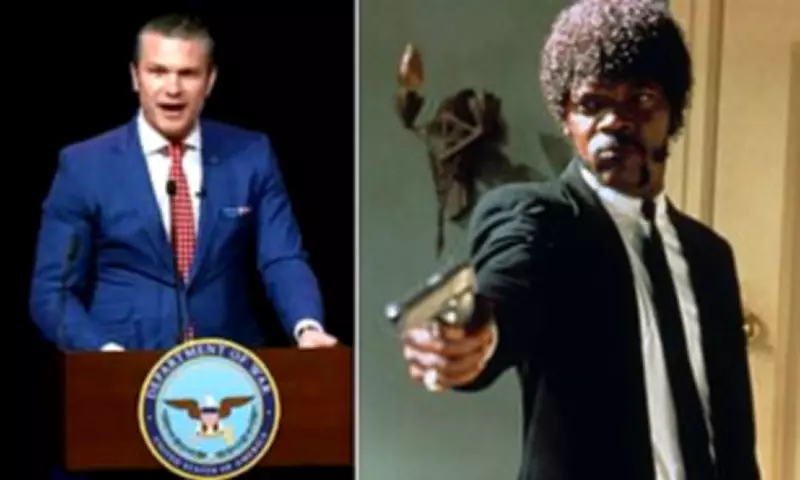
Pentagon Defence Secretary's Sermon Echoes Pulp Fiction Monologue
During a service at the Pentagon complex on Wednesday, Defence Secretary Pete Hegseth appeared to draw inspiration from a fictional Bible verse made famous in Quentin Tarantino's 1994 film Pulp Fiction. He invited the audience to join him in a prayer, which he described as commonly used in combat search-and-rescue missions, referencing a recent operation involving two US Air Force crew members shot down over Iran.
CSAR 25:17: A Prayer Blending Scripture and Cinema
Hegseth explained, "They call it CSAR 25:17, which I think is meant to reflect Ezekiel 25:17," before delivering the prayer. His rendition included lines such as, "The path of the downed aviator is beset on all sides by the iniquities of the selfish and the tyranny of evil men. Blessed is he who in the name of camaraderie and duty shepherd the lost through the valley of darkness, for he is truly his brother's keeper and the finder of lost children."
He concluded with, "And I will strike down upon thee with great vengeance and furious anger those who attempt to capture and destroy my brother. And you will know my call sign is Sandy One when I lay my vengeance upon thee. Amen."

Online Reactions Highlight Film Similarities
As footage of the sermon circulated online, viewers quickly noted that Hegseth's wording did not align with the actual Ezekiel 25:17 from the King James Bible, which states, "And I will execute great vengeance upon them with furious rebukes; and they shall know that I am the Lord, when I shall lay my vengeance upon them." Instead, many pointed out its resemblance to the monologue delivered by Samuel L. Jackson's character, Jules Winnfield, in Pulp Fiction.
In the film, Winnfield recites, "The path of the righteous man is beset on all sides by the inequities of the selfish and the tyranny of evil men. Blessed is he who, in the name of charity and goodwill, shepherds the weak through the valley of darkness, for he is truly his brother's keeper and the finder of lost children. And I will strike down upon thee with great vengeance and furious anger those who attempt to poison and destroy my brothers. And you will know my name is the Lord when I lay my vengeance upon you."
Social media users observed how Hegseth adapted the prayer to include military elements like the aircraft call sign "Sandy1" and references to rescue missions, blending cinematic inspiration with defence themes.
Hegseth's Christian Faith in the Pentagon
Since becoming defence secretary, Hegseth has frequently integrated his Christian beliefs into Pentagon activities. He hosts monthly Christian worship services for employees, and departmental promotional videos have featured Bible verses alongside military footage. In speeches and interviews, he often argues that the United States was founded as a Christian nation and that troops should embrace God, raising concerns about the military's secular mission and pluralism.
His rhetoric has gained new significance amid the US and Israel's conflict with Iran, an Islamic theocracy. At a recent Pentagon press briefing, Hegseth remarked, "The mullahs are desperate and scrambling," referring to Iran's Shiite Muslim clerics. He has also recited Psalm 144, a shared Scripture passage: "Blessed be the Lord, my rock, who trains my hands for war and my fingers for battle."
Historical Context and Controversial Views
Hegseth has a history of defending the Crusades, the medieval wars between Christians and Muslims. In his 2020 book American Crusade, he wrote that those who benefit from Western civilisation should "thank a crusader." This stance adds layers to his public expressions of faith, particularly in military settings.
The incident coincides with criticism directed at President Trump for sharing an AI-generated image depicting himself in Jesus-like robes, healing a man against a backdrop of American symbols such as the flag, military personnel, and fighter jets. Trump posted the image after attacking Pope Leo, accusing the Church leader of being "weak on crime, and terrible for Foreign Policy," and claiming, "if I [weren't] in the White House, Leo wouldn't be in the Vatican."

This convergence of events underscores ongoing debates about the intersection of religion, politics, and military culture in the United States, with Hegseth's sermon serving as a notable example of how pop culture and faith can intertwine in official contexts.