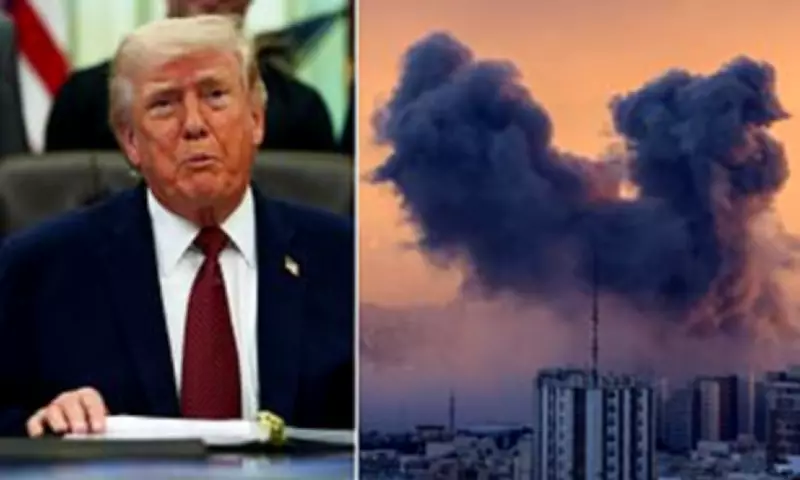
Iran Peace Talks Hang by a Thread as Trump Stands Firm on Blockade
High-stakes peace negotiations between the United States and Iran are teetering on the brink of collapse, with former President Donald Trump adamantly refusing to lift his naval blockade and issuing a stark warning that bombs will "start going off" if an agreement is not finalised by tomorrow. The situation has escalated dramatically, with Tehran declaring it is "prepared for military confrontation" and vowing to "punish the US" should President Trump fail to suspend the maritime siege and engage in substantive dialogue.
Summit in Islamabad Faces Uncertainty Amid Rising Tensions
The warring parties were scheduled to convene in Islamabad, the capital of Pakistan, today, but the summit's prospects appear increasingly doubtful following a series of provocative actions. American forces recently seized an Iranian tanker, prompting the regime to retaliate by closing the strategically vital Strait of Hormuz once again. This tit-for-tat manoeuvring has cast a long shadow over the diplomatic process, injecting significant uncertainty into whether the talks will proceed as planned.
US Vice President JD Vance was anticipated to depart last night to lead the American delegation, but Mr Trump emphasised he would "not be rushed into making a bad deal." He characterised the likelihood of extending the deadline as "highly improbable" and cautioned PBS News that failure to secure a deal would result in numerous bombs detonating. Simultaneously, the former president refuted speculation that he was contemplating ending the blockade of Iranian ports, stating unequivocally: "They want me to open it. The Iranians desperately want it opened. I'm not opening it until a deal is signed."

Conflicting Signals and Hardline Stances Complicate Diplomacy
In a contradictory development, Mr Trump announced the truce would now expire by "Wednesday evening Washington time," representing a 24-hour extension from the original deadline. He further asserted in a separate interview that Vice President Vance, alongside peace envoys Steve Witkoff and Jared Kushner, would arrive in Islamabad overnight, and he might even travel personally to sign an agreement. However, Tehran perceives the ongoing US naval siege as a "fundamental obstacle to negotiations," with hardliners arguing that participating in talks while the blockade persists would constitute a "strategic mistake."
Iranian officials contend the United States "did not fulfil its promise" by maintaining the blockade after Iran reopened the Strait of Hormuz last week as part of the ceasefire arrangement. This perceived breach led Iran to reclose the strait, followed by the US seizure of an Iranian-linked oil tanker. The Islamic Revolutionary Guard Corps (IRGC), which wields considerable influence behind the scenes, adopts a more aggressive posture than some public-facing politicians. A senior regime official yesterday indicated Tehran was "positively reviewing" its participation, but an IRGC-affiliated news agency later clarified that Iran has not "altered its decision to abstain" from the talks.
Deep Mistrust and Nuclear Demands Fuel Deadlock
The agency criticised US messages to Iran for containing "further excessive demands that cloud the prospects for the upcoming talks." Iranian foreign ministry spokesman Esmaeil Baqaei warned: "We have no plans for the next round of negotiation, and no decision has been made. The US is carrying out behaviours that do not in any way indicate seriousness in pursuing a diplomatic process." Iranian President Masoud Pezeshkian highlighted a "deep historical mistrust," stressing that honouring commitments "is the basis of meaningful dialogue" and that "unconstructive and contradictory signals" suggest the US actually "seek Iran's surrender. Iranians do not submit to force."
Mr Trump reiterated yesterday that any potential deal must include one non-negotiable condition: Iran must "get rid of their nuclear weapons." The previous round of talks in Islamabad reportedly foundered over US demands for Tehran to cease uranium enrichment for at least 20 years, while the regime insisted on a five-year limit. Nevertheless, there were faint signs of progress last night, as officials close to the negotiations informed the Wall Street Journal that a compromise involving a ten-year pause might resolve the stalemate.

Blockade Persists as Regional Diplomacy Continues
The naval blockade remained firmly in place last night, with only three vessels managing to transit the Strait of Hormuz. The US military reports it has redirected 27 ships to turn around or return to Iranian ports since the blockade commenced a week ago. Meanwhile, a second round of talks between Israel and Lebanon is scheduled for Thursday, following a ten-day ceasefire that began last Thursday, underscoring the broader regional context of these delicate negotiations.