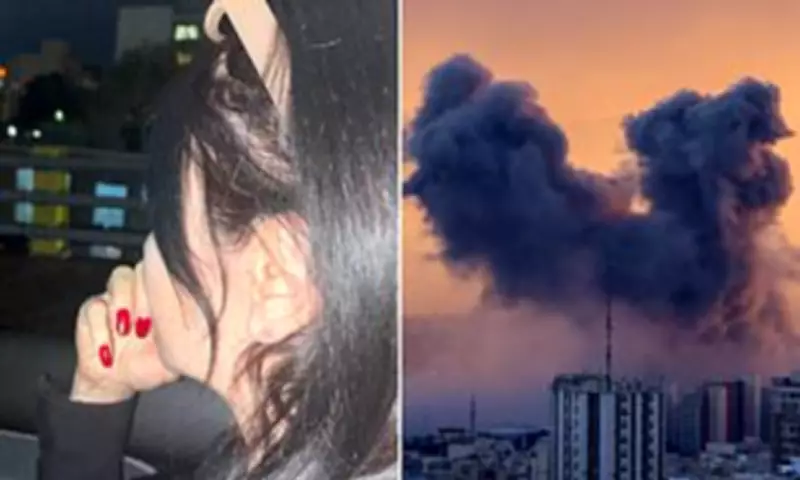
A secret dissident in Iran has revealed that citizens opposed to the regime live in constant fear of being identified by agents who patrol the streets looking for dissenters. The terrifying firsthand account, provided by 'Layla', a 50-year-old worker at Iran's Department of Health based in Tehran, offers insight into the plight of millions of ordinary Iranians who secretly hope that US attacks on the country may lead to regime change but worry their feelings could be discovered.
Layla's account of life under the repressive Islamic Republic government was shared via voice notes passed to the Daily Mail through a relative in Australia. She took the incalculable risk because she wants the wider world to understand how people like her, who oppose the Ayatollah, are living.
'We are constantly under stress, and our lives are not normal,' Layla said. 'We live in fear of regime agents who come into the streets every night, chant slogans, shine lasers into homes, and disrupt our lives. Right now, the fear of these people — the regime's agents — is far greater for us than the fear of American and Israeli bombings.'

Layla stated that she would rather the war intensify than end in a truce. 'Honestly, if regime change doesn't happen, this regime will destroy us — the people. And we are not a small number. Out of a population of around 90 million, I can confidently say that about 70 million people feel the same way: that if there is no regime change, this system will ultimately destroy the population. And in my view, this kind of regime change can only happen through external intervention, or through a ground force.'
She says the majority of ordinary Iranians share her view that it would be better for the tentative truce to collapse than to allow the repressive Iranian regime to regain a stronger internal grip. 'This regime should not be given the opportunity to rebuild itself. In my view, a ceasefire only gives it the time and space to recover and regain its strength. It must not be allowed to restore its capacity, especially when that capacity is used to suppress the people.'
'Since January, when the protests here began and were brutally suppressed, and thousands of people were killed, there has been no life left for us,' Layla added. However, she said civilians are not 'really afraid' of the bombings and stoically pull blankets over their heads to muffle the sound of explosions at night.
'When you look at the city, it doesn't appear as if it has been bombed or that you're facing a devastated place. In fact, the city's appearance hasn't really changed. The bombings have been so targeted that not only has the city's face remained intact, but you could even say that what we see now is a bluer sky. During the period of bombardment, many of the regime's activities were effectively halted. As a result, the damage the regime had been causing to the country's infrastructure also stopped during that time. The air feels cleaner, the rivers seem clearer, and some environmental conditions appear to have improved.'