

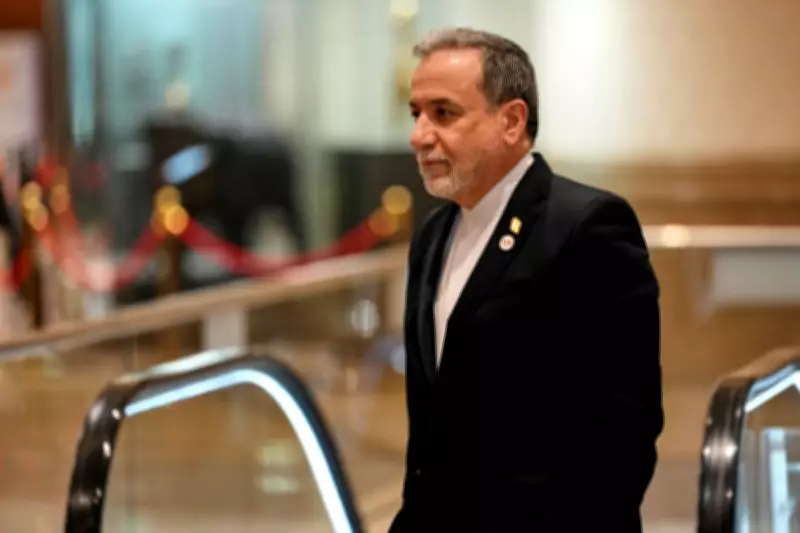
Iran's foreign minister stated on Friday that a lack of trust remains the primary barrier to negotiations aimed at ending the war with the United States. Abbas Araghchi, the Iranian Foreign Minister, expressed Tehran's willingness to accept diplomatic assistance, particularly from China, to alleviate tensions.
Distrust and Contradictory Signals
Araghchi highlighted that contradictory messages from the United States have created uncertainty about Washington's true intentions. 'We are in doubt about their seriousness,' he told reporters in New Delhi, adding that progress in negotiations would be possible if the US showed readiness for a 'fair and balanced deal.'
Earlier this week, US President Donald Trump dismissed Iran's latest formal proposal as 'garbage.' While the proposal reportedly included nuclear concessions, Trump insists on removing highly enriched uranium from Iran and preventing it from developing nuclear weapons. Iran maintains that its nuclear programme is solely for peaceful purposes.

Stalled Talks and Regional Tensions
With negotiations at a standstill amid a fragile ceasefire, tensions remain high, threatening to reignite open conflict in the Middle East and prolong the global energy crisis. Iran continues to exert control over the Strait of Hormuz, a vital waterway through which a fifth of the world's oil passed before the war, while the US maintains a blockade on Iranian ports. Trump and Chinese President Xi Jinping, who concluded talks on Friday, agreed on the need to reopen the strait.
China's Potential Diplomatic Role
Araghchi indicated that Iran would welcome diplomatic support from other nations, especially China, citing Beijing's previous role in facilitating the restoration of ties between Iran and Saudi Arabia. 'Chinese have a good intention. So anything that can be done by them to help diplomacy would be welcomed by the Islamic Republic of Iran,' he said.
Beijing has shown little public interest in US requests to become more involved, despite Trump telling Fox News' Sean Hannity that Xi had offered to help during their conversations. Pakistan announced on Thursday that it continues diplomatic efforts to ease regional tensions amid ongoing contacts over Iran-related ceasefire proposals, but declined to provide details or confirm whether the US had formally responded. 'The clock on diplomacy has not stopped. The peace process is working,' said Foreign Ministry spokesperson Tahir Andrabi in Islamabad.
Nuclear Sticking Points
Trump has demanded a significant rollback of Iran's nuclear activities, while Iran asserts its right to enrich uranium. Israeli Prime Minister Benjamin Netanyahu, who initiated the war with Trump on February 28, has also called for the removal of all highly enriched uranium from Iran. Araghchi acknowledged that the issue of Iran's enriched uranium stockpile is one of the most challenging topics in negotiations with the US.
Russia has previously offered to take possession of the stockpile if Iran agrees to relinquish it. However, Araghchi stated that Russia's proposal is not currently under active discussion but could be reconsidered if negotiations advance. 'When we come to that stage, obviously we will have more consultations with Russia and see if the Russian offer can help or not. This is not something for the time being,' he said.
Incident at Sea
A Chinese private security company, Sinoguards, reported losing communication with a ship it operated as an offshore work platform on Thursday. The same day, the United Kingdom Maritime Trade Operations centre noted that a vessel anchored off the coast of the United Arab Emirates had been seized. Sinoguards stated it had been informed through relevant channels that the vessel Hui Chuan was taken into Iranian waters for documentation and compliance inspection by authorities. The company's emailed statement indicated no injuries on board and that it was cooperating with the request for vessel and crew documentation. Neither the security company nor the UK maritime centre identified who was behind the seizure.

The incident occurred as a senior Iranian official reiterated Iran's claim of control over the Strait of Hormuz, while another official stated the country's right to seize oil tankers linked to the US. Last month, the US seized vessels in the Gulf of Oman. On Friday, Pakistan's Foreign Minister Ishaq Dar announced securing the return of 11 Pakistani nationals and 20 Iranian citizens who were aboard those vessels. 'All individuals are in good health and high spirits,' Dar said.
UAE Accelerates Pipeline Construction
The United Arab Emirates is expediting the completion of a new pipeline to enable the Gulf federation to export more oil without relying on the Strait of Hormuz. Sheikh Khaled bin Mohammed bin Zayed Al Nahyan, the crown prince of Abu Dhabi, directed state oil company ADNOC to accelerate work on the pipeline during a meeting of the Emirati capital's executive council, according to the Abu Dhabi Media Office on Friday.
ADNOC already operates a pipeline designed to transport 1.5 million barrels per day from oil fields in the west of the country to the port of Fujairah on the Gulf of Oman. The new pipeline is expected to double the company's export capacity through that port and become operational next year, the media office said.





