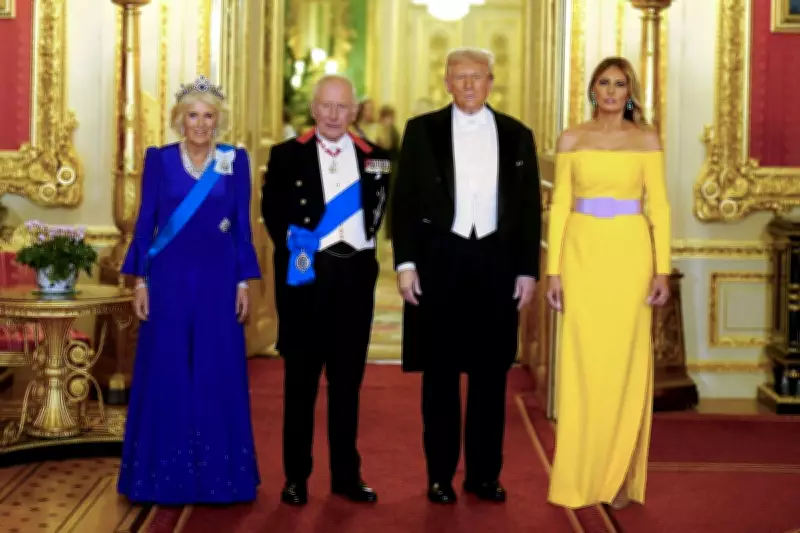
King Charles's state visit to the United States will go ahead despite ongoing concerns about the war in Iran. For weeks, the British embassy in Washington and the royal household in London have been fine-tuning plans for the visit, even when its feasibility was in doubt. Tensions between Donald Trump and Keir Starmer have escalated, with the US leader expressing anger at Britain's reluctance to join the conflict in Iran. Trump went so far as to declare that Starmer was "not Winston Churchill," a claim that even Starmer's most ardent supporters had never made. Some politicians suggested the King should not travel to the US at all, citing concerns about his health. However, it was ultimately decided that the visit was too important to cancel.
A Historic Diplomatic Mission
This year marks the 250th anniversary of American independence, and a visit by the most senior member of the British royal family serves multiple diplomatic purposes: reconciliation, strengthening of the special relationship, and reaffirmation of ties. At a low point in Anglo-American relations, the King is uniquely positioned to pour oil on troubled waters. He appears to be one of the few people in Britain for whom President Trump has unconditional respect.
Queen Elizabeth II's 1976 Bicentennial Visit
There is a strong precedent for such a visit. Queen Elizabeth II and Prince Philip visited the United States at the height of the bicentennial celebrations in July 1976. They were in America between 6 and 11 July, specifically to celebrate the friendship that had developed over the 200 years since the American Revolution. The Queen was wholly positive in her approach. She was particularly pleased to have been invited during the main week of celebrations, noting at the state banquet that "nobody can say that what happened on 4 July 1776 was not very much a unilateral affair between us."

A columnist at the time made a point that remains valid today: "The Queen has in the past shown her power to mend the ruptures that afflict the most natural of all alliances, and in the intense excitement over royalty which Americans can display even after six months of celebrating their release from the rule of monarchy, the best possible opportunity awaits her." It was also noted in the British press that President Gerald Ford, who had succeeded Richard Nixon abruptly in 1974, was aware that a state visit from Her Majesty could "do his fragile political prospects nothing but good."
The 1976 Tour in Detail
Elizabeth and Philip flew to Bermuda and embarked on the Royal Yacht Britannia. From there, the monarch sent Ford a message of "warm good wishes" for the happiness and prosperity of the United States on the anniversary. She brought a large entourage, including Foreign Secretary Anthony Crosland, a Labour minister. The Queen was the first British monarch to visit Philadelphia as a reigning sovereign. The Britannia arrived at Penn's Landing, where she visited the Liberty Bell and presented the Bicentennial Bell, a gift from Britain. Speaking as a direct descendant of George III, Elizabeth was conciliatory, stating that the founding fathers had taught Britain a valuable lesson: Britain lost the American colonies because "we lacked the statesmanship to know the right time and the manner of yielding what is impossible to keep." She paid America a huge compliment by saying this was a precursor to transforming the British Empire into the Commonwealth, even if that transformation occurred nearly two centuries later.
The Queen's visit received rave reviews in the American press. Dr. Henry Kissinger described the monarch as "a very interesting lady with a lot of savvy." She stressed Anglo-American friendship and, before pressing a button to ring the new Bicentennial Bell, said: "Let freedom ring: it is a message in which both our peoples can join and which I hope will be heard around the world for centuries to come." Tens of thousands of people greeted Elizabeth, and despite some protesters, she rightly ignored them.

From 7 to 8 July, the royal couple went to Washington as guests of President Ford and First Lady Betty Ford. In one speech, the Queen said: "America holds a special place in British hearts and affections, and so it will ever be." A state banquet was held in the Rose Garden, with guests including film stars Cary Grant and Greer Garson. Entertainment was provided by Bob Hope and Telly Savalas. Bob Hope had the guests laughing after the excellent California wine. Referring to recent political scandals in Washington, he quipped: "Priests are having a terrible time. Nobody goes to confession. They go straight to The Washington Post." He then sang a version of "Thanks for the Memory": "This dazzling affair/ This gracious royal pair/ Their presence on our birthday/ Brought joy beyond compare." The dinner greatly overran the schedule, but nobody minded. Musicians wandered around, while finger bowls with floating rose geranium leaves were circulated.
A Diplomatic Incident Over Attire
The Queen's foreign secretary, a Labour MP, caused a minor diplomatic incident that would hardly raise an eyebrow in 2026. He refused to wear white tie like everyone else at President Ford's state banquet, instead wearing black tie like the waiters. He had been prepared to wear white tie but had worn black tie at a banquet in London for President Giscard d'Estaing of France earlier that summer, so wearing white tie would have been considered a diplomatic snub.
New York and Beyond
The Queen went on to New York, where she received a ticker-tape welcome, arriving on the Britannia. In her speech, she referred to "the magical and audacious skyline of Manhattan." The next day, she and Philip visited Thomas Jefferson's estate at Monticello, considered an architectural masterpiece. On the last day, 11 July, they were in Boston, visiting the Old North Church and the Old State House, where the revolution had gathered momentum. A memorable moment saw Sir Martin Charteris, her private secretary, clapping and slapping his knee as she delivered a speech he had written. The visit ended with a return state banquet for President and Mrs. Ford on the Britannia off Newport, Rhode Island.
Conclusion
If King Charles can spread even a small part of the same magic as his mother, he will have served Britain well. Hugo Vickers' biography 'Queen Elizabeth II – A Personal History' is published by Hodder & Stoughton.