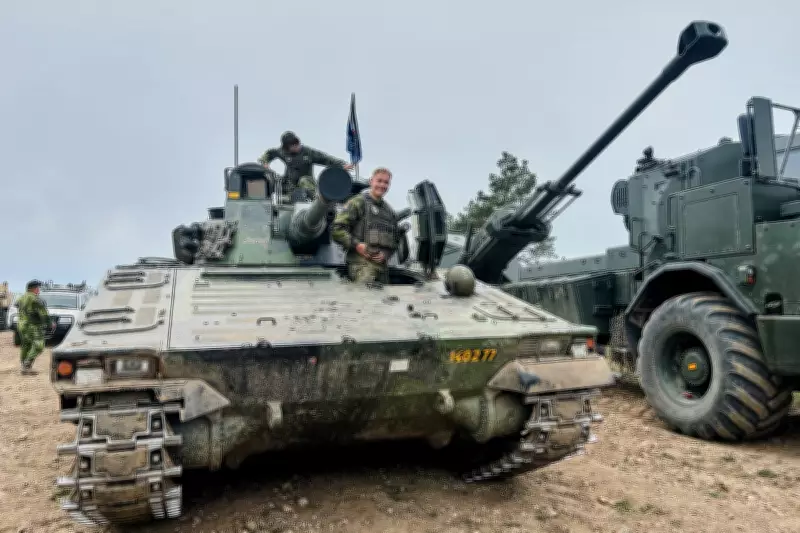
NATO allies conducted a war game this week simulating a threat to Sweden, one of the alliance's newest members, from an unnamed country amassing troops along NATO's eastern border. In an unusual twist, non-NATO member Ukraine participated to advise on drone warfare. The Associated Press was permitted to observe the Swedish-led military exercise as Europe faces not only the threat of Russia but also wavering support from NATO's most powerful member, the United States.
Real Threats Behind the Scenario
The war game, which also involved U.S. forces, was designed with a real threat in mind. For months, Russia has escalated sabotage operations, including cyberattacks on critical infrastructure and disinformation campaigns across Europe, as detailed by an AP investigation. The scenario envisioned the Swedish island of Gotland facing power outages and food shortages due to sabotage, testing what NATO members might do before invoking the alliance's collective defense clause, Article 5.
"In theory, it could happen tomorrow," said Rear Adm. Jonas Wikström, director of the exercise.

US Commitment Under Scrutiny
Sweden's chief of defense, Gen. Michael Claesson, noted that the U.S. remains Europe's most militarily capable ally, so "any change in the American presence" affects overall dynamics. He told the AP that announcements by President Donald Trump of troop reductions in Europe are interpreted "as the Americans are leaving — and they are not." However, Europe's military leaders are closely watching Trump's treatment of NATO, which he has described as a "paper tiger." Recently, Trump ordered the withdrawal of at least 5,000 U.S. troops from Germany and threatens further reductions.
Trump has also criticized allies for not supporting the U.S. in the Iran war, while U.S. air defense systems and missiles have been moved from Europe to the Middle East, raising concerns about defense gaps. Some European nations have been told they will face delays in U.S. weapons orders. Claesson denied that recent initiatives — such as a "hybrid navy" by Nordic, Baltic nations, the UK, and the Netherlands — are a hedge against a future without U.S. support, but added, "everything that offers European allies freedom of action is good."
Ukraine's Drone Warfare Expertise
Since Trump returned to the White House in January 2025, he has paused intelligence sharing with Ukraine and at times aligned with Moscow in negotiations to end the war. In the war game, Ukrainian forces demonstrated their battlefield experience, showing why their country might be a worthy NATO member. A group of Ukrainian drone pilots, invited to teach Western forces drone warfare, destroyed Sweden's troops in an exercise, according to a 24-year-old pilot using the call sign Tarik.
"They stopped the training three times" for troops to improve, but in real life they would have been dead, Tarik said. Another pilot, call sign Karat, noted that Swedish troops have potential but need better drones, tactics, and commanders with deeper understanding of drone warfare. He described flying small first-person-view attack drones on the front line against Russian forces, sometimes with reconnaissance support, other times "working blindly." Western forces cannot understand without seeing it firsthand, he added.
Gen. Claesson said all Western forces need to "learn rapidly" drone and counter-drone operations, and the "fastest" way is to listen to Ukrainians. Brig. Gen. Curtis King of the U.S. military emphasized survivability and detection: "What they've taught us is you have to really focus on your survivability and how you can't be detected." He added that Western nations need "deep" detection capabilities to spot drones from afar. Such knowledge is critical along Russia's border with NATO, where drone incursions have increased, including Ukrainian drones diverted by Russian jamming. King noted that integrating radar systems from different companies and countries is underway but "we're not there yet."

Strategic Importance of Gotland
The exercise focused on Gotland because of its strategic location in the Baltic Sea between the Russian exclave of Kaliningrad — where Moscow has stationed missiles — and Sweden. "If you control Gotland, you pretty much control the central part of the Baltic Sea," Claesson said. The Baltic Sea is a financial lifeline for Russia, with its "shadow fleet" carrying oil and LNG to fund the war in Ukraine. After the Cold War, Sweden abandoned its military presence on Gotland, but Russia's 2022 invasion of Ukraine prompted a rethink, leading to a strengthened military presence and Sweden's NATO membership in 2024.
Claesson described a "very reasonable scenario" where Russian President Vladimir Putin could use Gotland to test NATO by attempting to seize a small piece of alliance territory to probe the collective response.