North Korea Conducts Second Cluster Munitions Missile Test This Month
North Korea announced on Monday that it has test-launched ballistic missiles equipped with cluster bomb warheads for the second time in April, a move likely intended to demonstrate its growing ability to penetrate U.S. and South Korean missile defense systems. The official Korean Central News Agency (KCNA) reported the launches, which appear to correspond to multiple ballistic missile firings detected by South Korea, Japan, and the United States on Sunday off North Korea's eastern coast.
Kim Jong Un and Daughter Observe Launch
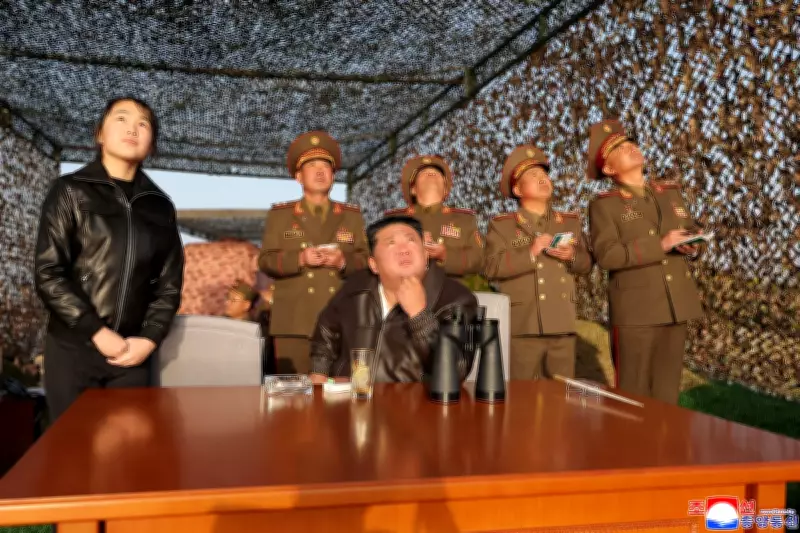
Photographs released by KCNA showed North Korean leader Kim Jong Un and his teenage daughter, both dressed in black leather jackets, watching the missile launch from a coastal observation point. The images depicted a projectile soaring over the water, leaving a trail of gray smoke. South Korea's intelligence services have recently assessed that the daughter, reportedly named Kim Ju Ae, could be considered a potential heir to Kim Jong Un.
According to KCNA, Kim oversaw the launches of five upgraded surface-to-surface Hwasong-11 Ra ballistic missiles, which were armed with cluster bomb warheads and fragmentation mine warheads. The missiles successfully struck an island target, and Kim expressed satisfaction with the results, stating, "It is of weighty significance in military actions to boost the high-density striking capability."

Recent Testing Activities and Strategic Implications
Earlier this month, North Korea tested Hwasong-11 Ka surface-to-surface ballistic missiles with cluster bomb warheads, claiming they "can reduce to ashes any target covering an area of 6.5-7 hectares (16 to 17.2 acres)." While North Korea has previously tested cluster bomb warheads, observers suggest that the ongoing conflict in Iran may have prompted the regime to showcase its cluster munitions and accelerate development efforts. The destructiveness of these weapons has been highlighted in the war, with Israel accusing Iran of using cluster munitions to challenge air defenses.
Cluster munitions burst open at high altitudes, dispersing dozens of smaller bomblets over a wide area, making them difficult to intercept. More than 120 countries have signed an international treaty banning the use of cluster munitions, but North Korea, Iran, Israel, and the United States are not signatories.
Broader Military and Diplomatic Context
Since the collapse of nuclear diplomacy between Kim Jong Un and former U.S. President Donald Trump in 2019, North Korea has been actively expanding its nuclear arsenal and developing advanced weapons systems. These include multi-warhead nuclear missiles, hypersonic weapons, and submarine-launched ballistic missiles, all of which could significantly enhance North Korea's ability to overcome U.S. and South Korean missile defenses.
Trump has repeatedly expressed interest in resuming diplomacy with Kim, and the North Korean leader has recently indicated openness to dialogue, though he has urged Washington to drop demands for nuclear disarmament as a precondition for talks. Trump is scheduled to travel to Beijing in May for a rescheduled summit with Chinese President Xi Jinping. Some analysts believe North Korea's recent missile tests are aimed at increasing its leverage in future negotiations with the United States, as the Trump-Xi meeting could create a diplomatic opening with Pyongyang.