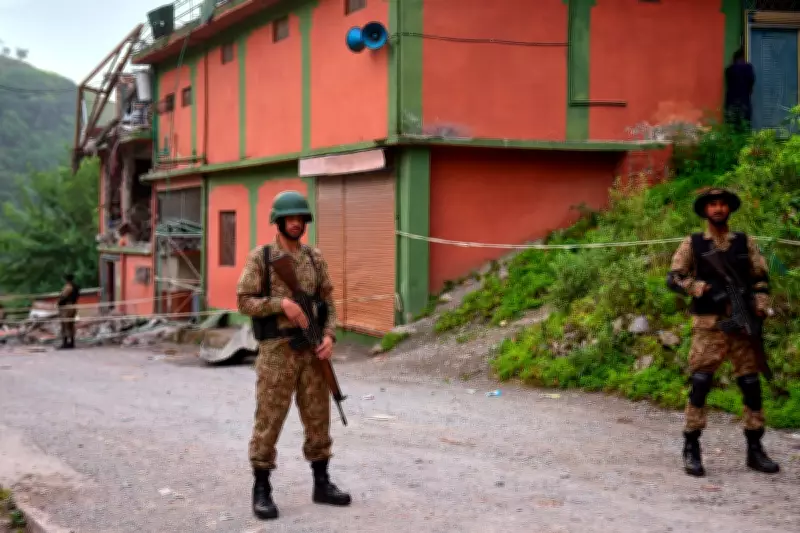
Pakistan's military issued a stern warning on Thursday, vowing a strong response to any attack as it commemorates the anniversary of last year's four-day conflict with neighboring India. The confrontation, which erupted in May 2025, brought the two nuclear-armed rivals perilously close to a full-scale war before a U.S.-brokered ceasefire halted the hostilities.
Military's Defiant Stance
The military declared that any "hostile design" against Pakistan would be met with "greater strength, precision and resolve" than India witnessed during the May 2025 conflict, which Islamabad has dubbed "Marka-e-Haq," or "Battle of Truth." The warning came during a televised press conference featuring senior military officials, including army spokesperson Lt. Gen. Ahmad Sharif Chaudhry, Deputy Chief of Naval Staff Rear Adm. Shifaat Ali, and Deputy Chief of Air Staff (Projects) Air Vice Marshal Tariq Ghazi.
Pahalgam Attack and Escalation
The conflict was triggered by an attack by gunmen in the Indian-controlled part of the disputed Himalayan region of Kashmir, which killed 26 people, most of them Hindu tourists. India swiftly blamed Pakistan-backed militants for the massacre in the town of Pahalgam, a charge Islamabad denied while calling for an independent investigation. India launched strikes inside Pakistan on May 7, prompting retaliatory actions from Pakistan, including drone incursions, missile strikes, and artillery fire. Dozens of casualties were reported on both sides before the ceasefire was reached on May 10, following mediation by the United States.

Claims and Counterclaims
Pakistan claimed to have shot down at least seven Indian military aircraft, including a French-made Rafale fighter jet. India acknowledged some losses but did not provide specifics. During Thursday's briefing, Air Vice Marshal Ghazi asserted that Pakistan had downed eight Indian fighter jets during the conflict and emphasized that the air force had exercised restraint, possessing the capability to inflict far greater damage on the enemy.
Lt. Gen. Chaudhry criticized India for blaming Pakistan for the Pahalgam attack without presenting evidence. "It has been one year since the Pahalgam incident, yet the questions Pakistan raised remain unanswered," he stated. He added that Pakistan does not underestimate India's military capability but is fully prepared to respond to any "misadventure." "We are prepared; if anyone wishes to test us, they are more than welcome," he asserted, while also noting, "We are not seeking conflict, we are not seeking war. But we know how to defend ourselves with honor and dignity."
Naval and Air Force Readiness
Rear Adm. Ali reported that the Indian navy had attempted to deploy vessels in the northern Arabian Sea during the fighting, aiming to target Pakistan's naval assets and disrupt maritime trade routes. "But due to the effective strategy of the Pakistan Navy, maritime traffic in all our waterways remained uninterrupted," he said. The press conference highlighted the military's readiness across all domains, with officials expressing confidence in their defensive capabilities.
Historical Context
Pakistan and India have a long history of strained relations, having fought two of their three wars over Kashmir, a region both claim in its entirety. The May 2025 conflict marked one of the most serious escalations in recent years, with the international community closely monitoring the situation. U.S. President Donald Trump has repeatedly taken credit for helping to avert a wider war through his administration's mediation efforts.
As the anniversary is marked, the region remains tense, with both nations maintaining a high state of alert. Pakistan's military has made clear that it will not hesitate to defend its sovereignty, while also expressing a desire to avoid further conflict. The coming days will likely see continued rhetoric from both sides, but the underlying issues—particularly the Kashmir dispute—remain unresolved.