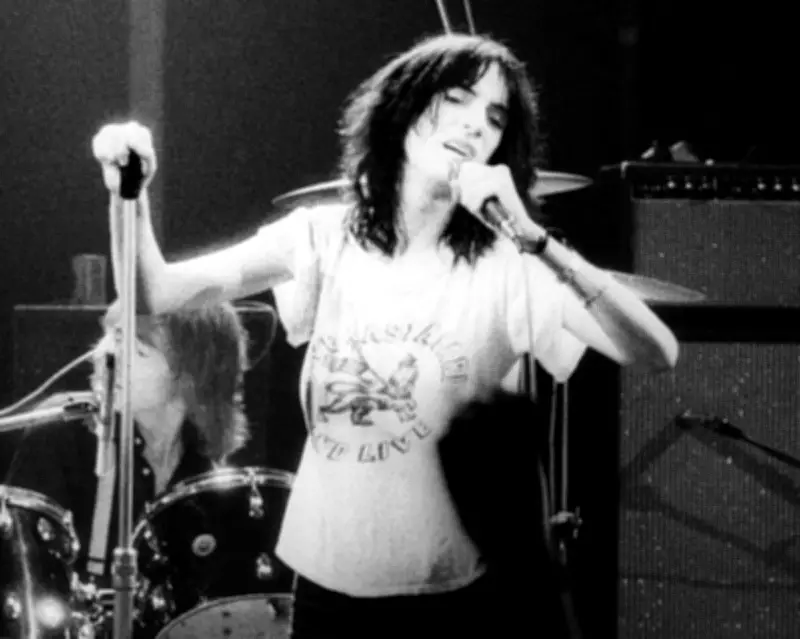
In May 1976, Patti Smith, New York's latest sensation, prepared for her first British concert at the Roundhouse. Robin Denselow met her in a Notting Hill Gate hotel, where she spoke passionately about rock music as an evolving art form.
A Visionary Arrival
Dressed in a white shirt, black tie, and black trousers, Smith's piercing blue eyes stood out. Despite just arriving from New York, she launched into an excited torrent of words: 'Being into rock is like being into the most important, newest art form. I feel like an early prospector in California before the gold rush. I feel rock is going to explode and encompass everything. It's like this fantastic plague over the universe and we're in on it. We're like catalysts of the new plague.'
Smith, then 29, had already been an artist, playwright, poet, and rock critic. The press dubbed her 'the wild mustang' and 'the rock queen of the seventies,' and she was gaining a varied, fanatical following across the United States.

Reviving the Underground Spirit
Just as American rock grew predictable and respectable, Smith crashed in with a reminder of the underground and the spirit of 1967. That year, she arrived in New York as 'a kid lurking round the Fillmore,' when 'giants walked the earth'—Hendrix, Janis Joplin, Jim Morrison. Alongside her heroes, The Rolling Stones ('Jagger is the greatest performer since Nijinsky'), these artists inspired her extraordinary style.
Her debut album, Horses (Arista ARTY 122), showcased a chillingly effective mix of surreal, improvised poetry and earthy rock. It sounded like a sixties new-wave poet (influenced by Rimbaud, Baudelaire, and Burroughs) jamming with a muddy East Coast band like the Velvet Underground or the New York Dolls. Smith admitted, 'I'm not an accomplished musician, but I'm verbal—extremely verbal,' performing rather than singing through joyously sexual and bi-sexual material, as well as strange, half-spoken pieces shifting from frightening fantasy to sixties rock echoes.
The Roundhouse Performance
By 20 May 1976, Smith had promised no half measures—she would either go beyond herself or totally fail. Sadly, she didn't quite achieve either. Appearing as a scruffy waif in tight jeans and flapping shirts, she failed to reproduce the drama of Horses. Her personality and harsh quavering voice matched the album's standard, but her band was ploddingly slow and uninspired, with a keyboard player resembling a permanently frightened zombie.
Despite this, Smith worked hard to warm the audience with lectures on rock's importance, risque stage chat, and poems. There was back-to-the-sixties naiveté but also sixties energy, which saved her. The spontaneity in her half-spoken song poems and her full-throttle renditions of 'Gloria' and 'My Generation' let her get away with more than she deserved.