Philippines Ambassador Confident in US Support Against Chinese Maritime Assertiveness
Manila's top envoy to Washington has voiced strong assurance that the United States will not abandon the Philippines as it confronts Beijing's growing assertiveness in the disputed South China Sea. This declaration comes even as former President Donald Trump and Chinese leader Xi Jinping pursue more direct diplomatic talks to resolve trade and tariff disagreements between their nations.
Steadfast Alliance Amid Geopolitical Shifts
Philippine Ambassador to Washington Jose Manuel Romualdez welcomed the renewed dialogue between American and Chinese leadership, while simultaneously emphasizing Manila's intention to "fine-tune" its own relations with Beijing to facilitate increased trade engagement. However, he made clear that the Philippines remains unwavering in defending its territorial interests in the South China Sea, where China asserts near-total sovereignty claims.
The United States and the Philippines, representing Washington's oldest treaty ally in Asia, have emerged as the most vocal critics of China's escalating activities in these strategic waters. In recent years, Chinese forces have employed powerful water cannons, launched signal flares, and executed dangerous blocking maneuvers against both Filipino maritime and aerial assets operating in the region.

Defense Commitments and Military Cooperation
The United States has repeatedly issued warnings to China, reminding Beijing of its treaty obligation to defend the Philippines should Filipino forces face armed attack. While Vietnam, Malaysia, Brunei, and Taiwan are also involved in territorial standoffs in the area, these nations have generally avoided openly condemning China's assertive actions.
Ambassador Romualdez acknowledged growing concerns that a potential U.S.-China rapprochement might marginalize Philippine interests. With Trump planning an April visit to China, potentially followed by a reciprocal visit from Xi to the United States, some observers have questioned whether Manila might be sidelined in broader geopolitical negotiations.
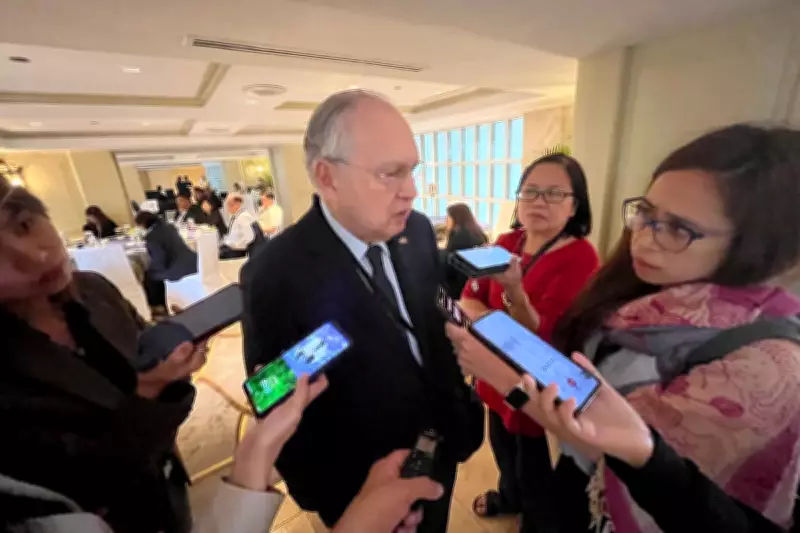
"Some people are saying, 'Is there going to be a deal where we're going to be thrown under the bus?'" Romualdez stated during a news conference in Manila. "Assurances are being made to us that, that's absolutely not true." The ambassador, a longtime critic of China's actions in disputed waters, emphasized that U.S.-Philippine defense engagements are "increasing even more now."
Military Modernization and Joint Exercises
Romualdez revealed that the U.S. Congress is currently working on a substantial financial appropriation to continue assisting the Philippine military with modernizing its defense capabilities. The ambassador himself plans to visit the U.S. Indo-Pacific Command in Hawaii this April to discuss upcoming military and defense activities between the two nations.
Last year witnessed approximately 9,000 American and 5,000 Filipino military personnel participating in one of their largest annual combat drills in the Philippines in years. During a live-fire exercise, U.S. and Filipino forces unleashed a coordinated barrage of missile and artillery fire, successfully shooting down multiple drones simulating hostile aircraft off a Philippine province facing the South China Sea. China has vehemently opposed these mock battle scenarios, labeling them as provocative military actions.
Balancing Defense with Diplomacy
Despite the ongoing maritime tensions, Romualdez indicated that the Philippines will simultaneously work to improve its relationship with China. He suggested that the two nations could cooperate on non-contentious issues including climate change initiatives, manufacturing partnerships, and developing alternative energy sources.
"There is only one thing that's permanent in this world, and that's change," Romualdez remarked. "We cannot stay stuck in one place." This statement reflects Manila's dual-track approach of maintaining robust defense cooperation with the United States while seeking areas of constructive engagement with China, even as territorial disputes in the South China Sea continue to present significant diplomatic and security challenges for all parties involved.