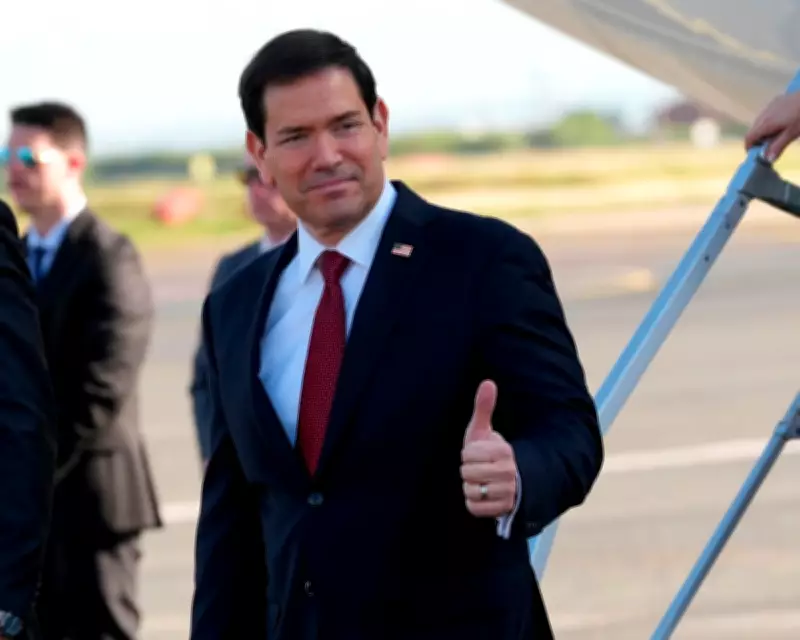
US Secretary of State Marco Rubio arrived in Rome on Thursday and is scheduled to meet Pope Leo at the Apostolic Palace in an effort to ease tensions following repeated criticisms by President Donald Trump of the first North American pontiff.
Rubio landed at Ciampino airport and will hold a morning meeting with Pope Leo before a series of talks with the Italian government. The visit comes amid unprecedented strain on relations between the Holy See and Washington.
On Tuesday, Trump accused the pope of supporting nuclear weapons and “endangering a lot of Catholics” with his stance against the Iran war, in the latest attack by the US president on the pontiff.

Pope Leo responded on Wednesday: “If anyone wants to criticise me for proclaiming the gospel, let them do so with the truth: the church has spoken out against all nuclear weapons for years, there is no doubt about that. I simply hope to be listened to because of the value of God’s word.”
Rubio downplayed the rift between Trump and the pope, telling reporters at the White House on Tuesday that the president’s criticism stemmed from his opposition to Iran potentially obtaining a nuclear weapon, which could be used against millions of Catholics worldwide. Trump “doesn’t understand why anyone – leave aside the pope – would think that it’s a good idea for Iran to ever have a nuclear weapon,” Rubio said.
Relations between the Vatican and Washington have never been so fraught. In April, Trump lashed out at Pope Leo over the pope’s criticism of the Iran war, branding him “weak on crime” and “terrible on foreign policy”, and claiming he was only elected pontiff because Trump occupied the White House. Trump later shared – before deleting – an AI-generated image depicting himself as a Christ-like figure.
Rubio’s likely goal is to smooth over Trump’s insults and repair increasingly damaged ties between the US and the Vatican. Analysts expect him to defend Washington’s rationale for the Iran war while avoiding a direct clash with the church’s position.
Asked whether he placed greater trust in Rubio or Trump, the Vatican secretary of state, Cardinal Pietro Parolin, told reporters on Tuesday: “I count on no one. I count only on our Lord Jesus Christ.” He added that Trump attacking the pope “in this way, or reproaching him for what he does, seems rather strange, to say the least”.
Rubio will meet Italian Prime Minister Giorgia Meloni on Friday as relations between Rome and Washington have also deteriorated.
Lorenzo Castellani, a political historian at Luiss Guido Carli University in Rome, said Trump’s attacks on the pope have provoked widespread outrage in Italy, where the papacy plays a crucial role in political and cultural imagination. This “has effectively forced Meloni to distance herself from the US president”, despite earlier this year saying she hoped Trump would one day receive the Nobel Peace Prize.
According to some Italian newspapers, Rubio’s goal in talks with Italy will not necessarily be to mend relations, but to reassert Trump’s position after the US president lashed out at Meloni in April, accusing her of lacking courage for refusing to join the US campaign against Iran.
Castellani noted that Meloni’s shift from being a staunch Trump ally to adopting a more critical stance is driven by political and electoral considerations. “For the first time since the second world war, foreign policy has become a central concern for Italian public opinion,” he said. “This shift had already begun with the war in Ukraine, but the current crisis represents a decisive escalation. The reason is simple: this is a conflict with direct geopolitical and economic consequences for Italy and for Europe as a whole.”
He added: “Meloni can no longer maintain a clear separation between foreign and domestic policy. In the past, she has taken positions that ran counter to segments of her own electorate. But now, recent polling suggests that across both the right and the left there is broad agreement in condemning the position of Trump. The same sentiments now cut across a vast portion of the electorate – arguably as much as 80 to 90%.”

Also expected to feature prominently in the talks is the future of the roughly 13,000 US military personnel stationed across seven naval bases in Italy. Asked last week whether he would consider pulling US troops out of Italy, Trump told reporters: “Probably … Italy has not been of any help to us.”