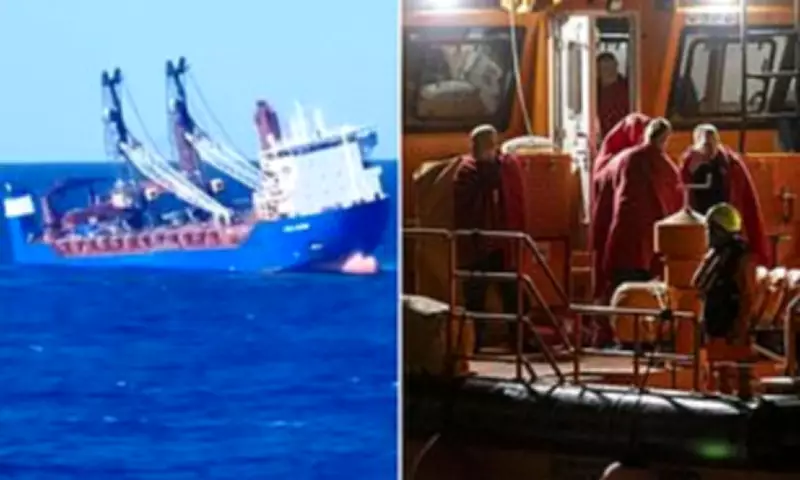
A Russian cargo ship that was likely carrying two nuclear reactors for submarines to North Korea suffered three explosions and sank in the Mediterranean, a new investigation has found. The true fate of the Russian vessel Ursa Major has long been shrouded in mystery following its sinking on December 23, 2024.
Details of the Sinking
The 466-foot Ursa Major sank in international waters between Spain and Algeria just after midday that day. Footage showed how the vessel began listing, or tilting to one side, after its engines exploded in the Strait of Gibraltar, around 60 miles off the coast of Spain. The area of the wreck was declared dangerous for shipping until the arrival of a Russian military vessel that took charge of the rescue operations, according to Spanish news outlet La Verdad at the time. Later, a Spanish Navy patrol boat joined them.
The ship went down after an explosion in its engine room, and 14 of its 16 crew members were rescued and brought to Spain, Russia said at the time. Initially, it was claimed that Ursa Major was heading to Syria to transport Russian military equipment being pulled from the country following the fall of dictator Bashar al-Assad.

CNN Investigation Reveals True Cargo
However, a CNN investigation has claimed that the vessel was carrying nuclear reactors for North Korea, likely a pair of VM-4SG models often found in Russia’s Delta IV class ballistic missile nuclear-powered submarines. Mike Plunkett, a senior naval platforms analyst for Janes, told the broadcaster that any decision for Russia to transfer this sort of technology would not have been undertaken lightly and is only ever done between very close allies. He added that if true, it is a major move by Moscow that will be very troubling, particularly for South Korea.
Sequence of Events
The ship's public manifest stated that Ursa Major was docked in Ust-Luga in the Gulf of Finland on December 2, before moving to a container facility in St. Petersburg’s docks. It claimed to have been travelling to Vladivostok, on the other side of Russia. After leaving the Gulf of Finland, it followed Europe's coastline while accompanied by two Russian military vessels, the Ivan Gren and Aleksandr Otrakovsky.
On December 23 at 11:53 a.m., the Ursa Major drastically changed course and slowed down, issuing an urgent call for help. It had suffered three explosions on its starboard side, near the engine room, which had killed two of the 16 crew members. The explosions also left the ship listing and immobile. A lifeboat quickly arrived, rescuing the 14 survivors and sending them to Spanish authorities.
At 7:27 p.m. that evening, a Spanish military vessel arrived at the vessel's location with the aim of assisting the crew. But less than half an hour later, the Ivan Gren ordered any nearby vessels to keep at least two nautical miles away. Spanish authorities insisted on conducting a rescue operation, sending a rescue chopper to check for survivors.
Despite extensive damage, the Ursa Major appeared stable and unlikely to sink. However, at 9:50 p.m., the Ivan Gren set off a series of red flares, and four explosions were heard. Just over an hour later, at 11:10 p.m., the Ursa Major had sunk to the bottom of the sea.
Captain's Confession
The Russian cargo vessel's manifest claimed it was carrying two large manhole covers, 129 empty shipping containers, and two large Liebherr cranes. But after the crew were rescued, the captain, named as Igor Anisimov, came under pressure to clarify what he meant by manhole covers. He finally confessed that they were components of two nuclear reactors similar to those used by submarines. According to his testimony, and without being able to confirm it, they did not contain nuclear fuel, according to a statement from Spain's government to opposition lawmakers cited by CNN. He was reportedly fearful of speaking about the contents of the ship, terrified for his safety.

Aftermath
The Yantar, a Russian vessel purportedly used for research purposes, was seen a week later at the scene of the sinking. It sat over Ursa Major's wreckage for five days, a source told the broadcaster, before four more explosions were detected. It is believed that these may have targeted the sunken vessel's remains on the seafloor. Several months later, the US military took a keen interest in the site, sending a sophisticated nuclear sniffer plane known as a WC135-R over the sinking site, once in August 2025, and again in February 2026.