

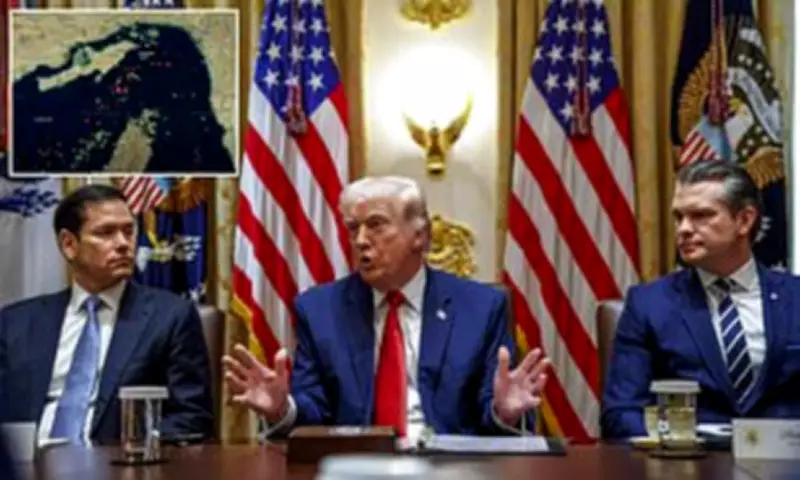
President Donald Trump gathered his inner circle for an urgent situation room meeting on Saturday to address the escalating crisis in the Strait of Hormuz, according to a report from Axios citing two US officials. The high-stakes discussions come as tensions with Iran reach a boiling point, with the narrow waterway—a conduit for 20% of the world's oil—becoming a flashpoint in a fragile ceasefire set to expire imminently.
Key Officials in Emergency Session
The emergency meeting included Vice President JD Vance, Defense Secretary Pete Hegseth, Treasury Secretary Scott Bessent, and Secretary of State Marco Rubio. Also in attendance were White House Chief of Staff Susie Wiles, Envoy Steve Witkoff, CIA Director John Ratliffe, and Chairman of the Joint Chiefs of Staff Dan Caine. This assembly of top advisors underscores the gravity of the situation, as US officials reportedly prepare to storm Iran-backed ships "in a matter of days," according to The Wall Street Journal.
Naval Blockade and Economic Pressure
The US has implemented a naval blockade of Iranian ports, which has already forced 23 ships to turn back, significantly ratcheting up economic pressure on Tehran. A White House spokesperson told the Wall Street Journal that officials believe this blockade could help facilitate a peace deal. However, Iranian officials have reacted with fury, continuing to blockade the Strait of Hormuz in retaliation, despite Trump's announcement that it was open just a day prior.

The Iranian blockade has sent global oil prices soaring to nearly $100 a barrel, though they dropped slightly following initial reports of the Strait reopening. With the waterway now closed again, the full impact on oil markets remains uncertain, adding to global economic anxieties.
Ceasefire on the Brink
The emergency talks unfold against the backdrop of a precarious ceasefire between the US and Iran, which is set to end in just three days. Trump has warned that if no permanent deal is reached, the war could renew, stating he might "start dropping bombs again." On Saturday, the 79-year-old president told the press that Iran cannot "blackmail" the US, asserting, "They wanted to close up the Strait again, as they've been doing for years, but they can't blackmail us."
Violence in the Waterway
Amid the diplomatic wrangling, violence has erupted in the Strait. On Saturday, at least two Indian ships were fired upon by Iranian forces as they attempted to pass through the narrow waterway. Iran's Supreme National Security Council indicated that new proposals from the US are under review, but no decision has been made. Trump expressed optimism, suggesting a deal could be finalized by the end of the day, telling reporters, "We'll have some information by the end of the day. We're talking to them. We're taking a tough stand. They've killed a lot of people. A lot of our people have been killed."
Iran's Stance and Warnings
Mohammad Bagher Ghalibaf, leading the Iranian delegation, stated that any interference with the Strait, including mine-clearing operations, would be considered a breach of the ceasefire, as reported by The New York Times. Iran has reiterated its demand for the US to lift the blockade, with Ghalibaf calling it a "reckless and misguided decision." He warned, "It is impossible for others to pass through the Strait of Hormuz while we cannot. If the United States does not lift the blockade, transit through the Strait of Hormuz will certainly be restricted."
Iran has declared that the continued US blockage of the Strait violates the ceasefire agreement. Furthermore, it issued a stark warning that any vessel approaching the Strait would be viewed as in "cooperation with the enemy" and targeted accordingly. This aggressive posture led Iran to re-close the oil-rich waterway merely a day after reopening it, heightening the risk of a full-scale conflict.
As the situation remains fluid, Trump is still weighing whether to extend the truce, emphasizing that military action remains a viable option if talks collapse. The Daily Mail has reached out to the White House for additional comment, but the world watches anxiously as the clock ticks down on a ceasefire that could determine the fate of regional stability and global energy markets.






