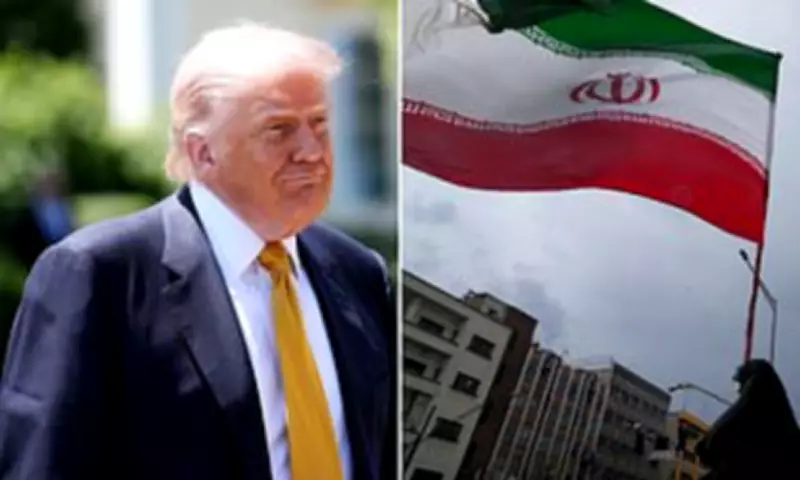
President Donald Trump has issued his most menacing threat yet to Iran, warning that time is running out for the Islamic Republic as peace talks remain deadlocked. In a blistering post on Truth Social on Sunday, Trump wrote: 'For Iran, the Clock is Ticking, and they better get moving Fast, or there won't be anything left of them. Time Is Of The Essence! President DJT.'
The commander-in-chief's message has sparked fears that he may resume military strikes against Iran if the regime fails to reach an agreement with the United States to end the prolonged conflict. Trump's warning came as he was scheduled to speak with Israeli Prime Minister Benjamin Netanyahu on Sunday afternoon to discuss the latest developments in the region.
According to an Israeli official cited by Axios, the two leaders discussed Iran during their call. The outlet also reported that Trump's national security team is expected to convene on Tuesday to assess the situation. Iranian media reported on Sunday that the Trump administration had offered no meaningful concessions in response to Tehran's latest proposals, raising concerns that negotiations could collapse entirely.

The warning followed Trump's earlier statement that the fragile ceasefire was on 'massive life support' and his dismissal of Iran's counteroffer as 'totally unacceptable.'
Drone Strike Hits UAE Nuclear Plant
On Sunday, a drone strike targeted the United Arab Emirates' sole nuclear power plant, sparking a fire on its perimeter. While no injuries or radiological releases were reported, the attack underscored the risk of renewed war as the Iran ceasefire remains tenuous. No group claimed responsibility, and the UAE did not assign blame, describing the incident as an 'unprovoked terrorist attack.'
War Costs Mount at Home
Domestically, Americans are increasingly bearing the financial burden of the conflict. With midterm elections approaching, the Trump administration faces mounting pressure to end the war in Iran as gasoline prices have surged by more than 50 percent, reaching a nationwide average of $4.51 per gallon.
Secretary of War Pete Hegseth faced lawmakers on Capitol Hill on Tuesday but avoided providing a clear answer on the total cost of the conflict. Appearing before the House Appropriations Committee alongside Pentagon comptroller Jay Hurst and other officials, Hegseth was pressed by California Democrat Pete Aguilar to share more details about the Pentagon budget. Hegseth responded that the Pentagon would 'share what we can when it's relevant and required,' prompting Aguilar to retort that 'this would be the format that would be required.'
Hurst informed lawmakers that the estimated cost of the war had risen to $29 billion, up from the $25 billion figure he presented at the end of April. He attributed the increase to 'updated repair and replacement of equipment costs, and also just general operational costs to keep people in theater.'
Regional Tensions Escalate
Diplomatic efforts for a more durable peace have faltered, and fighting has intensified between Israel and the Iran-backed Hezbollah militant group in Lebanon, despite a nominal ceasefire in place. The UAE recently accused Iran of launching drone and missile attacks as tensions have risen over the Strait of Hormuz, a vital energy waterway now under a US naval blockade and gripped by Iran.
Ut has hosted air defenses and personnel from Israel, which sparked the war by attacking Iran alongside the US on February 28. Iranian state television has aired segments featuring news anchors holding rifles, preparing the public for war.
The UAE Defense Ministry reported that three drones came over its western border with Saudi Arabia, with two intercepted. It is investigating who launched them. Iran and Iranian-backed Shiite militias in Iraq have also conducted drone attacks targeting Gulf Arab states during the conflict.