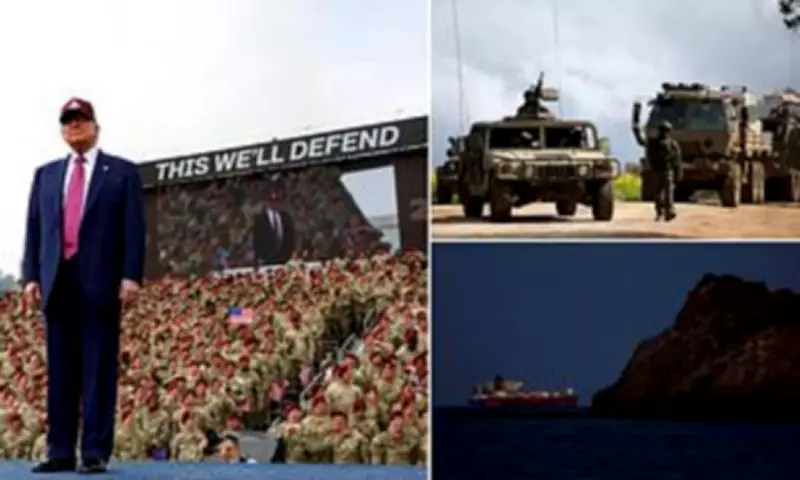
President Donald Trump has declared that United States military forces will remain stationed in the Middle East as delicate peace negotiations with Iran unfold, while issuing a stark warning of more aggressive action should a deal fail to materialise. In a late-night social media post, Trump asserted that US ships, aircraft, and personnel, bolstered with additional ammunition and weaponry, would stay positioned in and around Iran until a "REAL AGREEMENT" is fully honoured.
Trump's Threat of Escalated Military Action
Trump's message, shared on his Truth Social platform, contained a direct threat to Iran, stating that if compliance is not achieved, the "Shootin' Starts" would commence "bigger, and better and stronger than anyone has ever seen before." He emphasised that the US military is currently "loading up and resting" in anticipation of its "next conquest," underscoring a posture of readiness amid the ongoing diplomatic efforts.
Controversial Ceasefire and Negotiations
The president's remarks follow the initiation of a contentious two-week ceasefire involving the United States, Iran, and Israel, which took effect on Tuesday. Officials from these three nations are scheduled to convene in Islamabad, Pakistan, on Saturday to negotiate an end to the conflict. As part of the preliminary discussions, Iran publicly released a ten-point peace plan that includes demands for control over the strategic Strait of Hormuz and the right to enrich uranium.

Trump vehemently rejected this proposal, denying any agreement on uranium enrichment and insisting that the strait must remain open and safe. He dismissed reports from media outlets like The New York Times and CNN about the plan as a "totally FAKE TEN POINT PLAN" and a "made up HOAX," accusing them of attempting to discredit the peace process.
Backlash and Skepticism from Allies
The Trump administration has faced significant criticism over the ceasefire and Iran's proposed terms, even from some of the president's staunchest supporters. Republican Representative Don Bacon of Nebraska acknowledged "significant victories" but expressed doubts about the negotiations, cautioning that Iran could rebuild its military with support from Russia and China, posing a future threat.
Pro-Israel commentator Mark Levin, who maintains close ties to Trump, also voiced concerns, stating that while he trusts the president's instincts, Iran cannot be trusted as an adversary that remains "still surviving." This skepticism has been compounded by conflicting statements from the White House, where officials initially suggested the plan was negotiable but later claimed it did not align with Trump's intentions.
Regional Tensions and Ceasefire Violations
The ceasefire has encountered a rocky start, with reports indicating that Iran closed the Strait of Hormuz in response to Israeli attacks on proxy terror groups in Lebanon. Iranian media claimed that two tankers were allowed through as the ceasefire began, but operations were suspended due to the strikes. White House Press Secretary Karoline Leavitt denied these claims, asserting that Lebanon is not part of the ceasefire agreement.
Lebanese officials reported at least 182 fatalities and 890 injuries from the attacks, prompting Hezbollah to retaliate with rocket salvos and vow continued assaults until Israeli strikes cease. Additionally, Iran has threatened to destroy oil tankers attempting to traverse the strait without permission, imposing tolls of up to $2 million per vessel. Regional infrastructure, including Saudi Arabia's East-West oil pipeline and Kuwaiti facilities, has also been targeted in drone attacks, heightening tensions.
NATO's Role and Trump's Criticism
Despite these challenges, NATO Secretary-General Mark Rutte praised Trump's leadership in securing the ceasefire, stating on CNN that the world is "absolutely" safer as a result. However, Trump has sharply criticised NATO for its failure to intervene in the conflict, despite repeated requests for member nations to deploy warships to help reopen the Strait of Hormuz.

Trump reportedly discussed the possibility of the US withdrawing from the alliance during his meeting with Rutte, with Leavitt noting that NATO had "tested and failed" by turning its back on American people. In a subsequent social media post, Trump lamented that "NATO WASN'T THERE WHEN WE NEEDED THEM," and made a veiled reference to Greenland, a territory he has previously sought to acquire. The president is now considering punitive measures against NATO members that did not assist in the war effort.
A NATO spokesperson confirmed that Rutte and Trump engaged in a "frank discussion" on shared security issues, including Iran, with the secretary-general emphasising the need for allies to strengthen the alliance. As negotiations proceed, the situation remains volatile, with Trump's threats and military posturing casting a shadow over the fragile peace process.