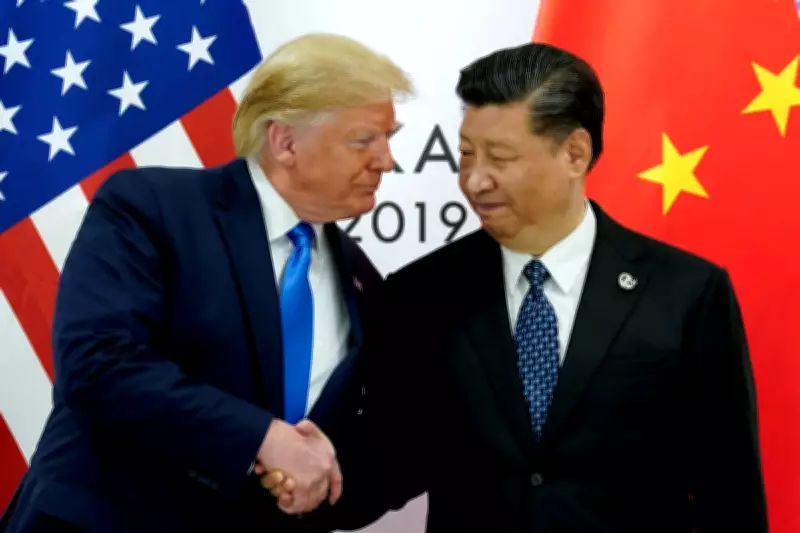
Flying over Taiwan, it is easy to see why the island set in the seas off China poses critical questions of war, peace and destiny for Chinese leader Xi Jinping when he meets President Donald Trump at a summit this week.
Taiwan's Strategic Vulnerability
To a military planner's eye, Taiwan is an exercise ground. On its western coast lie the landing beaches, then verdant farmlands stretch eastwards to a mountain range ideal for resistance hideouts. The cities, ports and high-tech factories, all vulnerable, stand open to an invader.
Smaller islands scattered in the straits between Taiwan and China ring the approaches to the port of Xiamen, where Xi served as vice-mayor at an early stage of his career; along the Chinese coast are the export powerhouse provinces where he rose to prominence. It all looks awfully close when viewed from the air, with contrails intersecting in narrow civilian aviation corridors while tankers, merchant vessels and grey warships ply the straits below.

The rival territories are never out of sight, and the margins of error are small. For all his adult life, the man who runs China has absorbed the lesson that Taiwan is part of the motherland and is to be reunified with its civilisational parent; that trade is necessary but not sufficient, and that history, politics and culture demand an end to separation.
"The will of the Chinese people for reunification is unstoppable," he has declared.
Xi's Personal Cause
To the rest of the world, it might seem a petty dispute. After all, it is but a small typhoon-swept island of 23 million people, ruled separately from China since the defeated nationalists in the Chinese civil war fled there in 1949, now a thriving democracy. But Xi Jinping has made it his own cause. That is why he is likely to raise it at an early stage when he meets Trump in Beijing. It will be their first meeting for six months, and the first time a US president has visited China since 2017.
The two leaders have global issues to discuss – Iran, Ukraine, trade wars, artificial intelligence, the risk of a new nuclear arms race and fragile agreements on the supply of critical “rare earth” minerals from China to American technology companies.
"It's important to understand that China thinks it is winning," said a veteran diplomat who has dealt with Xi. "They believe Trump is making America weaker, and so here is the Taiwan card. It is something they want for the home audience."
Taiwan's Political Landscape
Xi's rhetoric sharpened after Taiwan elected a president, Lai Ching-te, whose Democratic Progressive Party has historically supported formal independence for the island. That is a red line for the Chinese Communist Party. But the DPP does not have a majority in parliament, so there is no immediate risk of a showdown.
The fear in Taiwan is that Trump is always keen for a deal. China “hawks” in the first Trump administration argued for a military buildup to protect the island, plus an ironclad commitment to fight for American supremacy in Asia. Those aspirations have quietly been dropped. The Trump administration has failed even to use its influence to get a bill through Taiwan's parliament to boost defence spending. The law was diluted by the opposition Kuomintang, whose leader, Cheng Li-wun, has just been to China on a charm offensive to soothe the regime and who was honoured by her own mini-summit with Xi himself.
Strategic Ambiguity at Risk
Commentators in the Chinese state media hint that Xi will want Trump to change America's language to oppose an independent Taiwan. It sounds like a small, semantic difference, but it would mark a step away from the doctrine of “strategic ambiguity” that has kept the peace across the straits. That worries people in Taiwan who care about their democracy and want to protect it.
“Strategic ambiguity” meant that the United States was legally bound to help Taiwan defend itself but not committed to fight for it, while repeating the carefully crafted words of the Nixon-era “Shanghai Communique” of 1972, when the US formally acknowledged that “all Chinese on either side of the Taiwan Strait maintain there is but one China”.

The Iran war and the rapid changes in technology-led armed conflict have also started a debate: should Taiwan delay buying big-ticket items and focus on swarms of cheap drones and other new ways for a weaker combatant to deter a strong foe?
Trump's Approach
Under Joe Biden, America hardened its stance to deter the Xi regime from a snap invasion following the Russian war on Ukraine, but since taking office for a second term, Trump has talked of Xi as his “friend” and played down the Taiwan question. It is as if he is dropping a hint.
“Many observers have noted that a new round of discussion on China policy has emerged within the US”, said the Global Times, a tabloid affiliated with the party's flagship People's Daily, in a commentary welcoming the Xi-Trump summit. “History has repeatedly shown that dialogue between China and the US is better than confrontation,” it added.
Xi's veteran foreign minister, Wang Yi, warned the Americans that “the Taiwan question bears on China's core interests and is the biggest risk in China-US relations”.
Regional Implications
The risks include drawing Japan in if a war broke out. Under a new conservative prime minister, Sanae Takaichi, Japan's “Self Defence Forces” have worked more closely with American forces in northeast Asia and she has taken a sharp tone with China.
Recently, the SDF fired domestically made Type 88 anti-ship missiles during a joint military exercise with the US and the Philippines. The drill was plainly meant to simulate repelling a seaborne Chinese invasion of Taiwan, and it was the first time Japan launched offensive missiles overseas since the Second World War. China's state media calls Takaichi “a prominent right-wing figure who has repeatedly offered tributes at the notorious Yasukuni Shrine, which enshrines Class-A war criminals directly responsible for wars of aggression”. It has also accused her of “a white supremacy complex”.
Diplomatic Efforts
President Trump is not known for his sensitivity to other nations' emotions, so it was his secretary of state, Marco Rubio, who sought to lower the temperature on Taiwan in a briefing ahead of the summit.
“Both countries understand that it is in neither one of our interests to see anything destabilising happen in that part of the world,” Rubio said. “We don't need any destabilising events to occur with regards to Taiwan or anywhere in the Indo-Pacific.”
That will be a challenge for the master of the art of the deal.