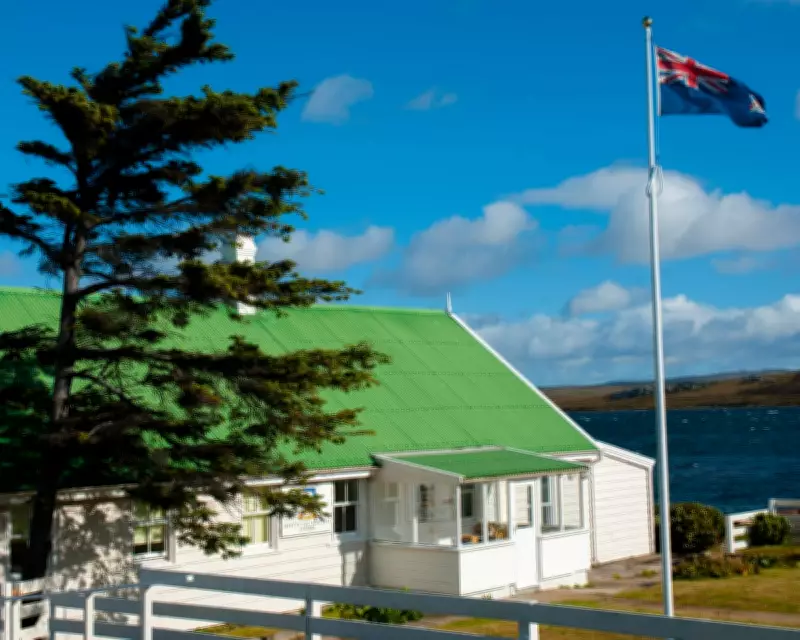
The United Kingdom's stance on the Falkland Islands remains resolute and unchanged, Downing Street has declared, following the leak of a Pentagon internal email proposing that the United States should reconsider its support for Britain's claim to the islands due to insufficient backing over the Iran conflict.
Downing Street Responds to Leaked Memo
Keir Starmer's spokesperson did not contest the likely authenticity of the email but emphasised that the defence and security partnership between the UK and the US continues to be exceptionally strong. The memo, reported by Reuters, suggests that Washington could review its policy of endorsing European claims to long-standing "imperial possessions," specifically highlighting sovereignty over the Falkland Islands, which were the focus of the 1982 war between Britain and Argentina.
The document was drafted in response to White House frustration that other NATO members had not provided sufficient support for the US-led 38-day bombing campaign against Iran. It also proposed that Spain should be suspended from NATO for refusing to allow US warplanes to be based in or fly over the country during Operation Epic Fury, although it remains unclear whether mechanisms exist for such a suspension.

When asked to comment on the email, Pentagon Press Secretary Kingsley Wilson stated: "As President Trump has said, despite everything that the United States has done for our NATO allies, they were not there for us. The war department will ensure that the president has credible options to ensure that our allies are no longer a paper tiger and instead do their part. We have no further comment on any internal deliberations to that effect."
UK Position on Falklands Unchanged
Regarding the email, Starmer's spokesperson affirmed: "We could not be clearer about the UK's position on the Falkland Islands. It is longstanding and unchanged. Sovereignty rests with the UK, and the islands' right to self-determination is paramount. That has been our consistent position and will remain the case." The spokesperson added that Falkland Islanders "voted overwhelmingly in favour of remaining a UK overseas territory, and we have always stood behind the islanders' right to self-determination."
When asked if the UK government was concerned about a potential change in stance from Donald Trump's administration, the spokesperson responded negatively, stating: "We have one of the most important security and defence relationships, if not the closest, that the world has ever seen, and it continues." On the question of whether the UK could defend the Falklands alone, the spokesperson declined to answer "hypothetical" questions.
Historical Context and Current Tensions
Although the Falklands proposal appears vague and there is no immediate indication of its adoption, the reference to the islands seems deliberately intended to provoke a reaction in the UK, where memories of the 1982 war persist. During that conflict, the US provided discreet support to the UK, including satellite and signals intelligence as well as Stinger hand-held missiles, following Argentina's invasion of the remote South Atlantic islands. Britain recaptured the Falklands in June 1982 after a bitter 74-day conflict that claimed 255 British military personnel, 649 Argentine soldiers, and three Falkland Islanders.
While there has been no return to hostilities, the status of the islands remains disputed by Argentina, now led by Trump ally President Javier Milei. Starmer largely kept the UK out of the Iran war but, unlike other European countries, permitted the US to fly B-1 and B-52 bombers on missions deemed defensive, including against Iranian missile launchers and targets used to threaten shipping in the Strait of Hormuz.
Trump has repeatedly complained about the lack of military support from the UK, accusing Britain of only wanting to help protect the strait after the war ended, describing the Royal Navy's aircraft carriers as "toys," and comparing Starmer to Neville Chamberlain. When asked if Starmer felt pressured by Trump to change his stance, the spokesperson said: "The PM has said very clearly that he will not be pressured on the Iran war. He will always act in the national interests of the UK and will not be dragged into this war."

Contrast with 1982 and Spain's Reaction
The public outbursts contrast sharply with 1982, when US President Ronald Reagan privately expressed support for British Prime Minister Margaret Thatcher. "We will do what we can to assist you. Sincerely, Ron," he wrote shortly after the initial Argentine invasion.
Spain's Prime Minister Pedro Sánchez downplayed the reports while speaking in Cyprus on Friday morning, where he attended a meeting of EU leaders discussing topics including NATO's mutual assistance clause. Sánchez stressed that Spain is a "loyal" NATO member that complies with its responsibilities. "We do not work on the basis of emails; we work with official documents and statements made by the US government," he added. "The Spanish government's position is clear: absolute cooperation with allies, but always within the framework of international law."
Sánchez, who has been the most vocal European critic of the US and Israel's war in Iran, angered Trump by refusing permission for the US to use jointly operated bases in southern Spain. Trump responded by threatening to cut off all trade with Spain. However, Sánchez renewed his criticisms of the US war, stating: "The crisis that this illegal war has brought to the Middle East shows the failure of brute force – and has prompted demands for international law to be respected and for the multilateral order to be safeguarded and reinforced."