

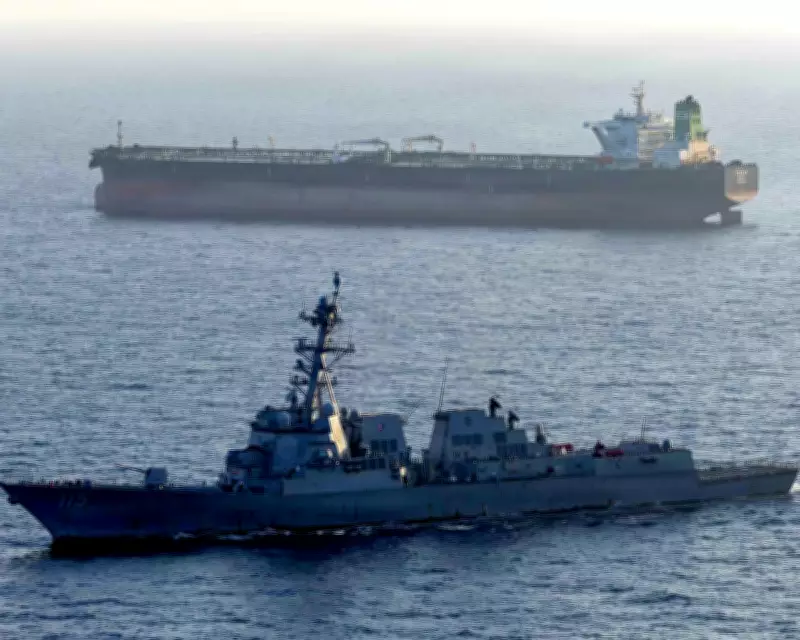
Exchanges of fire between Iran and the United States underscore the serious instability in the Middle East. Although US President Donald Trump described the late Thursday strikes as merely a 'love tap,' neither side can maintain the high-stakes standoff in the Strait of Hormuz indefinitely.
Military Superiority vs. Strategic Dominance
The US and its ally Israel demonstrated comprehensive military superiority over Iran during the 38-day campaign, suffering minimal casualties. However, Washington has failed to translate this into strategic dominance, allowing Iran to effectively control the strait and drive up oil prices.
Collapse of Project Freedom
The most significant development this week was the collapse of Trump's Project Freedom after just 50 hours. The unilateral US proposal aimed to create a safe zone for merchant shipping on the southern, Omani side of the strait, utilising over 100 fighter jets and several naval destroyers. Only two merchant vessels took advantage of the initiative.

The project ended amid objections from Saudi Arabia, which was not consulted before the launch. Riyadh refused to grant US access to its airspace and bases, fearing that Project Freedom could escalate into a full-scale war. Additionally, major shipping companies were not consulted, raising doubts about its effectiveness.
Richard Meade, editor of Lloyd's List, noted that no major industry organisations had been approached by the US for briefings. Security teams in the region remain unclear about the situation, and ship owners expressed no confidence that the initiative would change anything.
Iran's Continued Threat
Iran retains the ability to threaten and inflict damage on tankers passing through the Strait of Hormuz, effectively halting all other shipping. Over 1,550 vessels remain trapped in the Gulf, and no merchant ships transited the strait on Wednesday and Thursday, according to S&P Global Market Intelligence.
Burcu Ozcelik, a Middle East expert at the Royal United Services Institute, stated that Iran has proven to be a formidable adversary, demonstrating resilience that many did not predict. Trump sought a quick win but was unwilling to commit the substantial military force required to dislodge the regime.
Regime Resilience
Despite fragmented decision-making and uncertainty over the health of Supreme Leader Mojtaba Khamenei, most assessments indicate that the Tehran regime has been entrenched by the US and Israeli bombing campaign. CIA assessments suggest Iran retains 70% of its missiles, 75% of its launchers, and possibly half of its Shahed attack drones.
Iran appears confident in pushing back against US demands for a total end to its nuclear weapons programme, which includes dismantling nuclear sites, a 20-year moratorium on enrichment, and handing over near weapons-grade uranium. Trump seems unwilling to restart a full bombing campaign, possibly due to depleted high-end US missile stocks, down by a quarter to a half during the $25 billion Epic Fury campaign.
Economic Pressures on Iran
Diplomats who have dealt with Iranian negotiators complain that Tehran acts as if it has endless time, but it does not. The parallel US blockade east of the strait, where two carrier strike groups operate, prevents Iran from exporting crude. US Central Command has turned back 52 vessels since 13 April, and reports from within Iran indicate rising inflation, unemployment, and unpaid wages.
On Wednesday, Iran's top negotiator, Mohammad Bagher Ghalibaf, sought to shore up resistance, arguing that the US aims to destroy the country's cohesion through a naval blockade, economic pressure, and media manipulation. A US intelligence assessment suggests Iran could endure three to four months before facing severe economic hardship.
Limited Allies
Iran has no close allies in its current isolation. China is believed to supply drone parts, similar to its assistance to Russia, and may covertly send handheld air defence systems. A Russian GRU presentation suggests Moscow could send 5,000 fibre-optic drones, useful only against US ground troops if they seize an island in the Gulf.

It is unclear how military escalation helps Iran. The country's ability to endure the blockade is unpredictable, but simply holding on could be an economic disaster for its people. As Ozcelik notes, 'It is the insurgent's dilemma. At first to survive is to win, but there's always a point when that is no longer enough. When Iran gets to that point, we don't know.'
Trump's Political Problem
Trump, however, is fickle and impatient. He faces the political problem of resolving an economic crisis he essentially created while showing progress on the nuclear issue. Higher inflation is affecting the global economy, and oil shortages are particularly acute in Asia. The outcome remains unstable, with two sets of militaries facing each other, locked and loaded.





