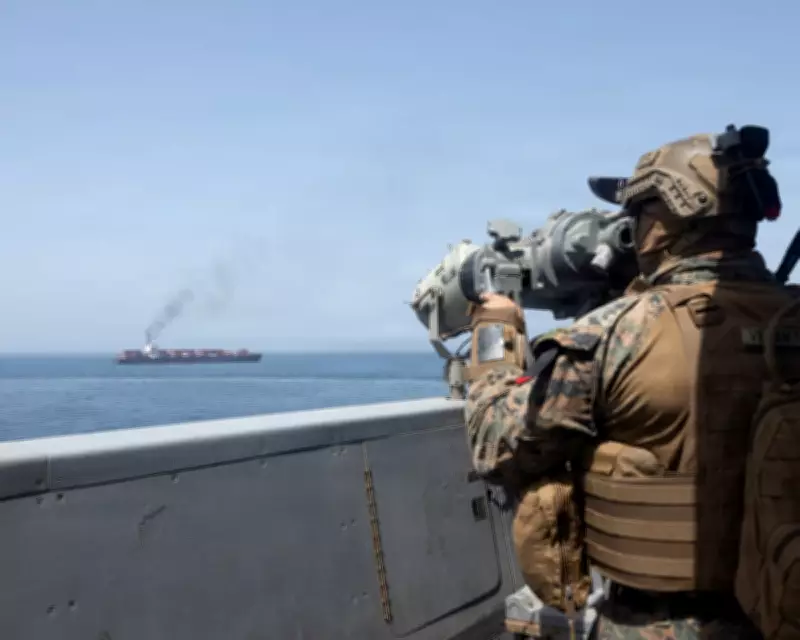
The decision by Donald Trump to extend the naval blockade of Iran indefinitely may do little to reduce global oil prices, but it could signal an acknowledgment that further US military escalation, in breach of the nominal ceasefire, carries heightened risks against a regime disinclined to surrender.
US Military Build-Up in the Region
In theory, Trump's military options are expanding. A third US carrier strike group, the George HW Bush, is set to arrive in the Middle East within days after rounding South Africa. A second taskforce of 2,500 US marines is sailing from the Pacific and is expected to arrive by the end of April. However, these additional forces may only be available for a short period, creating pressure for their deployment. It remains uncertain how much longer the USS Gerald R Ford, currently in the Red Sea, can remain operational given the carrier has been at sea for over 300 days.
Potential Seizure of Kharg Island
One possibility is that the US attempts to seize Iran's Kharg Island oil terminal, where 90% of the country's oil exports are loaded. This could involve the 2,000 paratroopers from the 82nd Airborne Division, who have been in the Middle East since the beginning of the month, or US marines not engaged in enforcing the blockade. However, analysts suggest that capturing Kharg would offer no additional advantage over the existing blockade. While seizing the island might be relatively straightforward given US military superiority, holding it and maintaining supply lines for months would be far more complex.

Matthew Savill from the Royal United Services Institute commented, "I suspect they would rather threaten an airborne assault or amphibious assault than actually conduct one. The US has the capabilities and firepower to do it. But would it be worth it?"
Impact of 38 Days of Bombing
The 38 days of bombing by the US and Israel against Iran were one-sided in military terms, with Iran's most effective retaliation directed at Gulf states. The US conducted 13,000 strikes on Iran, losing one F-15 fighter over the country and two transport aircraft during the ensuing rescue. Israel's air force dropped 18,000 bombs in 1,000 waves. Despite this, leaked US intelligence assessments indicate that Iran's military capability is not exhausted. An estimated half of Iran's missiles and launchers remain intact, along with a similar proportion of its Shahed attack drones. On Wednesday, Iran demonstrated its ongoing capability by attacking and seizing two commercial vessels in the Strait of Hormuz.
More than 3,000 Iranians have been killed, including Supreme Leader Ali Khamenei, but the number of casualties is not overwhelming. Iran's regime remains intact and regards itself as undefeated. The Revolutionary Guards, now in control, are in no mood for compromise.
Limited Impact of Further Bombing
It is not clear how a resumption of US-Israeli bombing could alter the political dynamic at this point. Earlier in the month, Trump attempted to bully Tehran by threatening to attack power plants, bridges, and desalination facilities—an extreme threat widely condemned and viewed by many legal experts as a war crime. Widespread devastation of Iran's basic infrastructure would be enduring, but it is unlikely to produce a willingness to accept US peace terms. Further strikes on hardline Iranian leaders could easily be counterproductive, adding to political stasis rather than resolving it. Nor would a return to bombing encourage protesters to return to the streets.
Iran's Anti-Imperialist Stance
Iran's modern history is defined by an anti-imperialist struggle with the US. Beyond trying to inflict economic costs in the Strait of Hormuz and the Gulf, Tehran has few good options other than attempting to outlast Trump's attention span. Brian Carter, a senior fellow at the American Enterprise Institute, stated: "This Iranian regime is so incredibly ideological. The actors that are in power are very committed to 'winning the war' and appear willing to suffer extreme economic damage to do so."

There is no prospect of a broader ground invasion. The US may have more than 50,000 troops in the region, but this number is trivial given Iran's population of 92 million. Iran's army, the Artesh, has a total size of 350,000 (including 220,000 conscripts), while the Revolutionary Guards number a further 150,000, according to the International Institute for Strategic Studies.
US Munitions Inventory Concerns
Recent studies indicate that US capabilities are not limitless. The US Center for Strategic and International Studies published estimates of US munitions inventories after Operation Epic Fury, the bombing of Iran. It estimated that the US fired more than 850 Tomahawk cruise missiles (at $2.6 million each) out of a total of 3,100, and over 1,000 JASSM air-to-ground missiles (also costing $2.6 million each) out of 4,400. Air defence systems have been particularly affected. Between 190 and 290 Thaad ballistic missile interceptors were used out of 360, at a cost of $15.5 million each, and about half of the Pac-3 Patriot missiles (costing $3.9 million each) were expended. High-sophistication missiles can take four to five years to replace, and the US has commitments to Taiwan and in East Asia that require maintaining munitions stocks.
Outlook: Battle of the Blockades
Military logic suggests that the battle of the blockades will continue for some time as both the US and Iran try to assert control over the Strait of Hormuz and see which country recoils first from the economic costs inflicted. However, in a tense situation, escalation can easily occur. On Thursday, an irascible Trump threatened to blow up any small Iranian boats caught laying mines.