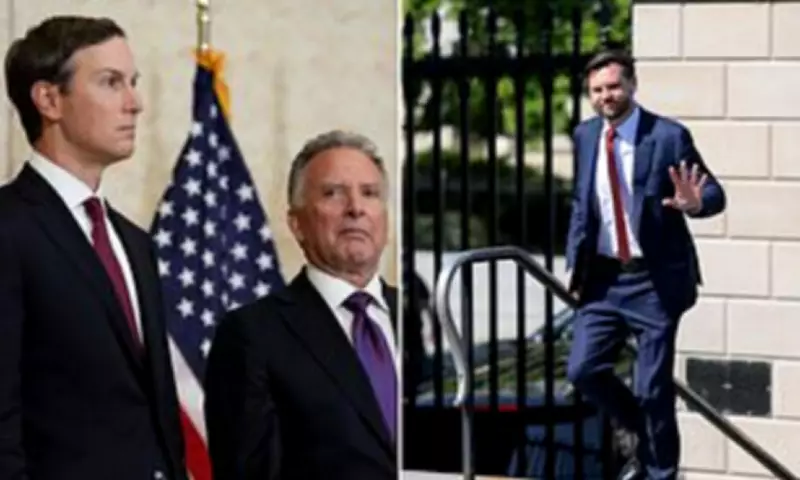
Vice President JD Vance has been sidelined from a second round of high-stakes peace negotiations with Iran, after his earlier efforts collapsed spectacularly. President Donald Trump dispatched special envoys Jared Kushner and Steve Witkoff to Islamabad on Saturday morning, leaving Vance on standby, according to White House press secretary Karoline Leavitt.
Vance's Failed Mission
Vance returned to US soil empty-handed following the collapse of talks that were widely seen as the first major test of his vice presidency. Despite his long-standing skepticism of foreign intervention and initial doubts about targeting Iran, Vance had spent weeks quietly maneuvering to secure a permanent diplomatic agreement, according to two sources familiar with the plans. However, his team failed to secure a historic deal, and he has now been effectively sidelined from the second trip.
New Envoys Take the Lead
White House press secretary Karoline Leavitt explained that Vance would not be going to Islamabad, at least for the time being. 'According to my understanding, Vice President JD Vance will not go, at least not for the time being… The Iranians reached out, as the President asked them to do, and requested this direct dialogue. So, the President is sending Steve and Jared to listen to what they have to say,' she told reporters.

Iran's Diplomatic Moves
Iranian Foreign Minister Abbas Araghchi has arrived in Islamabad to handle talks, accompanied by a small government delegation. The Ministry of Foreign Affairs in Pakistan confirmed the visit. Araghchi will then travel to Muscat and Moscow. 'The purpose of this trip is to hold bilateral consultations, discuss ongoing developments in the region, and review the latest situation regarding the war imposed by the United States and the Israeli regime against Iran,' Araghchi explained.
Two Pakistani government sources familiar with the conversations said Araghchi's visit would be a short one to lay out Iran's proposals for talks with the US. A Pakistani mediator would then relay that message to Washington. Pakistan has been desperately trying to restart ceasefire talks between Iran and the US.
Escalating Tensions
Tensions in the stand-off between the US and Iran over the Strait of Hormuz have intensified after President Trump ordered the American military to 'shoot and kill' Iranian small boats in the key waterway. Iran has also rejected Trump's claim there was a leadership rift in the Islamic Republic. 'In Iran there are no 'hardliners' or 'moderates'. We are all Iranians and revolutionaries,' Iran's president Masoud Pezeshkian and speaker of parliament Mohammad Bagher Qalibaf wrote in almost identical social media statements.
Since the killing of Supreme Leader Ali Khamenei in the first strike of the war on February 28, it has been unclear who in Iran wields ultimate authority over its collection of civilian figures and powerful generals who appear to be in charge. His son, Mojtaba, has been rumored to be in bad physical shape - hiding in the shadows since the worst of the military strikes between the US, Israel and Iran.
Blockade and Military Moves
Ramping up his efforts, Trump is sending yet another aircraft carrier to the Middle East to reinforce his naval blockade of the Strait of Hormuz as the Iranian regime mocks his 'meaningless' ceasefire. Secretary of Defense Pete Hegseth made the announcement during a press briefing at the Pentagon on Friday morning. 'Not only is the blockade growing, in fact, a second aircraft carrier will join the blockade in just a few days, but this growing blockade has also gone global.'
Hegseth said the 'ironclad' blockade will remain in effect, warning that 'every ship' entering or leaving Iranian ports will be prevented from passing through the strait. 'To the regime in Tehran, the blockade is tightening by the hour, we are in control. Nothing in nothing out,' he continued. 'They don't control anything. They're acting like pirates, acting like terrorists.'
The stand-off between the US and Iran has effectively choked off nearly all exports through the Strait of Hormuz, where 20 per cent of the world's traded oil passes in peacetime, with no end in sight. Trump also said on Thursday evening that Israel and Lebanon have agreed to extend a ceasefire between Israel and Hezbollah by three weeks after talks at the White House.