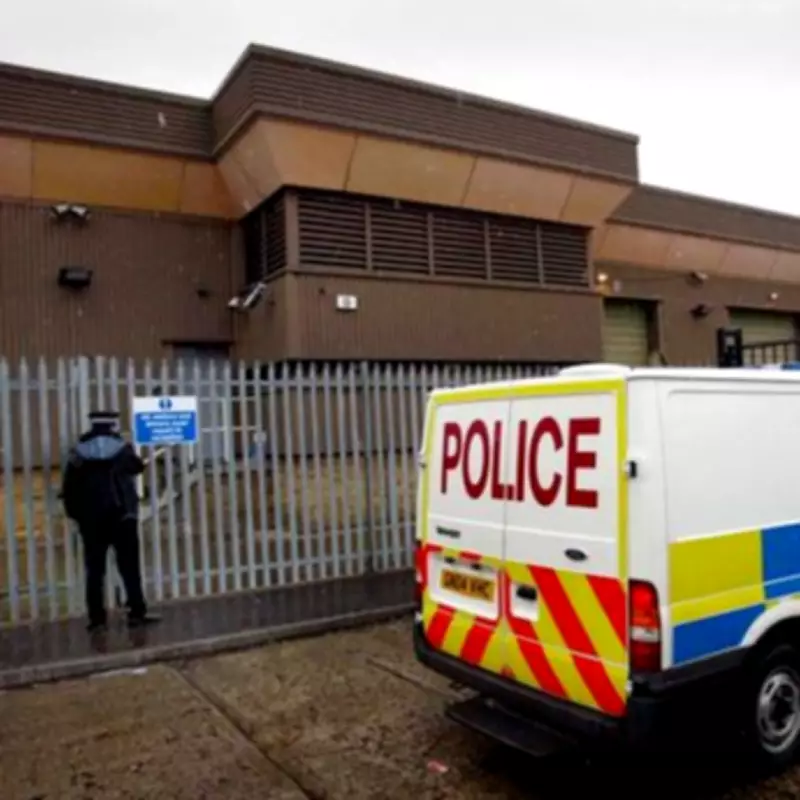
Britain's Biggest Cash Robbery: The £32 Million Mystery That Endures
Two decades have passed since Britain witnessed its largest ever cash robbery, yet a staggering £32 million remains unaccounted for, with authorities speculating the money could be literally rotting in the ground. The audacious heist at the Securitas cash depot in Tonbridge, Kent, in February 2006, saw violent criminals make off with £53 million in a meticulously planned operation that involved kidnapping and terror.
The Night That Shocked the Nation
The robbery began when depot manager Colin Dixon was intercepted by men disguised as police officers while driving home from work. Simultaneously, other gang members visited Dixon's home, falsely informing his wife that he had been in an accident. The entire family was then taken hostage at a farm building in Kent, where they were threatened at gunpoint and told they would be killed unless they cooperated.
Under this extreme duress, Dixon was forced to provide access to the Securitas depot. Once inside, seven masked men held staff at gunpoint while loading bank notes onto a 7.5-tonne white Renault lorry. Remarkably, the thieves left behind approximately £154 million because their vehicle simply couldn't hold any more cash, making this potentially a £200 million robbery.

The Aftermath and Convictions
Following the raid, an extensive police investigation led to multiple convictions. Five men—Stuart Royle, Lea Rusha, Jetmir Bucpapa, Roger Coutts, and Emir Hysenaj—were found guilty at the Old Bailey in 2008 and received substantial prison sentences. Additional conspirators, including Lee Murray who was jailed in Morocco and Paul Allen imprisoned in the UK, were also brought to justice for their roles in plotting the raid.
Despite these convictions, only £21 million of the stolen £53 million was ever recovered. Police discovered over £9 million in a container in Welling, southeast London, and another £8 million in a lock-up in nearby Southborough, with smaller sums found elsewhere. This leaves £32 million completely unaccounted for, creating one of Britain's most enduring criminal mysteries.
The Degrading Cash and Ongoing Investigation
Kent's chief constable Tim Smith, who served as senior investigating officer on the night of the raid, believes part of the missing haul might still be traceable, but acknowledges the significant challenge posed by the nature of the stolen currency. "This was before plastic was introduced into bank notes, it degrades," Smith explained. "So in 20 years of being buried... it is likely there's an awful lot of it that has been destroyed."
Smith vividly recalls the moment he realized the scale of the crime, when a worker at the depot told him: "I think it could be £50m." He reflected: "At that point, I realized there had probably never been a robbery of this much cash, certainly in the UK." The officer emphasized the traumatic experience endured by the Dixon family, describing how they were "terrorised" by masked men with guns. "For me it was a kidnap," Smith stated. "This robbery was only facilitated by the kidnap of Mr Dixon and his wife and their child and they were put through hell."
The Gang's Incompetence and Dispersal of Funds
True crime author Howard Sounes, who has studied the case extensively, described the perpetrators as "ragamuffins and misfits" who lacked sophistication despite their ambitious planning. "They didn't have a strong idea of how much money there was in the building," Sounes noted. "They couldn't steal anymore because they couldn't fit it in the lorry. When it was counted, they didn't actually have the wherewithal to count it, there was so much."
Ironically, the robbers created an "enormous" problem for themselves by stealing too much money. "You think that's every robber's dream, isn't it, to have £53m," Sounes observed, "but it's very difficult to actually spend £53m in cash." Some gang members converted their shares into Euros and fled abroad, while others hid cash in lock-ups, sports bags, wardrobes, and even car glove compartments. One robber reportedly gave his portion to his mother, while another disappeared to the Caribbean and, according to Sounes, "is probably still there living it up."

Unresolved Questions and Fresh Appeals
Twenty years after the historic robbery, Kent Police continue to seek answers. Chief Constable Smith remains convinced that at least one suspect evaded capture: "I'm convinced there are still people out there, one in particular who I think was probably in that cash depository that we've never traced."
Smith has made fresh appeals for information, emphasizing that there are "people out there who know something we don't" and that one vital piece of information could lead to other suspects. "Ultimately, if someone should still face justice for this," he asserted, "I would want to see that happen for the victims."
The Securitas depot robbery stands as a landmark case in British criminal history—not only for its unprecedented scale, but for the enduring mystery of what happened to £32 million that seemingly vanished into thin air, possibly buried somewhere in the British countryside, slowly decomposing as the years pass.