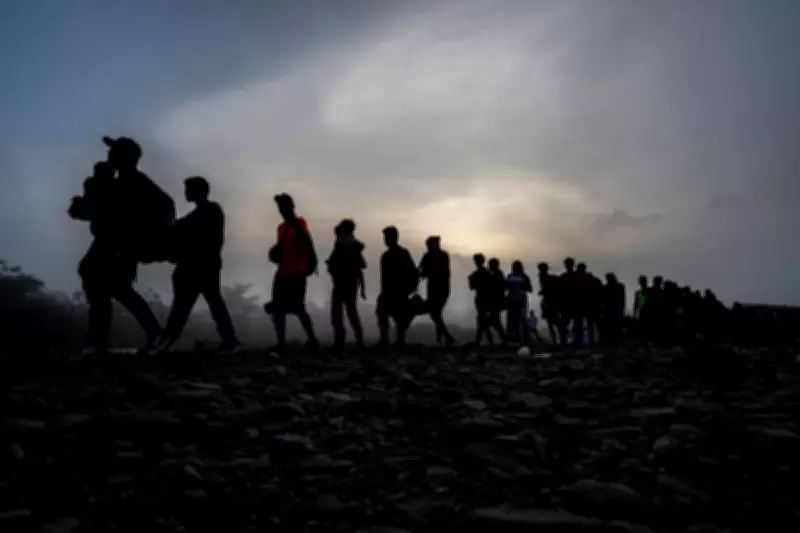
Two small scars on either side of his left thigh remind Mario Torres of the worst day he has had during the two-plus years he has spent on the road crisscrossing Latin America searching for a stable life. Torres fled Venezuela in 2018, when he was just 18 years old. After living in Colombia, Peru, and Chile for four years, rising costs of living prompted him to leave in September 2024 and head towards the United States. His journey involved buses, boats, trains, and walking across nine countries, taking months.
He traversed the Darién Gap, the lawless and dangerous jungle connecting Colombia and Panama. In Costa Rica, Nicaragua, Honduras, and Guatemala, his money dwindled and travel wore him down. But none of the difficulties matched the day in Mexico when he received those scars. “I was walking with a group of migrants on the road towards Coatzacoalcos, when three men with guns came out of nowhere,” Torres recalled. “It was getting dark and these men didn’t just want to rob us, they wanted to kidnap us.” Torres started running and felt a bullet pierce his leg. After being shot, he ran 100 metres to a gas station. Police and military officers were present but did not pursue the attackers; they simply called an ambulance.
Torres eventually reached Monterrey, Mexico, in January 2025, but by then it was too late. When Donald Trump returned to office on 20 January, he began implementing a draconian migration policy that effectively ended asylum access at the US-Mexico border and disrupted migration dynamics throughout Latin America. One of the first moves was shutting down the CBP One app, which allowed asylum seekers in Mexico to schedule appointments. About 300,000 people in the app’s pipeline, including Torres, found themselves stranded.

With no way forward, many began retracing their steps towards South America. This reverse flow initially garnered media coverage but soon faded. International attention shifted to Trump’s domestic agenda and foreign interventions. Deep cuts to humanitarian funding, including slashing the US foreign aid budget, left UN agencies and NGOs strapped for cash and capacity. The New Humanitarian spent 15 months reporting across Latin America to answer: what happened to the 300,000 people whose dreams were rebuffed?
The picture is of a fluid situation: some returned home, others ran out of resources and ended up stranded, while many still search for stability. Torres’s story of despondent confusion is echoed by countless others. More than a year later, he lives and works informally in Panama City, still figuring out his next move. “It’s hard to know what to do,” he said. “There have been so many changes.”
Growing Information Gap
Little data exists on the reverse movement from Mexico. The UNHCR told The New Humanitarian it had not monitored the CBP One pipeline and had no knowledge of Mexican government monitoring. Aid groups say shrinking resources hinder tracking trends. “There are growing gaps in what we know about returnees, their next steps and the situation of stranded populations in Central America,” said Simon Tomasi, regional manager for Latin America and the Caribbean at the Mixed Migration Centre (MMC).
The MMC interviewed about 1,500 people moving south in Mexico, Costa Rica, and Colombia between March and December 2025. Unpublished findings show the overwhelming majority were from Venezuela (85%), and 54% were returning somewhere other than their home country. Main destinations were Colombia (49%), Peru (21%), Ecuador (11%), and Chile (8%).
According to Colombian authorities, the reverse movement peaked between March and August 2025, slowed but continues. Besides Venezuelans, Ecuadorians, Haitians, Iranians, and citizens of African and Asian countries also headed south. Aid workers and shelter directors in Tapachula, Mexico, confirmed the data. “For the first half of the year, people were going back to their countries, mostly from Venezuela or Central America,” said Dr. José Espinoza of Médecins Sans Frontières. “People from Cuba, Haiti, or Africa won’t go back; they’re stuck here.”

The New Humanitarian spoke to many whose US protection hopes vanished when Trump shuttered CBP One. Many remain in limbo. Eduin, a 27-year-old Venezuelan, has been stranded in Panama City since August 2025 with his wife and two children. They sell chocolates and cookies at traffic lights. Between December and March, they saved $572—nearly half the fare needed to pay smugglers to reach Colombia, then head to the Colombia-Venezuela border and eventually Caracas. “We live day by day,” Eduin said. “We pay $15 daily for a hotel, and every ticket costs $350 for adults and less for children.”
Searching for Stability
Trump’s attack on Venezuela and abduction of President Nicolás Maduro in January added to anxiety. Torres does not want to stay in Panama and hopes the situation “settles down.” Many Venezuelans in Panama are waiting to see if Venezuela’s economy recovers before returning. Others have given up on return. “They want a stable country where they can make money, like Chile, Uruguay, and Panama,” Torres said. “Those who are here are not leaving.”
A regional crackdown on migrants is also felt in Panama, where conditions are difficult. Torres is undocumented and works as a waiter, earning only tips. He sends money to his mother and pays rent, unable to save for a passport or ticket to Venezuela. Daysi, 26, another Venezuelan stranded in Panama City, faces similar struggles. After trekking to Mexico, her family spent eight months waiting for a CBP One appointment. They stayed in Mexico for months after Trump’s return but decided to journey back towards Venezuela in June 2025—though not to stay.
The family often slept in the streets and struggled to find food. “Sometimes we have to buy something and stretch it among us,” Daysi said in November. They received no humanitarian assistance. By late December, Daysi was selling cookies at traffic lights, earning up to $150 per week, but not enough to continue. They planned to return to Venezuela temporarily for passports to leave again for Peru. In late January, the US attack on Venezuela disrupted their plans. “We are stuck here and don’t know what to do,” Daysi said. “The situation is difficult everywhere.”
Shifting Routes
Tracking reverse journeys has been challenging due to diminished capacity of UN agencies and NGOs. Over 800,000 people crossed the Darién Gap heading north in 2023 and 2024. The journey was gruelling and dangerous, with stories of robberies, rapes, deaths, drownings, and animal attacks. After surviving the Darién once, many returnees wanted to avoid crossing it again. Instead, they opted for sea routes, which also proved treacherous.
One route on Panama’s Caribbean coast involved boarding boats to Colombia from small towns. At least three people died in shipwrecks. Some were abandoned on cays when smugglers feared authorities. A second route on the Pacific coast from Panama to Colombia went through remote territory with armed groups. Around September 2025, this route shut down after migrants warned others of its dangers. Aid groups fear an unknown number of people have disappeared. The Caribbean route continues but numbers dropped from 2,914 in March 2025 to 816 in February 2026, with a slight uptick to 1,041 in March, according to Colombian data.
Aid workers expect movement to pick up as many remain stranded. One reason for the drop is increased smugglers’ ticket prices from about $100 to $300, according to Elías Cornejo of Fe y Alegría. “It has become a business,” Cornejo said. “There are a lot of people being held up in Guatemala, Costa Rica, the Costa Rican-Panamanian border, and within Panama that have to wait to have enough money to pay their way.” Another humanitarian worker said Panamanian authorities are stopping people in Nuevo Tonosí and only allowing those with enough money to pay inflated ticket prices. “It’s not that we won’t see migrants coming any more,” said Leonarda de Gracia of RET International. “What migrants say is that many are still in Central America, mostly in Mexico and Guatemala, working informally to make the money needed to cross to Colombia by boat.”
Colliding Regional Dynamics
The reverse flow is just one aspect of a regionally chaotic migration picture disrupted by Trump’s policies. People are still being pushed from homes by gang violence, economic conditions, political repression, and natural disasters, especially in Haiti, Cuba, and Venezuela. Many still head to Mexico, either to bide time before trying to reach the US or because the country offers better stability. Tens of thousands are stuck in Tapachula.
A second route circumventing Tapachula exists, according to activists. “This route is the new one for human trafficking and drug trafficking,” said Luis García Villagrán, a migrant rights activist in Mexico. In northern Guatemala, smugglers divide people: those with less money go to Tapachula; those who can afford a “premium” service are taken across the border into Tabasco near El Ceibo. From there, many Cubans and Venezuelans head to Cancún to join established communities, or continue north to Monterrey or Guadalajara. People from Cuba, where a US blockade has worsened the economic crisis, are increasingly staying in Brazil, Uruguay, and Costa Rica.
The US is also deporting hundreds of thousands to countries throughout Latin America, including thousands to countries other than their own. Aid workers and migration experts struggle to monitor these dynamics. “There is a multiplicity of dynamics coexisting at the regional level, and new ones are appearing, but since US funding cuts we have less data and less capacity to collect and analyse data,” said Tomasi.
Between Two Dead Ends
The surge in anti-migration policies by rightwing leaders in Latin America is making the situation more unpredictable. In Chile, President José Antonio Kast is promising a Trump-esque crackdown, including deploying the military, using drones, and building barriers. He is in talks with Peru and Ecuador to push Venezuelans out of all three countries back to Venezuela. El Salvador, Panama, Ecuador, Honduras, Guatemala, and Costa Rica have agreed to receive third-country nationals deported by Trump. In Argentina, President Javier Milei has started raids resembling ICE operations. A dozen regional countries have joined Trump’s “Shield of the Americas” initiative for border control.
“Migration is not seen as a humanitarian issue any more,” Cornejo said. “It is seen as a national security issue—a US national security issue.” Tomasi warned that deterrence policies are trapping migrants between two dead ends: barriers to regularisation and integration, and absence of conditions for safe return. “What will happen with the hundreds of thousands of people who will have to return?” Tomasi asked. “The region risks producing even greater precarity, immobility and forced re-migration.”