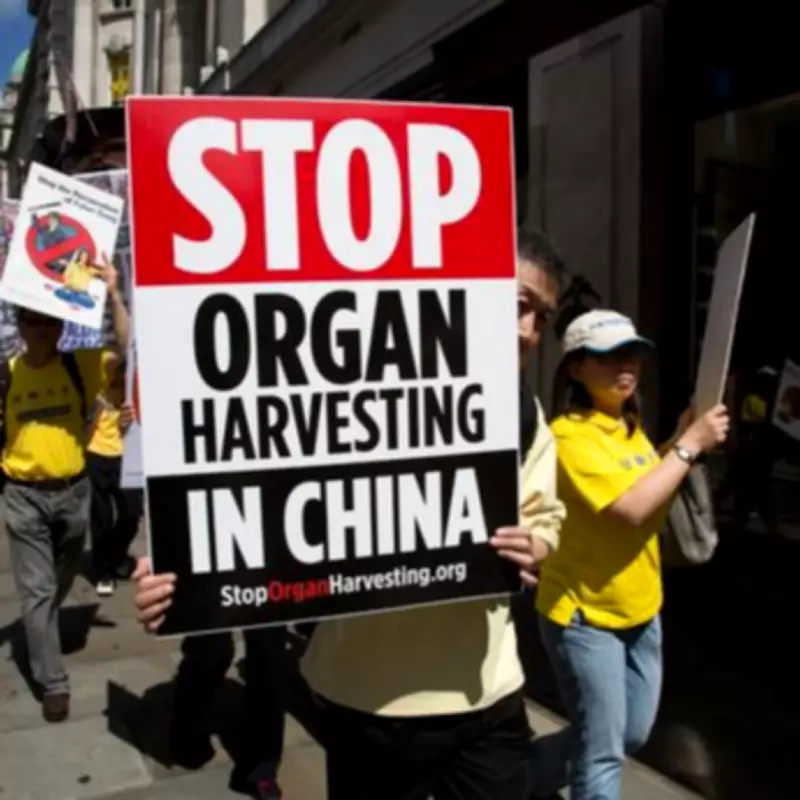
China stands accused of operating the world's most extensive organ harvesting network, where victims are allegedly 'killed to order' to supply government-regulated transplant centres. This brutal practice has sparked global protests as survivors come forward with harrowing accounts of waking up with critical organs missing after being forcibly detained.
The Survivor Testimonies: Waking Up With Organs Missing
Former prisoners who claim to have been victims of this harvesting operation have begun speaking out about their traumatic experiences. One survivor, identified only as Cheng, told The Sun that he was imprisoned in 2002 after advocating against government persecution of the Falun Gong movement.
Cheng described being taken to hospital against his will, where he refused to sign consent forms for an operation. 'I was held down by six guards,' he recounted. 'I was injected with something. The next thing I remember is being in a hospital bed with tubes in my nose, and I was going in and out of consciousness.'

A 35cm Scar and Missing Organs
When Cheng regained full awareness, he discovered a massive 35cm fresh cut on his side with a tube draining bloody liquid from beneath the bandages. Medical examinations later revealed parts of his lung and liver were missing. Years later, he was booked for surgery again, leading him to believe officials 'were going to kill me.'
Systematic Targeting of Falun Gong Practitioners
The Chinese Communist Party has outlawed the Falun Gong movement and allegedly targets its practitioners alongside Buddhist qigong followers for organ trafficking purposes. A recent government policy note, updated on January 30, confirms that detained Falun Gong members face:
- Physical and psychological coercion
- Torture to force renunciation of beliefs
- Forced organ harvesting on a significant scale
Despite official denials from Chinese authorities, the note states that forced organ harvesting continues both before and after death, with detainees identified as 'a principal source for organs.'
The Scale of the Operation
Estimates suggest China performs up to 100,000 transplants annually, with tens of thousands occurring each year since at least 2000. The International Coalition to End Transplant Abuse in China (ETAC) highlights the troubling discrepancy between multi-year waitlists in most countries and China's 'near-immediate availability' of organs.
'Organs must come from human donors,' the organisation states, 'and the stark contrast raises obvious ethical questions. At a minimum, many recipients choose not to probe the source too closely.'
International Investigations and Ongoing Concerns
The China Tribunal's 2020 judgement found 'no evidence of the practice having been stopped,' describing the harvesting as large-scale, systematic, and ongoing. Survivor testimony continues to indicate that this billion-dollar industry persists despite global condemnation.
With the practice generating enormous profits and facing limited international scrutiny, human rights organisations warn there appears to be no end in sight for this brutal trade in human organs.