

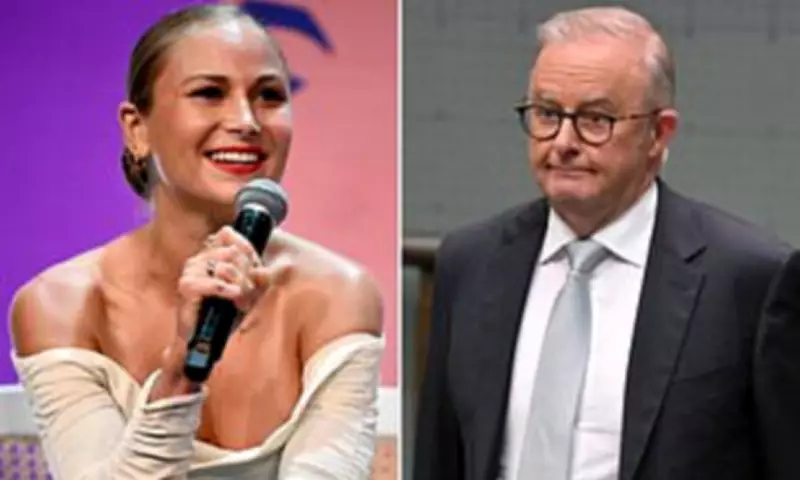
Grace Tame has provided a detailed explanation for why she believes Prime Minister Anthony Albanese described her as 'difficult' during a recent International Women's Day panel discussion. Speaking at a UN Women event held at a convention centre in Sydney on Wednesday, Tame delved into the controversy surrounding Albanese's one-word characterisation of her in an interview from February.
Tame's Clear Stance on the Prime Minister's Remarks
'I want to be absolutely clear about this,' Tame stated emphatically. 'The Prime Minister does not think I am difficult because I'm a survivor of child sexual abuse, because I'm a woman, or because I'm autistic.' She elaborated that Albanese's perception stems from her efforts to highlight what she views as a problematic allegiance between Australia, the United States, and Israel, which she argues conflicts with national interests. 'He thinks I'm difficult because I have put a spotlight on the toxic allegiance that we have with the United States and Israel that is in direct conflict with our national interests. That is why.'
Broader Context of Patriarchal Systems
Tame connected this personal incident to larger systemic issues, noting that 'for centuries, laws have been written by men, for men. Patriarchal interests have been protected above all else, with little consideration for women's rights or for our lived experience.' This reflection was part of a wider conversation at Women's Day events across Australia, focusing on how inequality impacts justice and the need for cultural shifts towards gender equality.

Albanese's Apology and the Initial Controversy
The dispute originated in late February when Albanese, while speaking at a conference in Melbourne, was asked to describe Tame in one word and responded with 'difficult.' This came after Tame, a former Australian of the Year, criticised him on social media for this description following her appearance at a pro-Palestine rally where she chanted 'globalise the Intifada.' Albanese later apologised, stating, 'Grace Tame, you certainly can't describe in one word. She has had a difficult life, and that was what I was referring to.' He also described other figures such as Donald Trump as 'president' and Pauline Hanson as 'divisive,' but declined to characterise Barnaby Joyce.
International Women's Day Theme and Legal Insights
This year's International Women's Day theme, 'balance the scales,' emphasised ensuring fair and inclusive access to justice for all women and girls. At the Sydney event, international human rights barrister Jennifer Robinson shared her experiences, including representing Amber Heard in defamation cases, to illustrate how legal systems can silence victims. 'The reality is that for centuries, laws have been written by men, for men,' Robinson echoed. 'Patriarchal interests have been protected above all else, with little consideration for women's rights or for our lived experience.' She advocated for legal reforms to prevent strategic lawsuits and non-disclosure agreements from suppressing victims of workplace harassment.
Addressing Violence and Grooming Awareness
Robinson highlighted alarming statistics from UN Women, noting that one in three women globally experiences gender-based violence, making it the most prevalent human rights abuse. 'We cannot begin to tackle violence against women if we can't speak about it,' she asserted. Tame, drawing from her personal history as a survivor of child sexual abuse, discussed the six phases of grooming—targeting, gaining trust, filling in need, isolating, sexualising, and maintaining control—to educate the public on protecting children. 'Offenders are operating among us constantly ... this is a ubiquitous problem. It's everywhere, it's in every tier of society,' she warned, urging knowledge as a tool to break cycles and recalibrate justice.

Calls for Accountability and Unity
UN Women Australia chief executive Simone Clarke underscored the importance of accountability in times of global crises, from conflicts in the Middle East to local incidents like the Bondi attacks. 'They remind us that peace, safety and security are tenuous and that we must hold people to account, stand together and protect our rights and freedoms,' she said. The event concluded with a strong message encouraging Australians to challenge misogyny in everyday conversations, fostering a cultural shift towards greater equality and justice for all.





