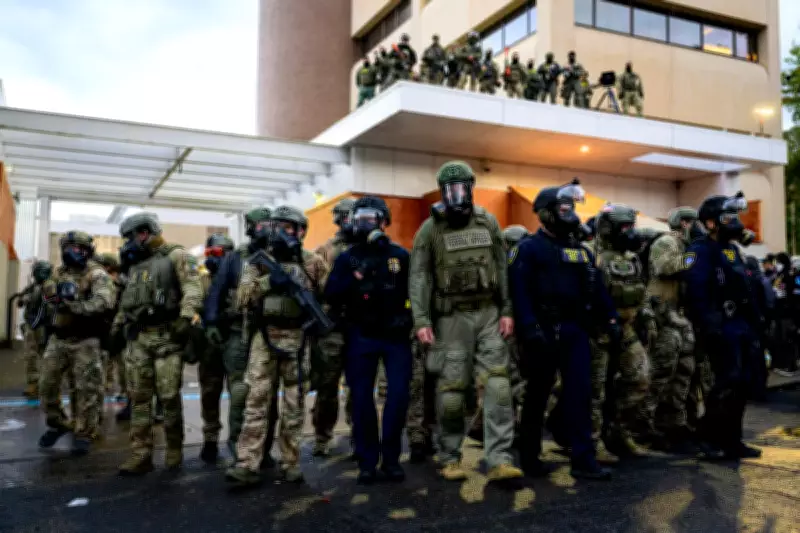
ICE Agents Disclose Daily Arrest Quotas and Surveillance Technology in Oregon Court Case
In a rare federal courtroom revelation, Immigration and Customs Enforcement (ICE) officers have admitted under oath to employing daily arrest quotas and a specialized surveillance application during operations in Oregon. This testimony emerged from a class-action lawsuit filed by Innovation Law Lab, an immigrants' rights non-profit, challenging ICE's practices of warrantless arrests.
Courtroom Testimony Unveils Internal Strategies
The lawsuit compelled ICE agents to provide sworn statements, offering an unprecedented glimpse into typically secretive internal tactics that have fueled mass detentions and chaotic raids across the state. A federal judge has broadly halted warrantless arrests in Oregon, siding with plaintiffs who argued these methods led to widespread racial profiling and unconstitutional actions.
During a December hearing, an ICE agent identified as JB testified that his team received verbal orders to target eight arrests per day. This team, consisting of nine to twelve officers, was part of the Department of Homeland Security's (DHS) "Operation Black Rose," which resulted in over 1,200 arrests in Portland from last fall through mid-December. Innovation Law Lab estimated this quota could translate to approximately fifty daily arrests statewide, contradicting DHS officials' repeated denials of quota systems.

Surveillance App Elite and Its Role in Targeting
The hearing also marked the first court disclosure of ICE's use of an app named Elite, described as similar to Google Maps but designed to highlight areas with a high density of individuals having an "immigration nexus." JB explained that this nexus could include any history of contact with immigration officials, potentially even naturalized U.S. citizens. The app, which pulls data from various sources, helps officers identify "target-rich" neighborhoods for detentions.
However, JB acknowledged Elite's potential inaccuracies, noting that information could be wrong and requiring officers to conduct additional checks. Testimony revealed that during a 30 October operation in Woodburn, a city south of Portland with many agricultural workers, officers used Elite to surveil an apartment complex before pulling over a van of farm workers. JB cited suspicions of human trafficking or smuggling, though these claims were later deemed unfounded by the judge.
Controversial Arrests and Judicial Criticism
In the Woodburn incident, officers smashed car windows and detained all seven occupants, including lead plaintiff MJMA, who had entered the U.S. with a valid temporary visa. Arrest records inaccurately stated she entered unlawfully and described the stop as consensual. U.S. Judge Mustafa Kasubhai sharply criticized ICE's tactics, highlighting Elite's inaccuracies and the targeting of lawful residents. He noted that at least thirty-five people were detained in Woodburn that day, driven by national demands for 3,000 daily immigration arrests.
Broader Implications and Legal Challenges
Stephen Manning, executive director of Innovation Law Lab, argued that arrest quotas incentivize officers to bypass legal protections, citing cases like Juanita Avila, a legal permanent resident tackled during a stop. The testimony suggests ICE uses Elite to create an "electronic dragnet" that may violate Fourth Amendment rights against unreasonable searches.
Details about Elite remain partially unclear, but reports indicate it was built by Palantir, a data analytics firm with DHS contracts, and includes features like confidence scores and geospatial mapping. DHS and Department of Justice spokespeople did not respond to inquiries, while Palantir described itself as a data processor without active involvement in client operations.
This case underscores ongoing debates over immigration enforcement, surveillance technology, and civil liberties in the United States, with advocates warning of increased risks for vulnerable communities.