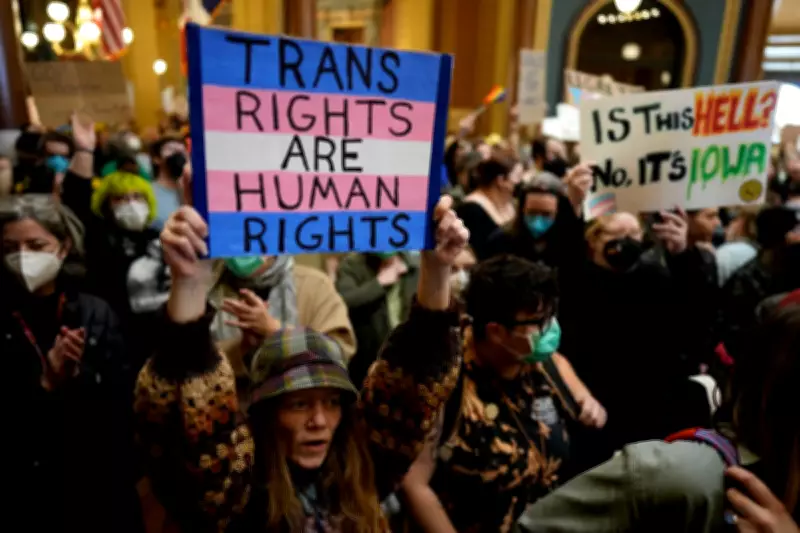
Iowa Enacts Law Barring Local Gender Identity Protections After Civil Rights Rollback
A new Iowa law has officially barred cities and counties across the state from adding local nondiscrimination protections for gender identity. This legislation comes after Iowa became the first state in the United States to roll back its civil rights code last year, marking a significant shift in the legal landscape for LGBTQ+ rights.
Preemption Law Takes Immediate Effect
The preemption law took effect on Tuesday, March 10, 2026, as soon as Republican Governor Kim Reynolds signed it into law. This statute prevents municipalities from enacting civil rights protections that extend beyond the categories explicitly identified in the state code. Many cities, including liberal populous centers such as Des Moines and Iowa City—home to the University of Iowa—currently have gender identity protections on their books. Last month, Ames, which hosts Iowa State University, also enacted an ordinance adding gender identity protections.
Republican Justification and Democratic Opposition
Republicans, who control both the House and Senate in Iowa, argued that the preemption law provides clarity on which classes are protected under state law. Republican state Representative Steve Holt stated, "There could literally be hundreds of situations where we have conflicts with local ordinances. And considering the climate that we’re in today, a patchwork of different civil rights ordinances would be extremely difficult for businesses and schools to navigate." Democrats, however, strongly objected to the law, viewing it as an overreach that undermines local autonomy.

Historical Context and National Comparisons
Sexual orientation and gender identity were not originally included in Iowa's Civil Rights Act of 1965. They were added in 2007 by the then-Democratic-controlled Legislature with support from about a dozen Republicans. Last year, Governor Reynolds and other Iowa Republicans contended that nondiscrimination protections could not coexist with recent laws restricting transgender students' use of bathrooms, locker rooms, and sports teams. According to researchers at the Movement Advancement Project, an LGBTQ+ rights think tank, at least two other states, Arkansas and Tennessee, have similar laws prohibiting local nondiscrimination ordinances that are broader than state law.
Local Response and Legal Considerations
In Iowa City, located about 100 miles east of Des Moines, gender identity protections against discrimination have been part of local code for approximately 30 years. City Council member and lawyer Laura Bergus explained that after last year's state law was enacted, the city passed a resolution to reinforce its authority and ensure residents knew discrimination based on gender identity remained prohibited. Bergus criticized the new law as "extreme overreach," arguing it prevents local governments from addressing community needs. Iowa City is now considering legal action, with Bergus affirming, "Our local leadership remains committed to protecting all of us."
Impact on Civil Rights Complaints and Birth Certificates
Iowans have until April 27, 2026, to file civil rights complaints with the state regarding gender identity incidents that occurred before the civil rights code rollback took effect on July 1, 2025. Data from the Iowa Office of Civil Rights as of February 13, 2026, shows only one complaint has been accepted for investigation since then, compared to 46 complaints accepted during the previous 12 months. The rollback also eliminated Iowans' ability to request changes to the sex designation on their birth certificates. State health department data provided to The Associated Press indicates that from January through June 2025, there were 208 birth certificate sex designation changes, a significant increase from 135 requests in all of 2024. The state no longer tracks these requests but continues to receive them, with all being rejected.