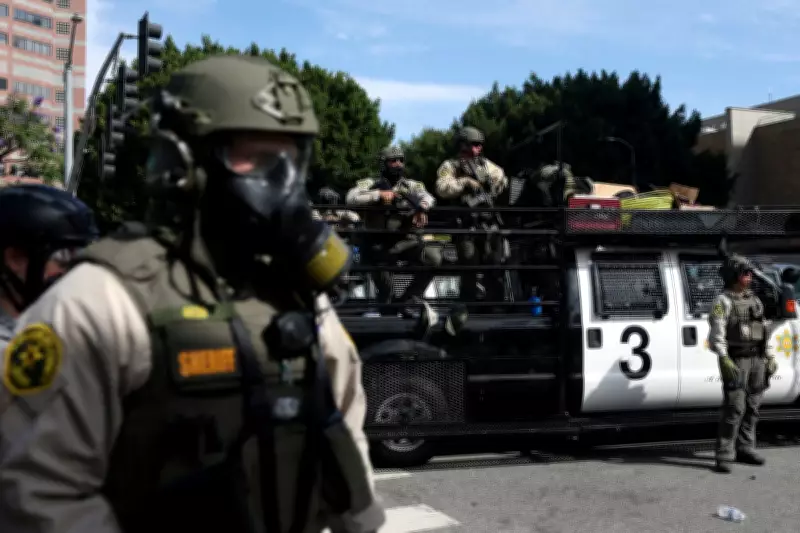
Federal Judge Halts California's Mask Ban for Federal Immigration Agents
A federal judge has issued a significant ruling blocking a California law that would have prohibited federal immigration agents from wearing facial coverings. However, the judge upheld a requirement for these agents to display clear identification showing their agency and badge number while on duty.
Discrimination Against Federal Government Cited in Ruling
Judge Christina Snyder issued the initial ruling on Monday, stating that the mask ban as enacted discriminated against the federal government because it did not apply equally to state law enforcement authorities. The judge found that federal officers can perform their duties effectively without wearing masks, but the law's selective application created an unconstitutional imbalance.
The ruling, which will take effect on February 19, 2026, could have national implications as states across the country grapple with how to regulate federal agents enforcing immigration policies. Judge Snyder left open the possibility for future legislation that would ban federal agents from wearing masks, provided such legislation applies uniformly to all law enforcement agencies.

Background of the Controversial Legislation
California became the first state to ban most law enforcement officers from wearing facial coverings when Democratic Governor Gavin Newsom signed the bill in September 2025. The legislation was prompted by high-profile raids conducted by Immigration and Customs Enforcement officers in Los Angeles during the summer of 2025.
The original bill, which was scheduled to take effect on January 1, 2026, prohibited law enforcement officers from wearing masks, neck gaiters, and other facial coverings. It included several exceptions for undercover agents, protective equipment like N95 respirators or tactical gear, and situations where not wearing a mask would jeopardize an operation.
Legal Challenges and Safety Concerns
The Trump administration filed a lawsuit in November 2025 challenging the California laws, arguing that they threatened officer safety and violated the Constitution by allowing a state to directly regulate the federal government. Government lawyers cited a multifold increase in assaults and threats against federal officers, including an incident in Los Angeles where three women allegedly livestreamed while following an ICE agent home and posted the address on Instagram.
At a January 14 hearing, Judge Snyder repeatedly questioned government lawyer Tiberius Davis about why banning masks would impede federal law enforcement, particularly since officers rarely wore masks prior to 2025. Davis argued that facial coverings provided necessary protection against harassment, doxing, and violence targeting federal agents.
State's Argument for Public Interest
Cameron Bell, an attorney for the California Department of Justice, challenged the federal government's claims, stating there was no concrete evidence that federal agents cannot perform their duties without facial coverings. Bell referenced declarations from U.S. citizens who reported feeling they were being kidnapped when detained by masked federal agents.
"It's obvious why these laws are in the public interest," Bell argued during proceedings, emphasizing the need for transparency and accountability in law enforcement interactions.
Political Reactions and Future Legislation
California State Senator Scott Weiner, who proposed the original bill to ban facial coverings, announced he would immediately introduce new legislation to include state police in the law. Weiner stated in a news release that "ICE and Border Patrol are covering their faces to maximize their terror campaign and to insulate themselves from accountability. We will ensure our mask ban can be enforced."
The federal government also argued in legal briefs that allowing California's legislation could embolden other states to impose similar unconstitutional restraints on federal operations. Davis cited a statement from Governor Newsom in July 2025 where the governor acknowledged, "It appears that we don't have the legal authority for federal agents but we do for other law enforcement authorities."

Local Enforcement and Broader Implications
Los Angeles County supervisors voted in December 2025 to enact a local ordinance banning law enforcement from wearing masks, which took effect on January 8, 2026. However, both the sheriff's department and Los Angeles Police Department stated they would not enforce the ordinance until after the court ruled on the statewide mask ban.
The ruling represents a significant development in the ongoing tension between state and federal authorities regarding immigration enforcement, with potential ramifications for how law enforcement agencies nationwide balance officer safety with public transparency requirements.