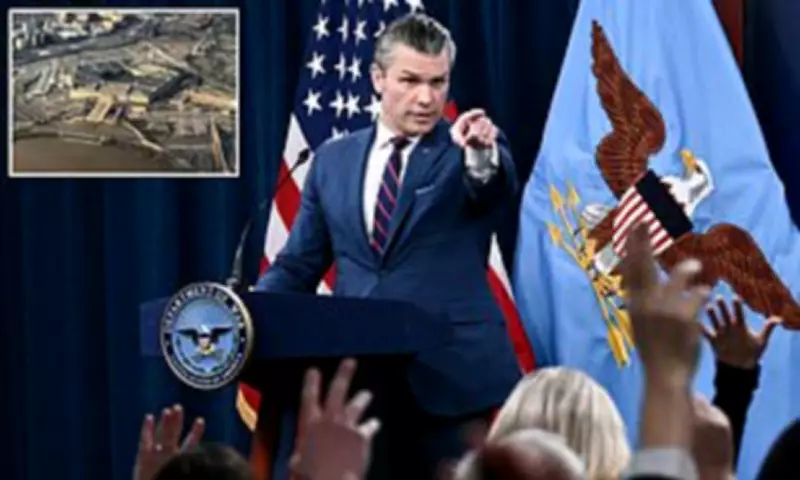
Federal Judge Halts Pentagon Media Restrictions in Landmark Ruling
A federal judge has delivered a significant blow to the Trump administration's efforts to control media access at the Pentagon, blocking enforcement of a controversial policy introduced under Secretary of War Pete Hegseth. The ruling represents a major victory for press freedom advocates who argued the measures unconstitutionally restricted journalists' ability to report on military affairs.
The Controversial Pentagon Agreement
The Department of War implemented the new credentialing policy in October, requiring all journalists with Pentagon press access to sign an agreement containing multiple restrictive provisions. The agreement prohibited military personnel from making what it termed 'unauthorized disclosures' to media representatives and imposed severe limitations on reporters' movements within the defense headquarters.
Under the policy, journalists faced revocation of their press credentials for asking staff for information not officially approved for release by the Secretary of War. The rules also barred reporters from accessing large areas of the Pentagon without military escorts and declared that requesting personnel to make unauthorized disclosures—characterized as asking them to 'commit criminal acts'—would not receive First Amendment protection.

Media Resistance and Legal Challenge
Major news organizations including The Daily Mail, CNN, The New York Times, The Washington Post, The Wall Street Journal, and The Atlantic collectively refused to sign the agreement. This unified resistance highlighted widespread concern within the journalism community about the policy's implications for press freedom and government transparency.
The New York Times initiated legal action in December, filing a lawsuit against both the Pentagon and Secretary Hegseth. The newspaper argued that the credentialing policy violated journalists' constitutional rights to free speech and due process under the First and Fifth Amendments.
Judge Friedman's Historic Ruling
On Friday, U.S. District Judge Paul Friedman, who was appointed to the bench by Democratic President Bill Clinton, issued a decisive ruling siding with The New York Times. Judge Friedman determined that the Pentagon policy illegally restricted the press credentials of reporters who had refused to comply with the new requirements.
In his written opinion, Judge Friedman stated that the policy 'fails to provide fair notice of what routine, lawful journalistic practices will result in the denial, suspension, or revocation' of Pentagon press credentials. He emphasized that the measures violated fundamental constitutional protections for both free speech and due process.
'Those who drafted the First Amendment believed that the nation's security requires a free press and an informed people and that such security is endangered by governmental suppression of political speech,' Judge Friedman wrote. 'That principle has preserved the nation's security for almost 250 years. It must not be abandoned now.'
Immediate Repercussions and Government Response
The judge ordered the Pentagon to reinstate the press credentials of seven New York Times journalists and declared that his decision to vacate the challenged policy terms applies to 'all regulated parties.' This broader application ensures protection for journalists across all media organizations covering the Pentagon.
Pentagon spokesperson Sean Parnell responded to the ruling with a statement posted on social media platform X, declaring, 'We disagree with the decision and are pursuing an immediate appeal.' The Defense Department had previously argued in court that the policy imposed 'common sense' rules necessary to protect national security information from unauthorized disclosure.
Government attorneys contended that 'the goal of that process is to prevent those who pose a security risk from having broad access to American military headquarters.'
Journalistic and Public Interest Perspectives
New York Times spokesperson Charlie Stadtlander welcomed the ruling, stating that the newspaper believes it 'enforces the constitutionally protected rights for the free press in this country.'

'Americans deserve visibility into how their government is being run, and the actions the military is taking in their name and with their tax dollars,' Stadtlander emphasized. 'Today's ruling reaffirms the right of The Times and other independent media to continue to ask questions on the public's behalf.'
Broader Context and National Security Considerations
Judge Friedman acknowledged in his ruling that legitimate security concerns exist, noting that 'national security must be protected, the security of our troops must be protected, and war plans must be protected.' However, he argued that transparency remains essential, particularly given current geopolitical circumstances.
'Especially in light of the country's recent incursion into Venezuela and its ongoing war with Iran, it is more important than ever that the public have access to information from a variety of perspectives about what its government is doing,' Judge Friedman wrote. He emphasized that such access enables citizens 'to support government policies, if it wants to support them; protest, if it wants to protest; and decide based on full, complete, and open information who they are going to vote for in the next election.'
The ruling comes amid increased government efforts to shape public perception of military actions. The White House and Pentagon have recently launched an aggressive social media campaign promoting the Iran conflict, incorporating real missile strike footage with video game imagery in videos that have accumulated billions of views. These productions, featuring dramatic narration from Secretary Hegseth, Call of Duty scenes, and intense musical scores, have drawn criticism from traditionalists who consider them disrespectful to American military personnel.
The policy's implementation followed Daily Mail reporting that revealed Secretary Hegseth's heightened concerns about security and media interactions, including accounts of staff dismissals for speaking with journalists and emotional outbursts related to personal safety anxieties. Judge Friedman's ruling now places significant constitutional limitations on the administration's ability to control media access to military information and personnel.