

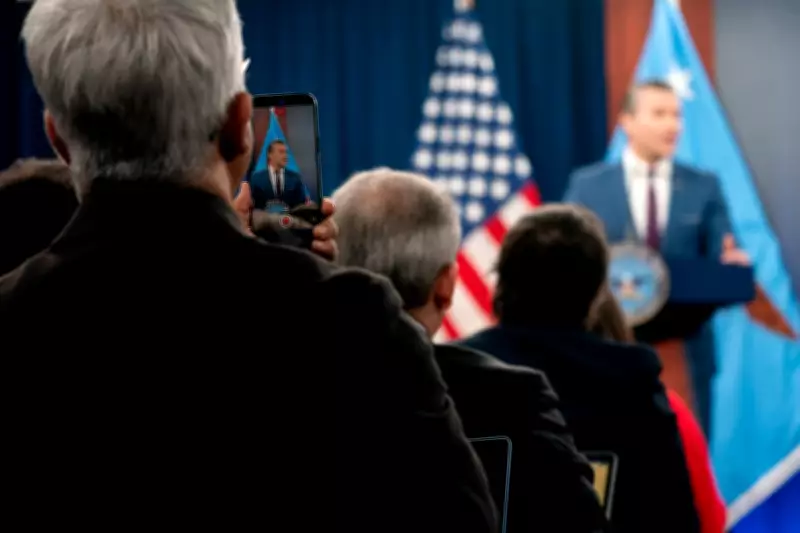
Federal Judge Halts Pentagon Press Policy in Victory for Media Freedom
A federal judge has intervened to block significant portions of the Pentagon's controversial press access policy, delivering a decisive victory for the New York Times and affirming constitutional protections for free speech. The ruling, issued by US District Court Judge Paul Friedman, strikes down measures introduced by the Trump administration in October that imposed severe restrictions on journalists covering military affairs.
Unconstitutional Restrictions on Media Access
The disputed policy prohibited reporters from soliciting information not directly provided by the Department of Defense and threatened to revoke credentials from outlets refusing to comply. This led to widespread defiance across the media landscape, with major news organizations including the Washington Post, Wall Street Journal, Associated Press, Reuters, Bloomberg News, and the Atlantic joining television networks in rejecting the terms. Out of 56 members in the Pentagon Press Association, only one outlet agreed to sign the new agreement.
In his opinion, Judge Friedman underscored the foundational role of a free press in national security, stating, "Those who drafted the first amendment believed that the nation’s security requires a free press and an informed people and that such security is endangered by governmental suppression of political speech." He emphasized that this principle has safeguarded the country for nearly 250 years and must not be abandoned now.

Lawsuit Allegations and Government Defense
The New York Times filed a lawsuit in Washington DC federal court, arguing that the policy granted the administration unchecked authority to penalize reporters and outlets based on unfavorable coverage, thereby violating First Amendment rights. The lawsuit contended that the rules unlawfully restricted essential newsgathering techniques and provided the Pentagon with "unfettered" discretion to revoke press passes, enabling viewpoint-based restrictions forbidden by the constitution.
In response, Justice Department lawyers acknowledged some subjectivity in the policy but maintained that credentialing decisions were guided by neutral, objective criteria. They further argued that soliciting unauthorized information from military personnel constituted unprotected speech, as it could involve criminal disclosures. The Trump administration defended the policy as a reasonable measure to protect military interests.
Broader Implications and Reactions
Judge Friedman's ruling highlighted the critical need for public awareness, particularly amid ongoing military engagements such as operations in Venezuela and conflicts with Iran. He asserted that "it is more important than ever that the public have access to information from a variety of perspectives about what its government is doing."
Following the decision, Pentagon spokesperson Sean Parnell announced that the administration is pursuing an immediate appeal. The policy had previously led to the formation of a new press corps comprising pro-Trump outlets and media personalities, approved by Defense Secretary Pete Hegseth.
Journalism advocates celebrated the ruling as a rebuke to attacks on press freedom. Seth Stern of the Freedom of the Press Foundation condemned the policy, calling it "shocking" and criticizing Justice Department lawyers for equating journalistic inquiry with criminal activity. New York Times spokesperson Charlie Statdlander affirmed that the ruling reinforces the media's right to question the government on behalf of the public.
This case echoes broader tensions, as seen in a pending lawsuit by the Associated Press against Trump administration officials over its removal from the White House press corps, related to naming disputes over the Gulf of Mexico. The outcome underscores ongoing battles over transparency and free expression in government dealings.






