

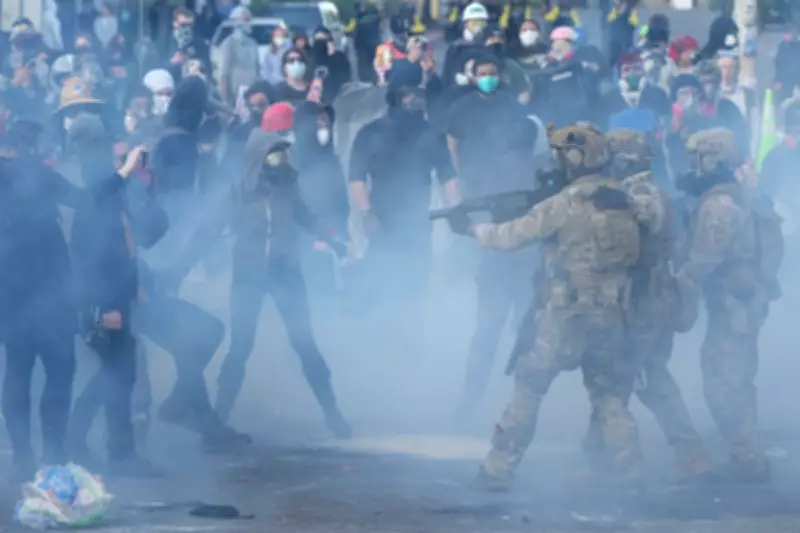
A federal judge in Oregon has issued a preliminary injunction limiting federal immigration officers' use of tear gas during protests at a Portland facility, following a lawsuit filed by residents of a neighboring affordable housing complex who have endured months of repeated exposure to chemical munitions.
Residents Describe Physical and Psychological Harm
U.S. District Judge Amy Baggio granted the injunction after a hearing last month where residents of the Gray's Landing apartment building testified about severe physical and psychological symptoms. These included difficulty breathing, persistent coughing, burning eyes, hives, anxiety, and panic attacks. Some residents reported wearing gas masks inside their own homes to protect themselves from the toxic fumes that permeated their living spaces during protests.
An Extraordinary Case Requiring Extraordinary Measures
In her written opinion, Judge Baggio emphasized that this case was not about the rights of protesters but rather about allegations from Gray's Landing residents that federal officers' use of chemical munitions had been "so excessive — so enveloping — that it violates Plaintiffs' rights." She stated, "The Court recognizes a preliminary injunction is an extraordinary remedy, but this is an extraordinary case."

The order specifically restricts agents from using chemical munitions in quantities likely to reach Gray's Landing, which sits catty-corner from the U.S. Immigration and Customs Enforcement (ICE) facility, unless necessary to respond to an imminent threat to human life.
Background of the Legal Battle
The property manager and several tenants of the apartment building filed the lawsuit against the federal government in December, arguing that the use of chemical munitions violated residents' constitutional rights to life, liberty, and property by making them ill, contaminating their apartments, and effectively confining them indoors. They requested the court to limit federal agents' use of such munitions except in response to immediate life-threatening situations.
This case emerges amid growing national concern over federal officers employing aggressive crowd-control tactics, as cities across the United States have witnessed demonstrations against the immigration enforcement surge spearheaded by President Donald Trump's administration.
Government's Defense and Counterarguments
The defendants, which include ICE, the Department of Homeland Security, and their respective heads, contend that officers have deployed crowd-control devices in response to what they describe as violent protests at Portland's ICE facility, which has been a site of demonstrations for several months. In court filings, the government stated that federal officers have at times used these devices against crowds that are "violent, obstructive or trespassing" or that fail to comply with dispersal orders.
The government has also challenged the tenants' claims of constitutional rights violations, arguing that under such reasoning, "federal and state law enforcement officers would violate the Constitution whenever they deploy airborne crowd-control devices that inadvertently drift into someone's home or business, even if the use of such devices is otherwise entirely lawful."
Vulnerable Population Affected
Court documents reveal that of the affordable housing complex's 237 residents, nearly one-third are aged 63 or older. Additionally, 20% of the units are reserved for low-income veterans, and 16% of tenants identify as disabled, highlighting the particularly vulnerable nature of the affected population.
The plaintiffs filed an updated request for a preliminary injunction in late January after agents launched tear gas at a crowd of demonstrators that included young children, which local officials described as peaceful.
Parallel Legal Proceedings
In a separate Oregon lawsuit filed by the ACLU of Oregon on behalf of protesters and freelance journalists, another federal judge previously issued a temporary restraining order limiting agents' use of tear gas during protests at the same building. That judge is also considering whether to grant a preliminary injunction in that case, indicating broader legal scrutiny of federal crowd-control tactics at the Portland ICE facility.

The preliminary injunction in the residents' case will remain in effect as the lawsuit proceeds through the legal system, providing temporary relief to those living in the shadow of the contentious immigration enforcement facility.





