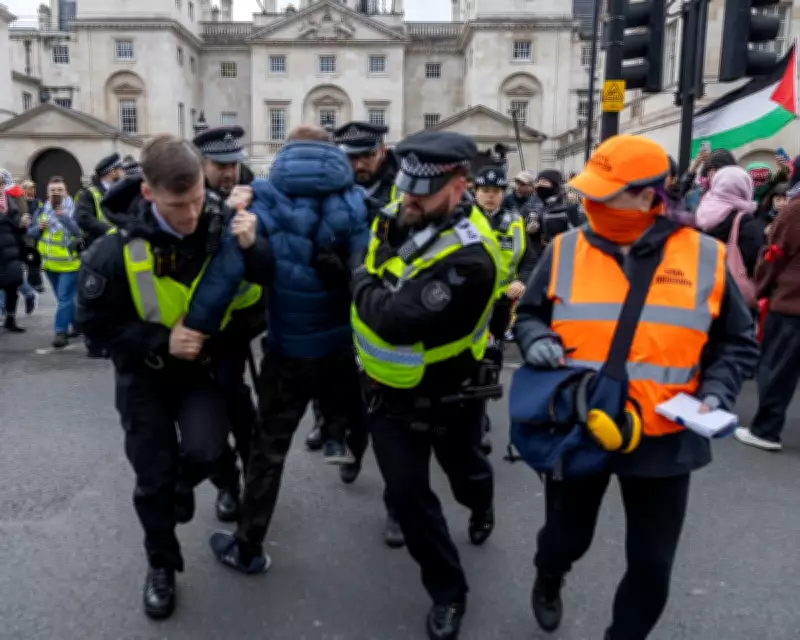
UK Protest Rights Under Threat as Government Review Sparks Alarm
Britons' fundamental right to protest is facing unprecedented threats, with a looming government review poised to potentially curtail civil liberties. If citizens value this democratic freedom, now is the time to speak out and defend it vigorously.
Historical Context and Current Concerns
Civil rights and women's rights advancements, achieved through persistent activism, might have been impossible under the legislative framework currently being considered by UK ministers. The situation, already precarious, risks deteriorating further into a state of heightened restriction.
Home Secretary Shabana Mahmood stated last year, "Lawful protest and free speech are fundamental rights, but we cannot allow them to be abused to spread hate or cause disorder. The law must be fit for purpose and consistently applied." She appointed Lord MacDonald, the former director of public prosecutions, to lead a review of public order and hate-crime legislation, with his report due imminently. For those who cherish the historic right to protest, as generations have before, the signs are deeply troubling.

Unequal Application of the Law
Laws theoretically govern the right to protest, but lessons from high-profile cases reveal stark inconsistencies in enforcement. Imran Khan KC, drawing from his experience as solicitor for the family of Stephen Lawrence, highlights that the law does not listen to everyone equally. While available in theory to Stephen's parents, in practice it failed to respond to them as equal citizens, a disparity that persists thirty years after his murder.
This uneven application is critical as the review examines how groups are treated when they organise, whether for single events or repeated high-profile demonstrations to raise their voices. Racialised groups remain disproportionately unprotected, as perception continues to shape legal outcomes.
Disproportionate Impact on Muslim Communities
Muslim communities, who experience the highest levels of recorded hate crime in England and Wales, face particular challenges. Despite repeated calls for action, objections arise when legally addressing Islamophobia, creating a palpable unfairness. Muslims are told they do not fall within race law scope, yet the threshold for religious discrimination is often set too narrowly to capture real-world Islamophobia.
In public life, they are treated as a monolithic group with ascribed characteristics, regardless of individual beliefs or behaviours. Scholars of race have long demonstrated that racial groups are socially and institutionally constructed, not biological. This racialisation affects Muslims exercising their citizenship rights, such as protesting against the genocide in Gaza.
Peaceful, family-oriented demonstrations calling for an end to violence are met with preemptive restrictions, heightened policing, and public warnings that blur lines between protest and criminality. Protest is increasingly viewed as a risk rather than a democratic right, with counterterrorism language justifying extraordinary measures like false imprisonment and terrorism charges.
Parallels with Black Communities
A similar pattern is familiar to Black communities, where assumptions about aggression and disorder have influenced stop-and-search practices, public-order policing, and criminal-justice outcomes for generations. These assumptions, rarely codified in statute, exert powerful influence over discretionary enforcement on the ground. Racialisation connects these experiences, underpinning skewed thinking and uneven law application.
The Threat of Cumulative Impact Focus
Against this backdrop, the ominous debate about protest and public order must be understood. Rather than starting from the premise that protest is a right to be facilitated, the review is urged to focus on constraining it. A particular threat is the emphasis on cumulative impact, which treats lawful protest as a collective nuisance rather than a series of individual exercises of protected freedom.

This approach contradicts Articles 10 and 11 of the European Convention on Human Rights, which protect political expression and assembly as rights exercised each time they occur, not as privileges that diminish through repetition. Recasting the inconvenience of repeated protest as justification for restriction undermines democratic principles.
Historical Precedents and Democratic Necessity
Consider other contexts: if transport workers were told they could strike only once because repeated action caused too much disruption, collective bargaining would lose its force. Pressure works because it is sustained, not because it remains tolerable. History teaches us that transformative change often requires persistence.
The suffragettes did not secure women's vote through a single demonstration or polite persuasion. Their campaigns were persistent, disruptive, and widely condemned, yet are now recognised as integral to change. Similarly, civil rights movements reshaped law and public life through sustained protest over time, facing significant inconvenience to those in power. Curtailing protests based on cumulative disruption alone would have stifled much of this progress.
Urgent Call to Action
There is much to fear from a review that threatens to entrench existing inequalities and restrict some rights to preserve others' comfort. This is a pivotal moment. Once the law, already misapplied to many citizens, begins to treat persistence as a problem rather than a feature of democratic participation, free speech ceases to be a right. It becomes what it should never be: a matter of political permission.
Imran Khan KC, a practising solicitor, urges vigilance and advocacy to protect these fundamental freedoms before they are eroded beyond repair.