

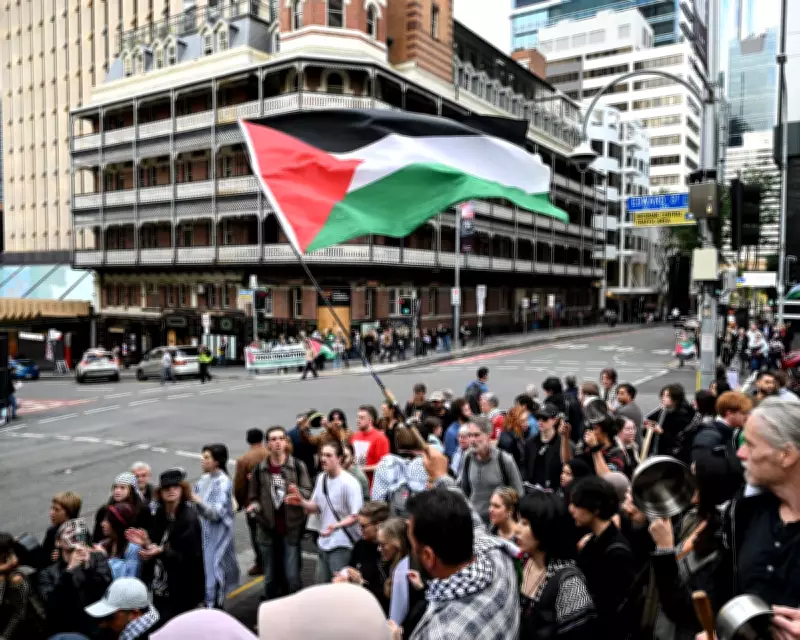
Queensland Implements Historic Ban on Pro-Palestine Phrases
The Queensland parliament has passed groundbreaking legislation making it the first Australian state to outlaw specific pro-Palestinian phrases, with offenders facing potential imprisonment of up to two years. The controversial laws target the expressions "from the river to the sea" and "globalise the intifada," classifying them as "proscribed phrases" under new antisemitism legislation.
Legislative Details and Penalties
The Fighting Antisemitism and Keeping Guns Out of the Hands of Terrorists and Criminals Amendment Bill 2026 was passed by the Liberal National Party government led by Premier David Crisafulli on Thursday. The legislation prohibits the "public distribution, publication, public display or public recitation" of these phrases when used in a manner that could cause "menace, harassment or offence" to any member of the public.
Key provisions include:

- Maximum penalty of two years' imprisonment for violations
- Application to social media posts, banners, chants, and online publications
- Coverage extends to phrases "likely to be confused with or mistaken for" the prohibited expressions
Context and Government Rationale
The legislation emerged following Australia's deadliest terror attack on December 14th, when fifteen people were killed and forty injured during a Hanukah celebration at Bondi Beach. Premier Crisafulli described the bill as "drawing a clear line" and "stamping out the embers of hatred that were allowed to burn unchecked for too long."
The original proposal granted the attorney general broader powers to ban additional expressions deemed hateful, but this was scaled back following criticism from across the political spectrum, including from right-wing think tank the Institute of Public Affairs.
Legal Interpretation Challenges
Constitutional law expert Professor Anne Twomey highlighted the complexity of enforcement, noting courts would need to determine whether chanting these expressions at peaceful rallies "might reasonably be expected" to cause offence or harassment. "Given the visceral objection to these expressions shown by some groups in the community, a court might well make such a finding, depending on the circumstances," Twomey explained.
Community Responses and Opposition
The Queensland Jewish Board of Deputies welcomed the reforms, with president Jason Steinberg stating they would make Jewish communities feel "safer, more protected and confident" after years of "unprecedented levels of hate, intimidation and fear." The organization maintains these slogans have been used by terrorist leaders to call for Israel's destruction.
However, significant opposition has emerged from multiple quarters:
- Free Speech Advocates: The Queensland Council for Civil Liberties president Michael Cope warned the laws would be "difficult and costly to detect, investigate and prosecute" and criticized linking the phrases to the Bondi attack as "unsupported by any evidence."
- Palestinian Support Groups: Justice for Palestine spokesperson Remah Naji called the legislation "Orwellian" and promised legal challenges, stating "history tells us that attempts to curtail free speech never succeed."
- Jewish Dissenters: Two Jewish groups submitted arguments against the bans, warning they risked increasing racism by targeting Arabic language and Palestinian political expression while ignoring hate speech affecting other communities.
Immediate Testing and Future Challenges
The laws face their first major test during a national student strike for Palestine scheduled for Wednesday, where protesters plan to gather at parliament house. Students For Palestine Queensland convener Ella Gutteridge confirmed participants would demonstrate "fierce opposition to the new laws" designed to create a "chilling effect" on criticism of Israel.
Gutteridge defended the phrase "from the river to the sea" as "a call for freedom and end to apartheid in Palestine from the Jordan River to the Mediterranean Sea" that "tens of thousands of people in Queensland have chanted for years."

Meanwhile, the New South Wales government has taken a different approach, with Premier Chris Minns acknowledging personal disdain for the phrases but determining blanket bans were legally and constitutionally unfeasible. A NSW parliamentary inquiry did recommend banning "globalise the intifada" when used to incite hatred, harassment, intimidation or violence.
As Queensland implements these unprecedented restrictions, the stage is set for legal battles, protest confrontations, and ongoing debate about balancing free speech protections with community safety concerns in Australia's evolving political landscape.





