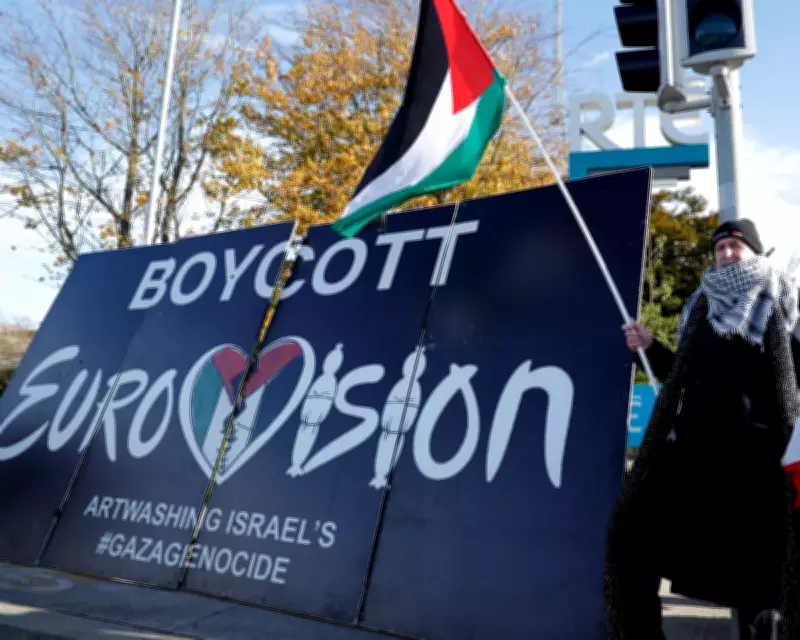
Demonstrators gathered outside RTÉ, Ireland's public service broadcaster, on 1 November 2025, calling for an Irish boycott of the 2026 Eurovision Song Contest if Israel participates. The protest underscores how the contest, once known for sequins and fun, has become a geopolitical battleground.
A History of Controversy
The Eurovision Song Contest, designed to promote European harmony and cultural exchange, has frequently morphed into a human rights battlefield. In 1969, Austria boycotted Spain because of its dictatorship. Half a century later, five countries are shunning the 2026 contest in Vienna over Israel's involvement, marking the biggest boycott in Eurovision history.
As ABBA sang in 1974: "The history book on the shelf is always repeating itself." This year's mutiny, however, is unprecedented in scale and bitterness, dominating headlines and polarising opinion.

The Boycott and Its Backdrop
Spain, the Netherlands, Ireland, Slovenia, and Iceland have withdrawn in protest at Israel's inclusion while attacks continue in Gaza. Spanish Prime Minister Pedro Sánchez stated: "In the face of illegal war and genocide, silence is not an option." Instead of performing, Spain's broadcaster TVE will air an alternative music show, Slovenia's RTV will show documentaries on Gaza, and Ireland's RTÉ will broadcast a classic Father Ted episode where priests earn zero points.
The European Broadcasting Union (EBU), which runs Eurovision, faces accusations of spinelessness. Supporters say it oversees a global spectacle with 166 million viewers, but critics argue it fails to navigate propaganda and politicisation.
From Harmony to Hostility
Founded in 1956 with seven countries, Eurovision aimed to prevent another world war. Its Swiss founder, Marcel Bezençon, was a friend of EU pioneer Jean Monnet. Politics initially stayed backstage, but that changed with the inclusion of Spain and Portugal. In 1964, a Danish activist stormed the stage with a "Boycott Franco & Salazar" banner. After Spain's alleged vote-rigging win in 1968, Austria boycotted the next year.
The 1970s saw tit-for-tat boycotts between Greece and Turkey, and Portugal's military used its 1974 entry as a coup signal. Arab EBU members refused to participate, and Jordan cut transmission during Israel's performance. In 2000, Israel's broadcaster disowned its entry after the band waved Syrian flags.
Yugoslavia's breakup produced one of the contest's most dramatic entries: Muhamed Fazlagic escaped besieged Sarajevo to represent Bosnia, turning his back on the audience as a protest against Europe's inaction.
LGBTQ+ and National Identity Politics
LGBTQ+ artists brought activism to Eurovision, turning it into a safe space. Newly independent post-Soviet states used the contest to assert nationhood. Russia's wars in Georgia and Ukraine sparked proxy battles, with coded lyrics bypassing political bans. In 2009, organisers blocked Georgia's song deemed a reference to Vladimir Putin. Ukraine's 2016 winning ballad '1944' addressed Stalin's deportation of Crimean Tatars.
Russia was banned in 2022 after its full-scale invasion of Ukraine, though Eurovision's CEO said the ban was due to the state broadcaster's lack of independence. He added that Russia could theoretically return while the war continues.
The Power and Pitfalls of Eurovision
Eurovision reflects national rivalries in a polarised world. As commentator William Lee Adams notes: "We don't vote for Jessica or David, we vote for Spain or Italy. Singers become political symbols." This is not necessarily bad: "Where else can tiny Moldova compete against the UK and win?"
Chris West, author of a Eurovision history, argues that the UK's poor results and Terry Wogan's snarky commentary fuelled Euroscepticism. Yet amid boycotts and bickering, Eurovision endures as a medium of cultural exchange. "It's a little part of being European," West concludes.