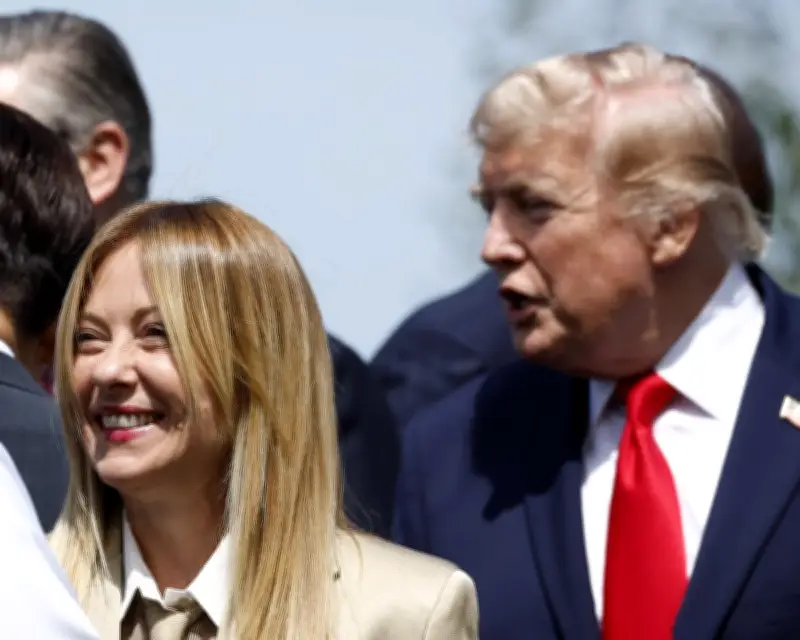
Italian Prime Minister Giorgia Meloni has launched a robust rebuttal against US President Donald Trump after he claimed she "begged" him for a photo at the recent G7 summit in Evian-les-Bains, France. In a social media video, Meloni dismissed Trump's assertion as "made up," stating, "I do not beg, nor does Italy." The exchange marks a significant rupture between the two leaders, who had previously maintained a cordial relationship.
Background of the Spat
The dispute traces back to an April disagreement over Pope Francis's criticism of the US war on Iran, but Trump reignited tensions in an interview with an Italian TV journalist. He later doubled down on Truth Social, claiming Meloni sought the photo to boost her flagging approval ratings, which he attributed to her lack of support for US actions in Iran. Spanish newspaper El País suggested Trump was irritated by a video showing Meloni appearing to scold him at the summit.
Meloni's response was unusually forceful. In an Instagram post, she insisted her popularity slide had nothing to do with the US, adding acerbically that being friends with Trump was not helping. Foreign Minister Antonio Tajani canceled plans to attend a US-Italian business forum in Miami, though he later confirmed attendance at a celebration of US independence at the US ambassador's residence in Rome, signaling efforts to mend ties.

Strategic Calculations Behind the Clash
According to Riccardo Alcaro, head of research at IAI in Rome, the rift is less about geopolitics than domestic electioneering. Meloni faces declining popularity: a March referendum saw voters reject her judicial reform package, and a new hard-right party, National Future led by former general Roberto Vannacci, is eroding her coalition's support. Polls suggest her governing coalition is set for defeat in the next general election, due by 2027.
Clashing with Trump, who is deeply unpopular in Italy, offers electoral advantages. It deprives the opposition of a key attack line over Meloni's previous closeness to Trump, and forces National Future to compete on nationalist conservative terrain that Meloni now seeks to dominate. She also aims to strengthen her position within the European right by distancing herself from pro-Trump figures like Viktor Orbán, aligning instead with France's National Rally.
Political Fallout and Electoral Maneuvering
Solidarity expressed with Meloni across the Italian political spectrum, including from Vannacci, validates her instincts. However, she is pushing for electoral law changes that would give bonus seats to the winning coalition, require new parties to collect 500,000 signatures, and force coalitions to name a premiership candidate in advance. This would either exclude Vannacci or force him into her coalition on her terms, while dividing the opposition.
The opposition has denounced the reform as a semi-authoritarian power grab. Meloni, lacking major policy successes, will rely on claims of ideological consistency and political stability, though her flip-flopping on Trump undermines that narrative. As Alcaro notes, "confidence begins to look more like performance than conviction." The electoral reform's approval will mark the unofficial start of the campaign, and Meloni can only hope voters don't care about the difference.