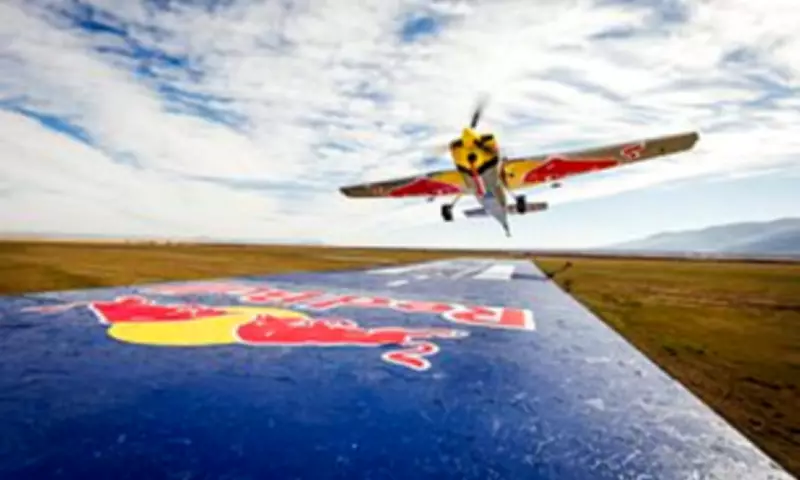
In an unprecedented aviation milestone, Italian pilot Dario Costa has successfully executed the world's first landing of a small aircraft on a cargo train moving at 75mph (120 kmph), immediately followed by a vertical takeoff. This daring feat, performed in Afyonkarahisar, Turkey, for Red Bull, required flawless synchronisation of speed and aerodynamic control, pushing the boundaries of aerial manoeuvrability.
The Challenge of Landing on a Moving Target
Mr Costa faced immense difficulties during the attempt, as he could only see the landing surface in the final seconds of approach. He had to contend with heavy turbulence generated by the train and fluctuating air speeds, making the alignment critically precise. Even the slightest mismatch between the plane and train velocities could have resulted in overshooting or misalignment, risking catastrophic failure.
Precision in Motion
Footage from the event shows Mr Costa grappling with the aircraft's joystick as he battled to manoeuvre the Zivko Edge 540 into position. Eventually, the wheels touched down on a cargo container with a painted mini-runway, for just a second, before he pulled the plane into a steep climb. The entire stunt was completed in 43.44 seconds, within a strict 50-second time limit set for approach, touchdown, and takeoff.

Years of Preparation and Testing
Preparations for this extraordinary achievement began two years prior, with engineering and flight teams developing simulations and controlled tests to replicate the landing dynamics. In the weeks leading up to the attempt, Mr Costa practiced using a car on a moving platform to simulate the conditions. On February 15, the real attempt took place, with a nine-carriage train speeding through the Turkish countryside as Mr Costa flew overhead.
Technical Specifications and Reactions
The plane used had a wingspan of 7.5m (24.6ft) and a landing gear width of 1.7m (5.6ft), operating under a 5kmph tailwind. After the successful landing, shouts of delight were heard from the cockpit, and Red Bull wingsuit athlete Sebastian Alvarez praised Mr Costa as a 'smooth operator'. Filippo Barbero, the project's aviation consultant, described him as 'a true magician', emphasising that there was no room for emotions during such a high-stakes project.
A History of Aerobatic Achievements
Mr Costa, aged 45, made his first solo flight at 16 and is now obsessed with aerobatic flying. This accomplishment adds to his list of incredible feats, including a 2021 tunnel pass that earned him a Guinness World Record for the 'Longest tunnel flown through with an aeroplane', measuring 1,730m (5,675 feet). Despite cross-winds, he navigated through a 360-metre tunnel into a longer 1,160-metre one, celebrating with a 360-degree loop afterwards.
Reflecting on the train landing, Mr Costa stated it was one of the most challenging projects of his career, relying solely on cognitive and flying skills due to the blind landing on a small, moving runway. The stunt involved a team of 40 people and over a year of planning, highlighting the collaborative effort behind this groundbreaking aviation moment.