Iran Considers Withdrawing from World Cup Following Military Strikes
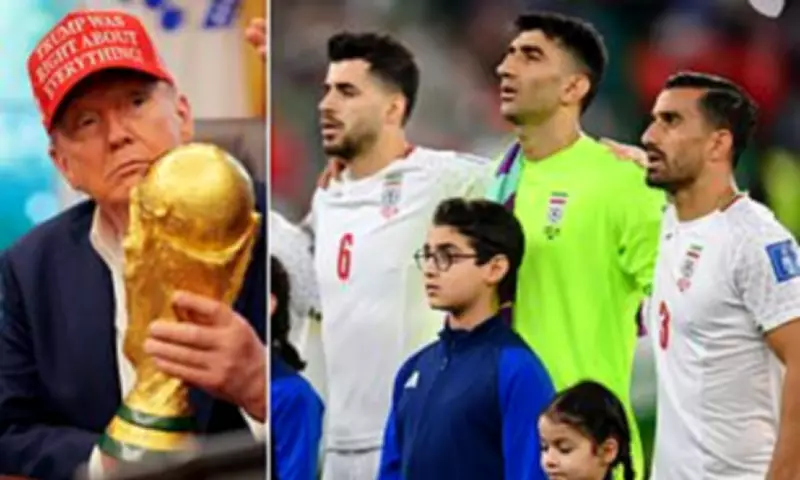
The Iranian football federation's president has declared that the nation may withdraw from this summer's 'inappropriate' World Cup hosted in America, citing the 'vicious' US and Israeli bombardments on their country. This announcement casts significant doubt over Iran's participation in the prestigious tournament, which is scheduled to commence in just 101 days across the United States, Canada, and Mexico.
Uncertain Participation Amid Regional Conflict
The Islamic Republic's national team has been drawn in Group G of the tournament alongside New Zealand, Belgium, and Egypt. However, the prospect of their involvement is growing increasingly uncertain following widespread retaliatory attacks launched by Iran across the Middle East, primarily targeting US and Israeli military bases. These actions come in the wake of the death of Supreme Leader Ayatollah Ali Khamenei, which has intensified regional tensions.
Mehdi Taj, who leads Iran's football federation, informed Iranian media over the last twenty-four hours that the country's participation in the tournament remains doubtful. Speaking on IRIB Channel 3, Taj stated, 'It's not possible to say exactly, but there will certainly be a response. This will be studied by the country's high-ranking sports officials and there will be a decision on what's going to happen.'

He elaborated further, noting, 'But what we can say now is that due to this attack and its viciousness, it is far from our expectations that we can look at the World Cup with hope.' Taj added that it was 'inappropriate' for Iran to compete under the current circumstances, highlighting the profound impact of the military strikes on their national psyche and sporting ambitions.
FIFA's Response and Replacement Protocol
With the tournament rapidly approaching, questions are mounting for FIFA regarding their contingency plan should Iran decide to pull out. At present, FIFA's only public comment about the war in the Middle East has come from their general secretary, Mattias Grafstrom. Speaking at the International Football Association Board's AGM in Cardiff, Grafstrom remarked, 'I read the news (about Iran) this morning the same way you did. We had a meeting today and it is premature to comment in detail, but we will monitor developments around all issues around the world.'
Grafstrom emphasized FIFA's focus on a safe World Cup with all teams participating, stating, 'We had the finals draw in Washington in which all teams participated, and our focus is on a safe World Cup with all the teams participating. We will continue to communicate as we always do with three (host) governments as we always do in any case. Everybody will be safe.'
Should Iran withdraw from the competition, FIFA will need to swiftly introduce a replacement team. According to their own regulations, this would be a 'nominated alternate, often the direct runner-up from the relevant qualifying playoff or highest-ranked non-qualified team from that confederation.' Iraq would be the frontrunners to replace Iran if they fail to qualify through this month's Inter-Continental play-off final against either Bolivia or Suriname.
However, if Iraq win and qualify automatically, the nation most likely to step in would be the United Arab Emirates, who lost their confederation play-off to Iraq last year. This potential reshuffling adds another layer of complexity to an already tense geopolitical situation impacting the world's most popular sporting event.
Logistical Challenges and Political Tensions
Iran's preparations for the tournament will also be severely affected, with no matches—including friendlies—to be played during the forty-day mourning period for the death of Supreme Leader Ayatollah Ali Khamenei. This disruption could hinder their competitive readiness and team cohesion ahead of the World Cup.
Adding further complications, fans from Iran were already banned from entering the United States under the initial iteration of a significant travel ban announced by the Trump administration last year. Only coaches and players from the team were set to be granted visa exemptions to enter the country and compete in the tournament, a situation that previously prompted Iran to threaten a boycott of the World Cup draw.

Potential off-field problems at the tournament are continuing to stoke fears, with alarm raised over cartel violence gripping Mexico and the chaos surrounding ICE agents in the United States. These security concerns compound the political tensions surrounding Iran's potential participation.
Political Context and Historical Precedents
US President Donald Trump has been front and centre of the build-up to the World Cup, from being awarded FIFA's Peace Prize by Gianni Infantino to having photo opportunities in the White House with the trophy. Speaking at the tournament's draw in December, Trump said, 'Gianni has done an incredible job. It is a nice tribute to you and the game of football, or as we call it soccer. It is beyond the numbers we thought were possible.'
Trump also asserted, 'The world is a safer place now. The USA was not doing well a year ago; now we are the hottest country in the world right now.' He has established a White House World Cup taskforce, led by Andrew Giuliani, who posted over the weekend that the strikes on Iran are making 'the world a safe place.' Giuliani added, 'We'll deal with soccer games tomorrow. Tonight we celebrate (the Iranian people's) opportunity for freedom.'
The most recent nation to be banned from competing in a World Cup was Russia in 2022 due to their invasion of Ukraine. However, FIFA president Gianni Infantino has recently suggested lifting such measures, claiming the ban 'has not achieved anything' and 'has just created more frustration and hatred.' Infantino argued, 'Having girls and boys from Russia being able to play football games in other parts of Europe would help.'
Responding to these comments, Ukraine sports minister Matvii Bidnyi branded Infantino 'irresponsible' and 'infantile,' stating, 'They detach football from the reality in which children are being killed.' This historical context underscores the complex interplay between international sports and geopolitical conflicts, a dynamic now playing out with Iran's potential World Cup boycott.
Should Iran participate in the tournament, their matches against New Zealand and Belgium will be held in Los Angeles, while their clash against Egypt is set to be hosted in Seattle. However, with the conflict showing no signs of immediate resolution, the world watches anxiously to see whether Iran will take to the pitch or withdraw in protest, leaving FIFA to navigate yet another political storm in global football.