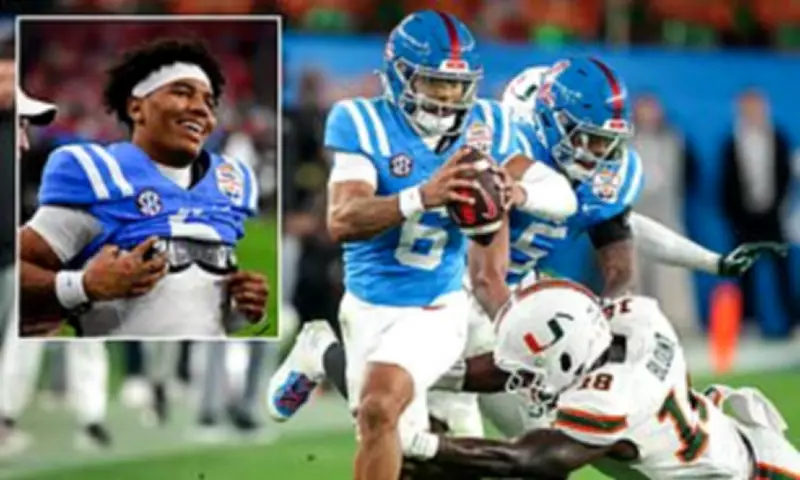
A Mississippi state judge has ruled that the NCAA 'ignored its own rules' and improperly denied Ole Miss star quarterback Trinidad Chambliss a sixth year of eligibility, siding with the athlete in a legal dispute that highlights ongoing tensions between collegiate sports governance and player welfare.
Court Decision Overturns NCAA Ruling
On Thursday, Judge Robert Whitwell issued a ruling in favour of Chambliss, stating that the NCAA's denial of the quarterback's waiver request for an additional season was conducted improperly. The judge emphasised that Chambliss would have suffered 'irreparable harm' if the initial ruling had stood, while the NCAA would not be harmed by allowing him to play a sixth season.
Chambliss had initially appealed the NCAA's decision to deny his waiver, but the governing body upheld its ruling on February 4. Subsequently, attorneys representing Chambliss filed a lawsuit alleging the denial was made in 'bad faith,' arguing that although he participated in five total seasons, health issues limited his active participation to only three of those years.

Health Issues Central to Legal Argument
The lawsuit, obtained by the Daily Mail, detailed a series of health problems that plagued Chambliss during his high school and collegiate career. These began with Epstein-Barr virus, which led to mononucleosis, and were later compounded by an extended bout of COVID-19 in 2020.
At his first college, Division II Ferris State in Michigan, Chambliss continued to face medical challenges, including chronic tonsillitis. Dr. Anthony Howard, an otolaryngologist from Grand Rapids, Michigan, provided testimony in the lawsuit stating that these conditions 'rendered him incapacitated and unable to participate in the 2022 season,' forming a medically valid basis for hardship consideration.
The legal argument relied heavily on the NCAA's history of granting extra eligibility to players dealing with similar health issues, suggesting inconsistent application of rules in Chambliss' case.
Ole Miss and NCAA Responses
Ole Miss' athletic department issued a statement expressing appreciation for the court's 'thoughtful consideration' and recognition of the circumstances surrounding Chambliss' case. 'We believe this outcome affirms what we have maintained throughout this process—that Trinidad deserves the opportunity to compete and complete his collegiate career on the field,' the statement read. 'Trinidad has demonstrated tremendous perseverance, character and commitment to his teammates, this university and college football.'
The NCAA has not responded directly to the lawsuit but has referred media to its previous ruling, which denied Chambliss eligibility for 2027. In a statement, the organisation maintained that 'this decision aligns with consistent application of NCAA rules.'
Broader Context of College Athletics
Chambliss' case occurs against a backdrop of significant changes in college sports. While some talented players still leave school early for NFL opportunities, other top collegiate stars have sought to remain at the NCAA level after the organisation lifted rules preventing endorsement deals and other revenue streams.
The ruling also follows other notable eligibility decisions, such as Montana linebacker Solomon Tuliaupupu receiving a ninth year of eligibility after beginning his college career at USC in 2018. Tuliaupupu suffered severe knee injuries in 2018, 2020, and 2023, demonstrating the NCAA's occasional flexibility in hardship cases.
Chambliss himself shined during a dramatic season for Ole Miss, which saw head coach Lane Kiffin depart for LSU before the Rebels' College Football Playoff debut. Despite the coaching change, Chambliss led Ole Miss to the semifinals, where they ultimately fell to Miami.
This legal victory not only grants Chambliss another season on the field but also raises questions about the consistency and fairness of NCAA eligibility determinations, particularly regarding athletes facing significant health challenges.