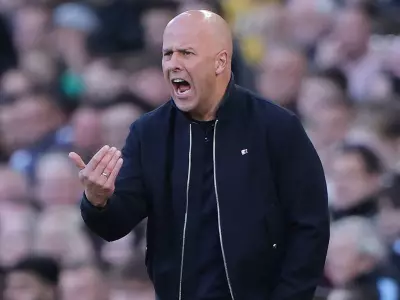
Scotland's Six Nations Title Dream Relies on Unprecedented English Support
As Gregor Townsend concluded his post-match media obligations on Saturday evening, a thunderous roar erupted from outside Murrayfield stadium. Thousands of Scottish supporters had remained in the car park to watch Italy's historic victory over England on large screens, celebrating England's latest setback with the same fervour they had shown for Scotland's seven tries during their emphatic demolition of France earlier that afternoon.
However, the tables will turn dramatically next weekend. For the first time in his entire life—as a coach, player, and fan—Townsend will find himself fervently hoping for an England triumph over France in Paris. This unlikely scenario could pave the way for Six Nations glory, provided his Scottish squad first accomplishes their own formidable task of defeating Ireland in Dublin.
A Bizarre Twist of Sporting Fate
While acknowledging the challenge ahead, Townsend conceded this would represent a unique moment in his rugby experience. "Have I ever supported England in a match before? That's an excellent question," the Scotland head coach reflected. "Probably not, but we shall see. England-France encounters have traditionally been fiercely competitive over many years. You have a motivated English team determined to finish their season on a high note."

He continued: "We faced France last season when they were pursuing the championship, and we delivered an exceptional performance against them. Although France managed to pull away during the second half, the opposition certainly didn't hold back that day, and I'm confident England won't either next week. Nevertheless, we must still accomplish everything possible to secure victory, something we haven't achieved against Ireland for several years, so that remains our primary challenge."
Saturday proved to be a spectacular day for rugby union, with Scotland derailing France's Grand Slam ambitions in what many are calling an all-time classic encounter, while Italy secured their historic win against England. With nearly every team inflicting damage upon their rivals at various stages, this championship has emerged as one of the finest in the Six Nations era.
The Championship's Dramatic Finale
The tournament now approaches its climax with three nations—France, Ireland, and Scotland—entering the final weekend still contending for the title. Multiple permutations exist, but fundamentally, Scotland must overcome Ireland while relying on England to perform them an enormous favour by defeating France in Paris.
The championship remains within French control. Should they secure a bonus-point victory over England, they will claim the title outright. However, if they only obtain four points, this again creates an opportunity for Scotland provided they achieve maximum points in Dublin. Meanwhile, Ireland's hopes depend on France failing to win their final match.
When questioned about whether all three final matches should commence simultaneously on Super Saturday to eliminate any perceived advantage, Townsend dismissed the idea. "No, I believe everyone thoroughly enjoys Super Saturday," he stated. "It's magnificent, isn't it? Supporters prefer watching games separately. Fans arrive early at venues to watch the preceding match. I think it's wonderful. The Six Nations represents a superb tournament, featuring six different nations while also being spread out appropriately."
He added: "The transition to six weeks this year instead of seven hasn't diminished the quality; it has actually enhanced it. Super Saturday now stands as brilliant entertainment. France could have won the tournament this weekend, but they didn't. Three teams remain in contention next week, so I believe the organisers and rugby public couldn't have requested a more exciting final day."
Scotland's Magnificent Performance
Scotland delivered an outstanding display on Saturday, rising magnificently to the challenge against a French team that had been in scintillating form. Following such a remarkable result and performance, inevitable comparisons arise regarding where this victory ranks historically.

Undoubtedly, this represents the finest achievement of Townsend's nine-year tenure. Considering the opposition's quality and what was at stake, this triumph sits at the very pinnacle. It might even constitute Scotland's greatest victory of the professional era—a seismic result that opens the door to what could become a glorious conclusion in Dublin next weekend.
As St Patrick's Day weekend approaches, Scotland aim to celebrate. While back pages will feature Willie Mullins and the Cheltenham Festival throughout the coming week, Scotland face one final hurdle to overcome. Knowing the championship hangs in the balance, there exists something almost poetic about facing Ireland in Dublin on the final day.
Overcoming Historical Hurdles
Ireland have become Townsend's nemesis. He has failed to defeat them in eleven previous attempts as head coach, a streak extending back to 2011. This includes several heavy defeats, including a couple of World Cup disappointments where Scotland departed with their tails firmly between their legs.
However, Townsend believes this current squad possesses such belief and momentum that they occupy a completely different space compared to previous encounters with the Irish. "We have perhaps been guilty in the past of examining Ireland too intensively," he acknowledged. "We anticipate Ireland will perform well—they could still win the championship—so we must prepare accordingly. We need to replicate our performance against France, maintain relentless pressure, and sustain it for eighty minutes to have any chance."
He continued: "We understand we're pursuing an opportunity to win the title, but also a Triple Crown that we haven't secured since 1990. We confront a significant opponent that we haven't beaten for an extended period. Therefore, sufficient motivation exists to ensure we do everything possible to win the match."
Individual and Collective Brilliance
Where does one begin analysing this performance? Both individually and collectively, Scotland elevated their standards to unprecedented levels. This marked the day they truly came of age against a genuinely top-tier opponent.
During the first half, Finn Russell, Sione Tuipulotu, and Huw Jones tore France apart with their fluid midfield movement. Is there currently a superior 10, 12, and 13 axis in world rugby? Based on this form, it appears unlikely. On the wings, Kyle Steyn and Darcy Graham provided rapier-like incision and finishing prowess.
Steyn will undoubtedly feature on the shortlist for player of the championship. He sustained a nasty cut on Saturday and had to leave the field injured, but Scotland expect him to recover for Dublin. Meanwhile, Jack Dempsey proved a human wrecking ball upfront, repeatedly making destructive carries. Having nearly torn his bicep against England, it seemed he might miss the remainder of the championship.
This was Dempsey The Terminator—an indestructible force of nature. He would require limbs hanging off to keep him away from Dublin now. Particularly during the twenty minutes following half-time, Scotland completely overwhelmed France. Leading 19-14 at the interval, they engaged their turbo-booster, actually leading 47-14 with under twenty minutes remaining.
This represented mind-bending brilliance, with every French error ruthlessly punished with lethal precision, leaving 67,000 spectators with their jaws on the floor. It became a demolition job, and at that stage, Scotland were poised to top the table, becoming masters of their own destiny heading into the final weekend.
They may rue the late flurry of four French tries during the final fifteen minutes that swung the championship back in favour of Les Bleus. Nevertheless, this had been an extraordinary day—the very finest of Townsend's tenure. For the first time in the Six Nations era, Scotland now possess a genuine shot at glory entering the final weekend.