

Super League at 30: How Rugby League Has Evolved for Matchgoing Fans
A lot has changed since 1996 – summer matches, bigger crowds, more foreign players, a salary cap, skin-tight jerseys, and female referees – but some things always stay the same. By No Helmets Required.
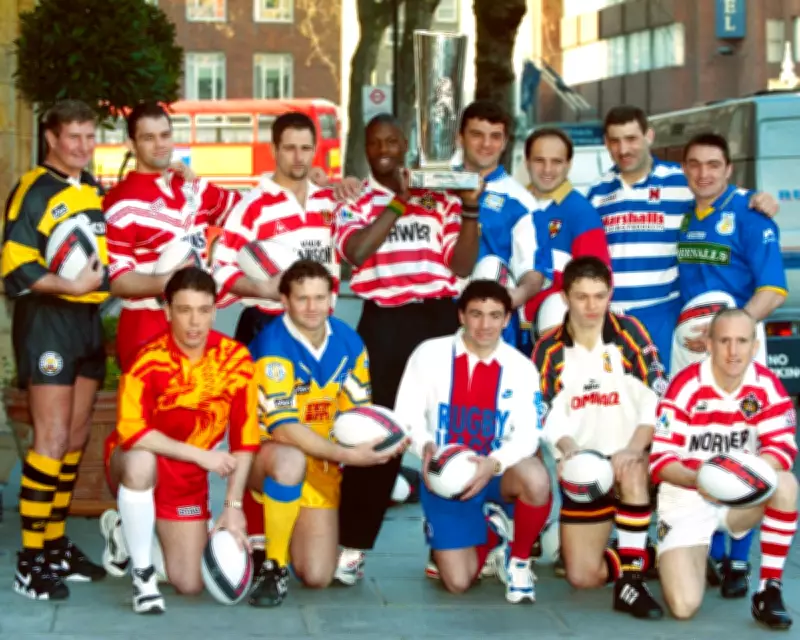
The first season of Super League kicked off on 29 March 1996, when 17,873 people watched Paris Saint-Germain beat Sheffield Eagles 30–24 at Stade Charléty. The opening fixture might sound outlandish 30 years later, but it set the tone for the next decade of competition.
Early Dominance and Club Transformations
St Helens ended Wigan’s run of seven successive titles, and Bradford showed what was to come by finishing third. These three clubs dominated the opening era before Leeds finally fulfilled their potential. Leeds RLFC, where rhinos were still something you only saw at the zoo, finished 10th in the inaugural season, winning just six of their 22 games.

Hull KR were scrambling off the canvas, romping to the third-tier title, while Hull FC finished third in the second tier behind Salford and Keighley. The first season featured a Halifax club approaching the end of their boom time and Oldham shuffling towards a financial precipice.
The competition stretched north to the Cumbrian stronghold of Workington and south to newly created glamour in Paris. Century-old clubs added silly suffixes as if it would transform them into NFL franchises: the Bears and Blue Sox only lasted until the painted signs faded in Oldham and Halifax, but the Tigers still prowl around Castleford.
Stadium Upgrades and Modern Arenas
It wasn’t long into the summer era that St Helens, Wigan, Warrington, Hull, and others realised the cost of updating their ageing Edwardian grounds for the 21st century were far outweighed by the opportunity to move to modern arenas, encouraged by local councils.
Every fan under the age of 40 considers the "new stadiums" home, and names such as Thrum Hall and Watersheddings sound like northern music hall skits or dismal places dreamed up by Charles Dickens or a Brontë sister.
You can still go to rugby league at Borough Park in Workington, and watch Sheffield Eagles play Championship rugby at Olympic Legacy Park on the site of Don Valley. But if you wished to reconstruct a scene from 1996 at a current Super League ground, you would have to go to Wheldon Road or Odsal. Neither has changed much. Headingley, the only other survivor from the first season, has been transformed.
Wakefield and Leigh's Remarkable Revivals
Time travellers heading along Doncaster Road to watch Wakefield host Leigh in Super League last Friday would have felt at home – until they arrived at the DIY Kitchens Stadium. Wakefield are still playing at Belle Vue, where a scaffold arch welcomes hospitality guests to the "World’s Oldest Rugby League Ground".
But there has been a startling renovation. When I called in there one afternoon a decade ago, the only visible employee was a young lad with his flip-flopped feet on the reception desk. The Ellis family, owners of Europe’s biggest kitchen company and a luxury hotel, have since transformed Belle Vue from what appeared to be an abandoned archaeological dig into a high-spec sports entertainment venue.
The idea that Wakefield or Leigh would be contending for silverware would have seemed preposterous four years ago, let alone 30. In 1996, Wakefield were hammered 52-2 at Hull in their first match of the season in the second tier, while the newly christened Leigh Centurions lost at Bramley in the third tier.
A swanky sports bar – with 16 television screens and 12 desserts to choose from – and a new club shop now overlook Wakefield’s field of dreams. Leigh coach Adrian Lam walked into the refurbished press room, clocked the podium beneath a giant curved screen and said: "This is a bit posh, innit?" It’s like an NFL set popping up in a David Peace movie.
Crowd Growth and Changing Demographics
Summer rugby league initially made little impact on gates. Average crowds of 6,571 in Super League’s inaugural season were par for the top division in the 1990s. Wigan only drew 14,000 to Central Park twice; now that is standard. Five-figure gates were also rare at St Helens and Leeds, where fewer than 5,000 saw their final home game of a dismal campaign.

Last season Super League average gates nudged 10,000. Initial bouts of Super League fever were sporadic: London nearly broke the 10,000 barrier for their opener against Paris at The Valley and did so for the visit of Wigan that August, an achievement never repeated.
Bullmania was bubbling up: Bradford started the season struggling to break 10,000. By July more than 17,000 fans rammed into Odsal for their win over Wigan. Leigh and Wakefield drew tiny crowds in 1996; now combined they attract about 17,000.
Player Dynamics and Salary Cap Impact
With 1996 sandwiched between union going pro and the financial boom bringing a raft of NRL superstars to the competition in the 2000s, only three overseas players started a game for champions St Helens, just two for runners-up Wigan, while third-place Bradford had five.
With 10 overseas players now allowed, clubs fighting to survive are scouring the Australian second tier, just as expansion clubs PSG and London did in 1996, when the Broncos had 30 Antipodeans on their books. We have moved on a generation – literally. The fathers of Ben McNamara, Jarrod O’Connor, and Kai Pearce-Paul all played in the opening round of Super League.
With no salary cap yet, Wigan were heavy favourites to win yet another title but lost out to St Helens by a point. Leeds were expected to come third but slumped to 10th. The salary cap has only edged up from £1.8m in 2002 to £2.1m plus exemptions now, but it has helped eight clubs reach the Grand Final in the last eight years.
Modern Innovations and Future Prospects
There are other things that would befuddle a fan from 1996: all-seated stadiums, skin-tight jerseys, six-again bells, HIAs and green cards, everyone staring at their phones, no paper tickets or programmes to buy or giant sponge fingers to wave, adverts everywhere for betting companies rather than keg beer – and a female referee in charge: Tara Jones will make history when she referees Wigan v Huddersfield on Sunday. We have certainly moved on.
Hovering in the background at Super League’s 30th birthday party is NRL Europe and a potential repeat of 1995’s concentrated plan. The NRL believes Europe needs a 10-team top flight, as News Corp originally did via ill-advised merger proposals before accepting 12 clubs in six areas.
In 2026, Super League’s 14 clubs are crammed into just five northern markets plus two in France. The league has been and gone from London, Paris, Sheffield, Salford, Tyneside, Toronto, Wales, and Cumberland.
Just as News Corp handed places in the original Super League to London and Paris at the expense of a handful of traditional town teams, the NRL is rumoured to want London Broncos back but is not keen on Huddersfield, Castleford, Leigh, York, or Toulouse.
Soon after Super League launched, Shirley Bassey sang: "They say the next big thing is here, That the revolution’s near, But to me it seems quite clear That’s it’s all just a little bit of history repeating." She was bang on.





