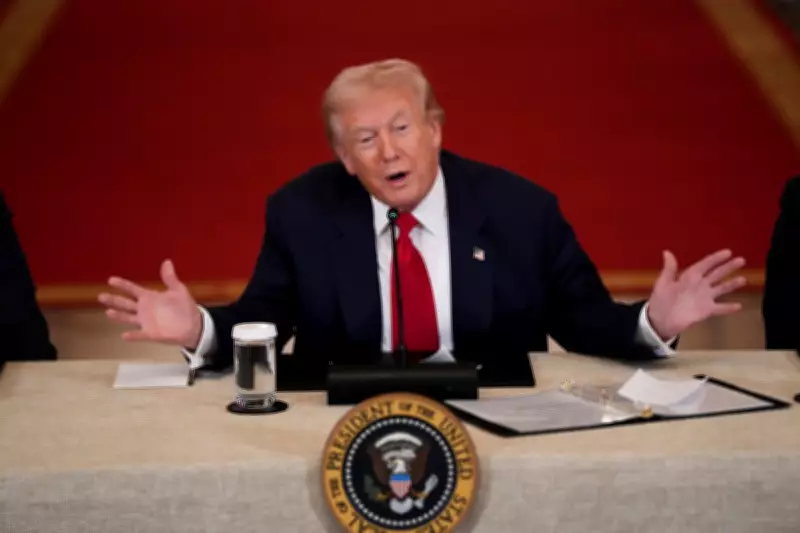
Trump Dismisses Iran Conflict as 'Easy' Compared to College Sports Pay Crisis
President Donald Trump declared on Friday that questions regarding the ongoing war in Iran were "easy" when contrasted with the formidable challenge of regulating college sports and curbing escalating salaries for football players. This remarkable assertion was made during a roundtable discussion that included prominent figures from the sports world, highlighting the administration's intense focus on collegiate athletics amid global tensions.
Roundtable Gathers Sports Luminaries to Address NCAA Turmoil
The president convened a panel of experts, featuring former Alabama football coach Nick Saban, SEC commissioner Greg Sankey, and Notre Dame athletic director Pete Bevacqua. For over an hour, Trump and participants argued that substantial paydays for star athletes, alongside recent changes like the transfer portal, have severely damaged the fabric of college athletics. This lengthy debate was particularly striking given that the United States and Israel initiated strikes on Iran just one week prior, underscoring the unusual prioritization of domestic sports governance over international military affairs.
When a reporter attempted to shift the conversation to Iran at the event's conclusion, Trump interjected, stating, "That's an easy problem compared to what we're doing here." Further pressed about his decision to fire Homeland Security Secretary Kristi Noem, the president expressed frustration, questioning if it was possible to remain on the subject of college sports. Later, Trump reflected on his focus, acknowledging that the issue might seem trivial compared to global conflicts but emphasizing its personal importance and his commitment to resolving it.

Trump's Critique of Modern College Athletics
College sports, especially football, enjoy immense popularity, yet their governance remains a persistently complex issue. Trump has consistently criticized the NCAA's name, image, and likeness era, arguing that rising athlete salaries are detrimental. He contends that high-revenue sports like football are marginalizing smaller sports and women's athletics, and even suggests that some universities risk financial insolvency due to excessive payments to athletes.
The roundtable followed closed-door meetings with top officials, likely discussing Iran and other critical matters, where Trump announced agreements with defense contractors to boost weapons production. Despite this, it was notable that Trump, accompanied by Secretary of State Marco Rubio and White House chief of staff Susie Wiles, allocated significant time to college sports. Participants included House Speaker Mike Johnson, Florida Governor Ron DeSantis, ex-Ohio State coach Urban Meyer, and New York Yankees president Randy Levine, all expressing concerns for the future of college football. No current college athletes were present.
Push for Legislative Action and Executive Measures
The event centered on Trump urging Congress to pass the SCORE Act or similar legislation, aimed at imposing new rules on college sports but criticized as favoring the NCAA and powerful schools. When informed that the bill faced likely rejection, Trump vowed to draft an executive order on college sports, warning, "If this doesn't work, colleges are going to be destroyed." This approach contrasts with a previous executive order from July that sought clarification on whether college athletes could be considered school employees.
Trump nostalgically advocated for a return to the "old system" of scholarships with minimal compensation, questioning if reverting to a simpler model was feasible. His comments underscored a deep-seated belief that the current landscape threatens the integrity and sustainability of collegiate athletics, making it, in his view, a more daunting issue than international warfare.