

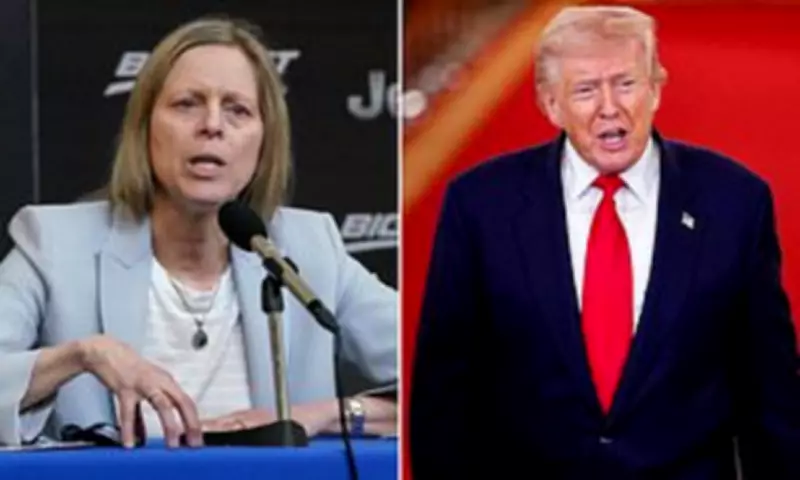
Trump's Vision to Reverse College Athlete Payments Faces Reality Check
Former President Donald Trump's ambitious plan to roll back the system allowing college athletes to profit from their name, image, and likeness (NIL) has been met with strong skepticism from a key figure in collegiate athletics. During a recent White House summit, Trump advocated for a return to a pre-revenue sharing era, but Big East Conference commissioner Val Ackerman has cast significant doubt on the feasibility of such a move.
Trump's Criticism of Judicial Rulings
Last Friday, Trump launched a scathing attack on the judicial decisions that paved the way for NIL deals and revenue sharing in college sports. He specifically targeted Judge Claudia Wilken, whose rulings were instrumental in these changes. "A person who knew nothing about sports made a ruling, and she turned the whole thing upside down. And it's really a disgrace, if you want to know the truth. A damn disgrace," Trump declared.
The former president expressed a desire to completely revert to the previous system, stating, "In some ways, I'd like to just go exactly back to what we had and ram it through a court if we have to, because I'm not sure you're ever going to come up with a system that's comparable to what you had."

Ackerman's Realistic Assessment
In an exclusive interview with the Daily Mail ahead of the Big East Tournament, Val Ackerman provided a starkly different perspective. When asked if Trump's vision of eliminating NIL and revenue sharing is possible, she responded unequivocally: "I don't think so."
"I think the horse is out of the barn as it relates to the athletes sharing in some portion of the revenue," Ackerman explained. "There's so much money in the system now that it was inevitable, in my judgment, that the athletes were going to say, 'Hey, wait a minute. A scholarship of free education isn't enough.'"
Ackerman acknowledged concerns about devaluing education but emphasized the financial realities of modern college sports. "Given the money in the system, what coaches make, et cetera, I think it was inevitable that we were going to get to this point," she added.
Moving Forward Rather Than Looking Back
The commissioner argued against nostalgia for past systems, advocating instead for pragmatic solutions within the current framework. "I don't think being wistful about the old days is where we need to be. I think what we need to do is figure out, Okay, here's where we are now, and can we take what we have and the circumstances we have and just create a more sensible system that puts some structure back into this, creates some limits," Ackerman stated.
She highlighted the importance of establishing boundaries, noting that universities differ fundamentally from professional sports teams. "Universities aren't pro-sports teams. They are not built for the cost structures that we have now in many levels," Ackerman explained. "If there's a way to restore some structure around the realities we have now, I think that's the better way, that's the best place to end up, more realistic as well."
Concerns for Women's and Olympic Sports
The White House summit also addressed the chronic underfunding of Olympic sports and women's sports at institutions with prominent football programs. Ackerman, who previously served as WNBA commissioner and now leads a conference without football, expressed strong support for increased protections in these areas.
"Schools know they have Title IX obligations, which is important, and I think [the SCORE Act] would be a base layer of protection. But there's really a lot of unknowns, I think, around this," she noted. Ackerman pointed out the financial disparities between conferences, explaining that leagues without football revenue face different challenges.
Trump's Threat of Executive Action
During the roundtable discussion, Trump threatened to sign an executive order to intervene in college sports, citing his belief that the Democratic Party would block the SCORE Act in Congress. While he didn't specify the order's contents, Trump described it as a "common sense" and "very well thought out" solution.

The former president also launched an extraordinary attack on the Supreme Court, which had ruled against the NCAA's position on athlete compensation. "I think the Supreme Court ought to be ashamed of itself for a lot of reasons, okay, a lot of reasons," Trump declared. He warned of dire consequences if the current system continues, predicting that colleges could face bankruptcy and women's sports could be destroyed.
The Stalled SCORE Act and Future Prospects
Ackerman expressed disappointment over the failure of the SCORE Act to advance in Congress. "It never made it to a vote and disappoint[ed] many of us," she said. The legislation contained several crucial provisions, including antitrust protection for colleges, non-employment classification for athletes, and state law preemption to reduce regulatory uncertainty.
Regarding Trump's mention of an executive order, Ackerman remained cautious. "Wasn't clear what the contents of that would be, and I don't know the status of that. But I think, again, the fact that it happened and that there's interest in trying to move along, potentially some federal legislation I take as a positive," she concluded.
The debate over college athlete compensation continues to evolve, with Trump's proposed rollback facing significant practical challenges according to industry insiders like Ackerman. The focus appears to be shifting toward creating structured systems within the new financial reality rather than attempting to return to a pre-revenue sharing era.





