US Hockey Champions Greeted at State of the Union Amid Political Spotlight
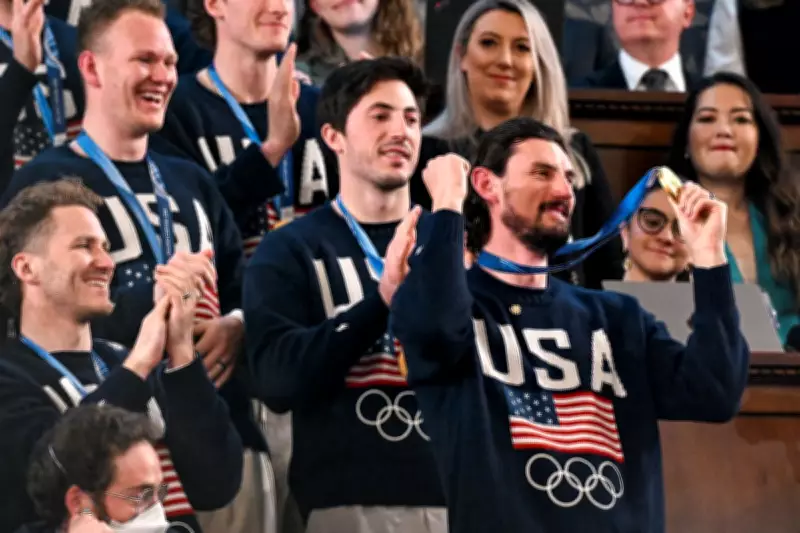
During Tuesday's State of the Union address, President Donald Trump welcomed members of the newly crowned US men's national ice hockey team to the House gallery, prompting enthusiastic chants of "U-S-A, U-S-A!" from the assembled lawmakers. The Olympic champions, who had secured gold by defeating Canada just days earlier, received a warm bipartisan applause, yet their presence was strategically leveraged by Trump to underscore his political narrative.
A Presidential Honour and Political Prop
Trump announced that Team USA's goaltender, Connor Hellebuyck, would be awarded the Presidential Medal of Freedom, praising the players as "special champions." However, the introduction was prefaced with Trump's assertion that "our country is winning again," framing the athletes as symbols of national success under his leadership. This move highlighted how, in Trump's America, proximity to power is inherently politicised, transforming celebratory moments into tools for partisan messaging.
Team Reactions and Backlash
The players first entered Trump's orbit on Sunday when a widely circulated video showed them receiving a White House invitation after their victory in Milan. While many laughed during the exchange—interpreted by some as derisive—scorer Jack Hughes later clarified the team's excitement, stating, "We're proud to be Americans, and that's so patriotic." Hughes lamented the pervasive politicisation, remarking, "Everything is so political. We're athletes," yet acknowledged the unavoidable collision of sports and politics in the current era.

Trump's Hockey Focus and Geopolitical Undertones
Trump's interest in hockey extends beyond domestic accolades, intertwining with geopolitical tensions. Last winter, he speculated about annexing Canada and later warned that China might "end ice hockey" in Canada as part of trade disputes. These comments, following Canadian Prime Minister Mark Carney's perceived upstaging at Davos, reflect Trump's hierarchical worldview, where hockey serves as leverage in asserting dominance over allies who resist his authority.
Internal Divisions and Absences
Despite the show of unity in the House gallery, not all team members attended the address. Four players from Minnesota—a state impacted by Trump's immigration policies—were absent, citing various reasons without directly condemning the president. Meanwhile, the entire US women's national ice hockey team, also gold medalists, declined their invitation, demonstrating a nuanced understanding of how attendance can imply endorsement. Trump mentioned a future Oval Office visit for the women, but no official plans have been confirmed.
Broader Implications for Athletes
The incident echoes broader expectations under Trump's presidency, where athletes, like allies, are pressured to prove loyalty. Earlier in the Games, freestyle skier Hunter Hess faced Trump's rebuke online after distancing himself from US immigration policies, with the president labelling him a "loser." This reinforces that in Trump's America, sports figures are increasingly scrutinised for their political alignments, expected to align with his vision of patriotism or face consequences.
Ultimately, the State of the Union appearance underscores that sports and politics are inextricably linked, particularly under an administration that views athletic achievements through a lens of loyalty and hierarchy. As Hughes and others seek simplicity, the reality remains that in today's climate, every gesture—whether showing up or staying away—carries profound political weight.