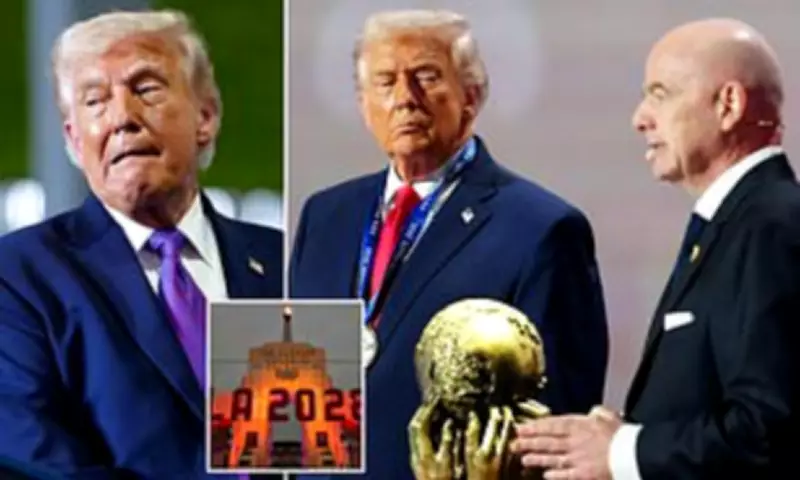
The World Anti-Doping Agency is poised to deliberate on a contentious proposal that could bar President Donald Trump from attending major international sporting events, even those hosted on American soil. This extraordinary measure is scheduled for discussion during a WADA executive committee meeting in Baku, marking a dramatic escalation in a protracted dispute over the United States government's refusal to settle its annual financial obligations to the organisation.
Financial Standoff and Proposed Sanctions
The United States has withheld a total of $7.3 million in dues for 2024 and 2025, a protest against WADA's management of several high-profile cases. Among these is the controversial handling of 23 Chinese swimmers who were permitted to compete at the Paris Olympics despite testing positive for a banned substance. WADA has been exploring the concept of barring government officials from non-paying nations since 2020, coinciding with increasing American criticism. The proposal formally reached the executive committee in 2024.
Historical Context and Current Dynamics
Rahul Gupta, the drug czar during the Biden Administration, previously served on the committee and led efforts to reject similar measures. Gupta was notably critical of WADA, a stance mirrored by his successor, Sara Carter. However, the United States no longer holds a representative position on the executive committee, potentially altering the balance of power in these discussions.

WADA spokesman James Fitzgerald indicated that, if enacted, the rule would not apply retroactively. Consequently, it would not affect President Trump's potential attendance at this summer's World Cup, the Los Angeles Olympics in 2028, or the Salt Lake City Games in 2032. Nevertheless, a copy of the proposal obtained by The Associated Press does not explicitly include language confirming this non-retroactive application.
Enforcement Challenges and Symbolic Implications
The proposal outlines a three-tiered sanction system for nations failing to pay dues. For the United States, this involves approximately $3.7 million from 2023 and $3.6 million from 2024. The most severe penalty includes excluding government representatives from major events such as World Championships and the Olympic & Paralympic Games. This could theoretically apply to President Trump, Vice President J.D. Vance, and members of Congress, who have recently authorised substantial funding for World Cup and Los Angeles Games security.
However, the practical enforcement of such a rule remains highly questionable. Rahul Gupta recently expressed scepticism, stating, "I have never heard of a $50-million-budget Swiss foundation being able to enforce a rule to, for example, prevent the United States president from going anywhere. And the next question you have to ask is: How are you going to enforce it? Are they going to post a red notice from Interpol? It's ludicrous. It's clear they have not thought this through." Thus, the rule would likely be largely symbolic, given the limited authority an international sports federation holds over a national leader attending domestic events.
Governance and International Agreements
Established in 1999, WADA derives its funding equally from governments participating in the Olympic movement and the International Olympic Committee. Its decision-making bodies typically maintain an equal representation between sports and government interests. Participation in major events like the Olympics and World Cup requires all involved parties to adhere to WADA's rules, covering both doping-related and administrative matters.
Sports organisations, including the IOC and individual sport governing bodies, are signatories to the WADA code. Governments are linked to WADA through agreements with the United Nations Educational, Scientific and Cultural Organization (UNESCO), which mandate dues payment and rule compliance.

Ongoing Dispute and Political Reactions
While President Trump has not publicly commented on the specific proposal, his drug czar, Sara Carter, affirmed that the US government "will continue to stand firm in our demand for accountability and transparency from WADA to ensure fair competition in sport." This conflict has simmered since the first Trump administration, rooted in American distrust of the global anti-doping system. This scepticism was initially fuelled by WADA's handling of the Russian doping scandal preceding the 2014 Sochi Games and later intensified by the Chinese swimmers case in 2024.
The Office of National Drug Control Policy and Congress, under both the Trump and Biden administrations, have consistently withheld payments to WADA. The next meeting of WADA's Foundation Board, which would make the final decision on the proposal, is not scheduled until November, four months after the World Cup final in New Jersey. The United States, alongside Canada and Mexico, is set to co-host this summer's international soccer championship, adding further complexity to the timing and implications of this potential rule.