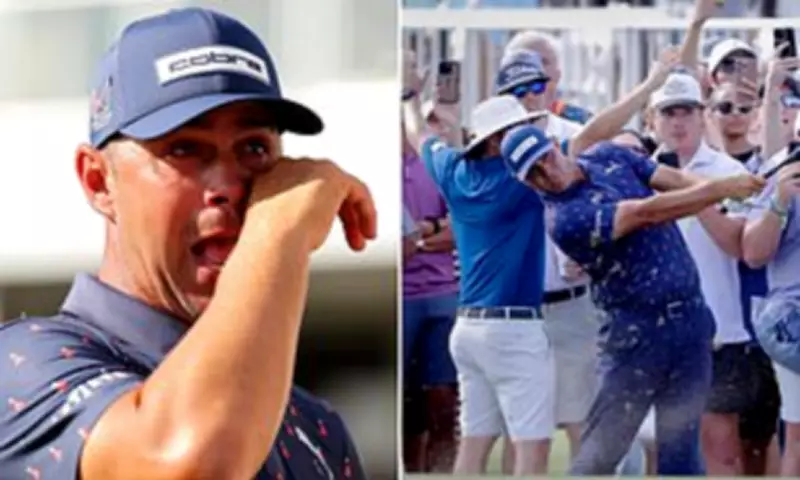
Professional golfer Gary Woodland has disclosed that he will receive enhanced security protection at the upcoming Masters tournament, following severe mental health struggles that left him terrified spectators were attempting to murder him during play.
A Triumphant Yet Troubled Return
Woodland secured his dramatic return to Augusta National with an unexpected victory at last month's Texas Children's Houston Open. This marked his first PGA Tour win since undergoing brain surgery in September 2023 to remove a lesion. The 2019 US Open champion recently revealed he has been battling post-traumatic stress disorder for approximately a year.
The Medical Journey Behind the Struggle
The benign brain lesion was causing seizures, intense anxiety, and irrational fears that he was dying. Surgeons removed a baseball-sized portion from the side of his skull. However, when symptoms persisted post-operation, Woodland received the PTSD diagnosis that explained his ongoing psychological turmoil.

On Tuesday, Woodland expressed both happiness and excitement about competing at the Masters again. Yet the American golfer admitted he has negotiated for a security detail to help him manage tournament crowds. During the second round in Houston, Woodland became so hypervigilant that he battled through the final ten holes convinced people were trying to kill him.
Security as a Psychological Anchor
"If I can see security, then I can remind myself that I'm safe constantly," the 41-year-old father of three explained. "I don't have control when this thing hits me, and it's tough. It can be a fan. It can be a walking score official. It can be a camera guy running by me. Just any startlement from behind me can trigger this pretty quickly... when I'm not on the course, I'm in a battle, and when I'm on the course, I'm in a battle."
He added: "It's a big week for me this week. The fans are very close on the tee boxes. There's a lot going on. There's probably not a safer golf tournament in the world, so I'm happy for that, but it's still a battle in my head if I'm safe or not. That's a tough pill to swallow."
Emotional Victory and Ongoing Recovery
Woodland was overcome with emotion after securing victory in Houston, stretching out both arms, exhaling deeply, and looking skyward before tears streamed down his face. "The doctors - and everybody I'm working with - were trying to slow my heart rate down, trying to slow my thoughts down just to function and be healthy," he explained at Augusta. "But doing those things obviously helps my golf game as well. I wish I knew a lot of this stuff 20 years ago. It's given me purpose, golf has, for sure."
Reflecting on his diagnosis three years ago, Woodland said: "When I was diagnosed with this brain tumor, my number one thought was: I wasn't going to let this thing win. I've dreamed of being a professional athlete since I was a little kid, and I would do everything in my power to live that dream for my childhood self. Golf has given me something a lot more to fight for than just myself and my family... there's been times where I didn't know if I was going to be able to do it, but I was going to fight and give it everything I had."
Physical Excellence Versus Mental Stamina
Woodland believes his physical game has reached peak performance levels this year, potentially surpassing even his 2019 US Open-winning form. "But there's been times where I didn't know if I'd have the mental stamina to get through a week," he confessed. "I fought hard earlier this year with some struggles, and that's hard, that's a hard pill to swallow that this thing could be taken away from me for something that's out of my control."
Public Revelation and Personal Mission
The golfer has been astonished by the public response to his decision to share his diagnosis openly. "It just shows that everybody is going through something. Everybody's battling something. Whether it's way bigger or way less, it doesn't matter what you're battling. To you it's important," Woodland stated.

He continued: "Winning the U.S. Open in '19 had the biggest impact in my life from a golf standpoint. There's no doubt. I hope winning in Houston had a bigger impact on somebody else's life. I hope somebody that's struggling with something sees this guy out here fighting every day and still living his dreams, and then they want to get up there and fight and live their dream too. I really from the bottom of my heart hope that happens."
A Message of Hope and Connection
Woodland urged others facing similar challenges to seek support rather than battling alone. "You don't have to fight this on your own," he emphasized. "We live in a world, as men and especially as an athlete, that you put your head down and you fight through it. I've done it my whole life. This is honestly one battle that I'm not able to do on my own. I tried, and it wasn't working. And talking has helped me so much."
Woodland's best Masters finish came in 2023 before his surgery, when he tied for 14th place. He missed the cut in 2024 and was absent from last year's tournament field. For an extended period, the golfer admitted that tournament victories or Augusta returns were "probably the last thing" on his mind.
"I didn't know that releasing this battle was going to make me stronger, and it's done that," Woodland concluded, highlighting how vulnerability has paradoxically become a source of resilience in his ongoing journey.