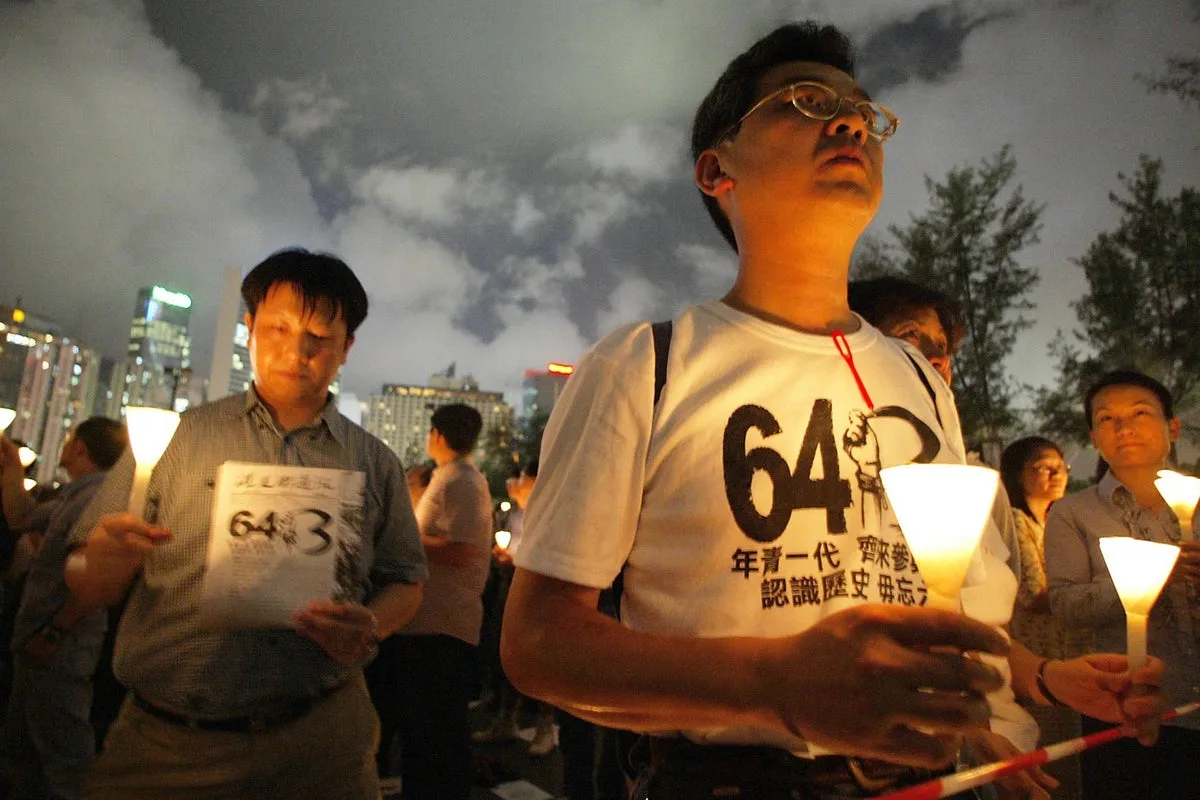
A performance artist in Hong Kong was stopped by police on Wednesday as he attempted to mark the anniversary of the 1989 Tiananmen Square crackdown, highlighting the city's shrinking freedom of expression. Sanmu Chen tried to attach a symbolic 6.4-metre red thread to a street signpost in Causeway Bay, a busy shopping district near Victoria Park, which for decades hosted a candlelight vigil on 4 June to remember those killed when the Chinese military suppressed student-led protests in Beijing. Police officers intercepted Mr Chen, searched his bag, and then released him.
Hong Kong was once the only place in China where a large-scale public commemoration of the crackdown was permitted. However, the annual vigils were banned in 2020 during the Covid pandemic, and public acts marking the Tiananmen Square killings have become increasingly sensitive since. Mr Chen said his thread was 6.4 metres long, an apparent reference to the date of the crackdown. Speaking to reporters after the encounter, he stated that his act was intended to express condolences for the deceased. 'When you are trying to say or do something and you are being monitored, that is a very abnormal situation,' he remarked.
Mr Chen has been detained at least twice for similar acts in the past. In 2024, he was briefly held on 3 June after appearing to write the Chinese characters for 'eight nine six four' – numbers referencing the crackdown's date – in the air. The previous year, he was detained on the same date in the same neighbourhood for chanting: 'Hong Kongers, do not be afraid. Don't forget, tomorrow is 4 June.' As night fell on Wednesday, another artist, Chan Mei Tung, was stopped by police outside a nearby department store while holding a question-mark-shaped balloon. Officers quickly escorted her to a subway station as journalists observed.

Police later issued a statement saying officers had encountered a man and a woman lingering on the street at locations matching the artists. They added that officers approached them to learn more and the individuals subsequently left on their own. The statement further asserted that any police action was handled 'in accordance with the law' and that the force would make 'appropriate deployments based on threats to national security, public safety and public order'. In 1989, the military was deployed to Tiananmen Square to quell weeks of protests on the night of 3-4 June. Soldiers opened fire, resulting in hundreds and possibly thousands of deaths, including dozens of soldiers.
Annual vigils in Hong Kong's Victoria Park previously attracted thousands of attendees until the event was prohibited in 2020. That same year, China imposed a national security law on the city following extensive anti-government protests. Since then, city authorities have increasingly suppressed dissent. Numerous leading activists have been arrested, several vocal media outlets have been shut down, and dozens of civil society groups, including the one that organised the vigils, have been disbanded. Three former vigil organisers were charged in 2021 with inciting subversion under the national security law. Two are currently awaiting a verdict, potentially in July, and face a maximum penalty of 10 years in prison if convicted. The third organiser entered a guilty plea, which typically leads to a reduced sentence.
Following the lifting of Covid restrictions, the former vigil site has become the location for a yearly carnival organised by pro-China groups. Over the past three years, individuals attempting to commemorate the Tiananmen Square killings on the anniversary have been detained there. This year's carnival commenced on Wednesday. Later that day, near the site, Tang Ngok Kwan, a former vigil organiser, bowed in commemoration. He told reporters he quietly read a list of victims and criticised the event's name, 'carnival', for its festive connotation. The actions by Mr Tang and other muted expressions in Hong Kong underscore the decline in civil liberties that Beijing had pledged when the former British colony returned to Chinese rule in 1997. However, even as public commemoration fades in Hong Kong, overseas communities continue to keep the memory alive.